- In recent years, British department stores have slowly faded from existence
- READ MORE: Which decade has the best diet: From 'fat-burning' grapefruit in the 1920s to the noughties' Special K plan, nutritionists reveal the retro food trends that CAN help you lose weight - and what to avoid
- See more Daily Mail on Google - save us as a Preferred Source
They were once the pinnacle of weekend shopping trips amid a golden era of the beloved British high street.
But in the modern age of online shopping and next-day delivery, British department stores have slowly faded from existence - with the few still remaining struggling to cling onto their popularity.
This week, it emerged that the historic Harvey Nichols is 'on brink of collapse' without a buyer or cash injection, as bidders for the Knightsbridge department store are yet to be finalised.
Elsewhere, John Lewis, considered to be a cornerstone of British retail history, has also put 200 jobs at risk amid plans to shut down desks operating gift wrapping and foreign exchange services, while its managing director has also stepped down.
Bricks and mortar retail across towns and cities has been devastated in recent decades by the shift to online shopping which was exacerbated by the pandemic.
Meanwhile, a squeeze in disposable income, higher cost pressures and changes to consumer spending habits have also led to well-known brands falling into administration.
However, several Britons continue to share in their nostalgia for the nation's former high street's glory days - and the flagship department stores that slowly shut their doors one by one.
From British Home Stores to Debenhams, Littlewoods and Woolworths, read on to reminisce over the beloved lost department stores of Britain and see which ones you still fondly remember...
British Home Stores (BHS)
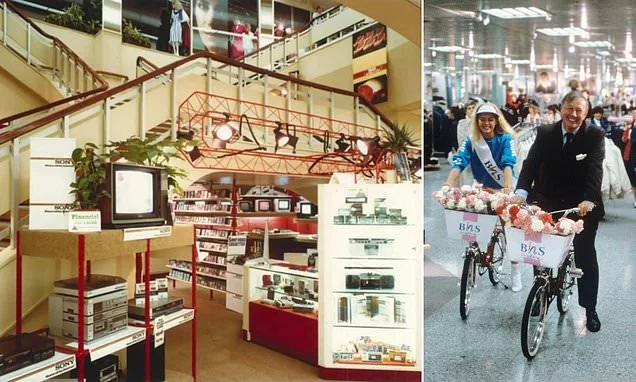
In the modern age of online shopping and next-day delivery, British department stores have slowly faded from existence. Pictured: Sir Terence Conran rides a bike through a BHS store
Founded in 1928, British Home Stores (BHS) opened its doors to the UK public at its first store in Brixton, London that year before slowly growing in prominence across the nation
In June 2016, BHS shut its doors for good - having accumulated debts of more than £1.3billion, which included a pension deficit of £571million
Financial deficit, poor management and an inability to adapt to the growth of online shopping saw the 88-year-old chain collapse into administration after being sold for just £1
Founded in 1928, British Home Stores (BHS) opened its doors to the UK public at its first store in Brixton, London that year before slowly growing in prominence across the nation.
However, financial deficit, poor management and an inability to adapt to the growth of online shopping saw the 88-year-old chain collapse into administration after being sold for just £1.
In June 2016, BHS shut its doors for good - having accumulated debts of more than £1.3billion, which included a pension deficit of £571million.
BHS bosses had attempted to negotiate a rescue deal more than two months prior to the closure which eventually fell through.
It had been the go-to department store for many hoping to buy clothing and household items but was criticised for catering to the elderly market and failing to innovate.
Indicative of the nation's love for the store, there was even a guerrilla campaign in May 2016 that saw historic landmarks around London - such as Marble Arch, Wellington Arch and Blackfriars Bridge - lit up with the #SaveBHS slogan.
It was hoped that this would help find a saviour to take ownership of the 163 BHS stores across the country but this ultimately proved unsuccessful.
Littlewoods
Founded in 1923 in Liverpool by brothers John and Cecil Moores, Littlewoods soon established itself as a major UK department store that dominated the high street
By the post-war decades, Littlewoods was Europe's largest private company, with the grand stores featuring floors stocked with clothing, footwear, homewear and toys
In its heyday, the company employed 30,000 individuals and soon became a household name that expanded far beyond Liverpool
In 2015, the famous shopping catalogue was axed after more than 80 years - with 90 per cent of customer orders having shifted online. At its peak Littlewoods sent out as many as 25 million copies a year
Founded in 1923 in Liverpool by brothers John and Cecil Moores, Littlewoods soon established itself as a major UK department store that dominated the high street.
In its heyday, the company employed 30,000 individuals and soon became a household name that expanded far beyond Liverpool.
By the post-war decades, Littlewoods was Europe's largest private company, with the grand stores featuring floors stocked with clothing, footwear, homewear and toys.
However, competition from other stores and online shopping saw Littlewoods struggle to compete with other supermarket giants, and by 2005 the company was forced to make numerous store sell-offs and major job cuts.
In 2015, the famous shopping catalogue was axed after more than 80 years - with 90 per cent of customer orders having shifted online.
At its peak Littlewoods sent out as many as 25 million copies a year, but the last one was mailed to fewer than 300,000 homes as the firm cut back on its expensive print run.
Woolworths
Woolworths was once a staple of the British high street, known for its pick 'n' mix sweets and its bargain prices', it sold everything from clothes, to records and household goods
The much-loved high street variety retailer launched in Liverpool in 1909 and had more than 800 shops in the UK
Pictured: scores of shoppers crowd a Woolworths during the Christmas rush of 1955
Affectionately referred to as 'Woolies', the once-ubiquitous department store chain collapsed amid the financial crisis of 2008 as cheaper shops ate into its market share
Woolworths was once a staple of the British high street, known for its pick 'n' mix sweets and its bargain prices', it sold everything from clothes, to records and household goods.
The much-loved high street variety retailer launched in Liverpool in 1909 and had more than 800 shops in the UK.
By the 1930s, the British firm was experiencing an unrivalled period of prosperity, with record levels of sales and profits.
This continued into the 1950s when Woolies celebrated its Golden Jubilee in 1959 with record profits and saw its 1,000th branch open in West Sussex.
Affectionately referred to as 'Woolies', the once-ubiquitous department store chain collapsed amid the financial crisis of 2008 as cheaper shops ate into its market share.
Some historians believe that Woolworths revolutionalised the retail industry in the UK, with founders in America being surprised at how well it had been adopted by the British people.
Woolworths' lower prices, loyalty bonuses and its broad range of items meant customers could buy anything and everything all in one place. Its biggest competitors were penny bazaars such as Marks & Spencer's which has stood the test of time.
There had been talk of a Woolies revival back in 2017, when former brand director Tony Page teased plans to buy the name back from Shop Direct, but the comeback never materialised.
The brand still exists abroad, including in Germany.
Fenwick
With an eye for quality, JJ Fenwick opened the doors of his shop after initially learning his trade as a shop assistant
Fenwicks gained its reputation as a luxury retailer with its sophisticated shopping space, and as a hallmark of British business savvy became popular for its cutting edge items, restaurants and in-store events. Pictured: shoppers in 1971
Pictured: Fenwicks' luxury perfume department in Newcastle in 1922
Fenwick was at the forefront of luxury fashion, with an advert from its archives boasting about its bargains for women's winter coats
In 2024, Britons bid farewell to the department store after its London flagship Mayfair branch closed its doors for the final time, more than 130 years since first opening
Fenwicks gained its reputation as a luxury retailer with its sophisticated shopping space, and as a hallmark of British business savvy became popular for its cutting edge items, restaurants and in-store events.
It was founded by John James Fenwick when he opened his first store as Mantle Maker and Furrier in 1882, kickstarting a legacy for which he would be revered for bringing luxury to the British high street.
With an eye for quality, JJ Fenwick opened the doors of his shop after initially learning his trade as a shop assistant, where he cultivated a passion for retail and customer service.
But in 2024, Britons bid farewell to the department store after its London flagship Mayfair branch closed its doors for the final time, more than 130 years since first opening.
The closure of the four-storey store on New Bond Street, which first opened in 1891, left shoppers 'devastated' after the luxury retailer sold the property to developers for £430m.
Lewis's
Picrtured: Lewis's famous stocking department in a store in Manchester in 1957
Founded in Liverpool in 1856 by David Lewis, it didn't take long for this UK department store to soar in popularity across the north of England, before eventually opening up a famous London store in Selfridges during the mid-20th century
Its Liverpool store even featured a flagship self-service cafeteria, Red Rose Restaurant and hair salon. Pictured: shoppers in Lewis's in Liverpool in December 1966
Pictured: shoppers enjoy the sales at Lewis's Department Store in January 1962
Founded in Liverpool in 1856 by David Lewis, it didn't take long for this UK department store to soar in popularity across the north of England, before eventually opening up a famous London store in Selfridges during the mid-20th century.
Selling a range of goods including the likes of jewellery, fashion, perfume and homewares, the brand expanded across Manchester, Birmingham Sheffield and Leicester.
Its Liverpool store even featured a flagship self-service cafeteria, Red Rose Restaurant and hair salon.
However, in 1991, the Lewis's company went into administration, with all but the Liverpool store sold off.
The Liverpool store then went into liquidation in February 2007, before being sold to Vergo Retail Ltd who traded under the Lewis's name.
In 2010, shoppers were left devastated when the flagship brand announced it would be closing its doors for good - bringing an end to the nation's oldest department store after 154 years of trading.
Debenhams
Shoppers are seen charging through the doors of a Debenhams department store on the first day of the sales in 1977
Crowds of shoppers pack into the Debenhams on London's Oxford Street for the post-Christmas sales in December 1982
It was a mainstay on UK high streets for 242 years, but in 2021 Debenhams shut its stores for good leaving British shoppers devastated
Margot Perry, who was first in line, has her hair set while queuing for the start of the Debenhams sale in December 1977
By April of 2019, the retail giant entered administration and delisted from the stock market. It undertook a major restructuring, designed to restore it to its former glory, but went into liquidation in 2020
It was a mainstay on UK high streets for 242 years, but in 2021 Debenhams shut its stores for good leaving British shoppers devastated.
In 1778 William Clark opened a drapers store on 44 Wigmore Street in central London, selling expensive fabrics, bonnets, gloves and parasols.
By 1950, Debenhams was the largest department store group in the UK, owning 84 companies and 110 stores.
Following demerger from the Burton Group, Debenhams was listed on the London Stock Exchange until 2003, when it was acquired by Baroness Retail.
In 2014, after a decline in company profits, retail tycoon Mike Ashley bought 4.6 per cent of the company's shares.
However, the business had now felt the full effect of difficult high street conditions and sky-high rents, resulting in a £491 million pre-tax loss in 2018.
By April of 2019, the retail giant entered administration and delisted from the stock market.
It undertook a major restructuring, designed to restore it to its former glory, but went into liquidation in 2020.
Although the pandemic sealed its fate, the department store's woes had built up over decades as it failed to keep up with changing trends and locked itself into long, expensive leases.
Debenhams said the closing down sale was the last chance for customers to say goodbye to their local shop 'before sadly our stores close for good'.
Beales
A picture of Beales' first ever department store in Bournemouth is depicted in years gone by
Beales flagship store in Bournemouth, Dorset, where it first opened as The Fancy Flair in 1881. Rising competition and an increase in rent saw Beales go into administration in January 2020
Last year, Beales department store bid farewell to its last outlet after 144 years - citing budget hikes by Rachel Reeves as a factor in its last outlet closing down.
Founded in 1881 by John Elmes Beale, the flagship store became a fixture on the southern English highstreet for more than a century.
The family-run department store 's first shop opened in Bournemouth in 1881. Over the decades, it became a prominent fixture across market towns and a beloved regional chain.
Offering fashion, homeware and gifts, it became Bournemouth's largest department store and in 1885 it claimed to host the first in-store Santa. And the shop's Christmas promotions saw loyal customers returning every year for the festive magic.
However, rising competition and an increase in rent saw Beales go into administration in January 2020.
Most of the 22 remaining branches closed in March that year after the coronavirus crisis brought an early end to clearance sales.
Beales in Poole, which employed 30 people, was the last remaining store, and closed its doors in April 2025.
C&A
Pictured: a shopper takes in the expensive hats on sale at C&A in Marble Arch, London, in 1962
For many years, C&A retail clothing stores were a major presence on high streets throughout the UK. Pictured: an early morning queue of shoppers wait to enter C&A department store for a sale
C&A opened stores in a number of out-of-town locations, most notably its store at the Merry Hill Shopping Centre in the West Midlands, which opened in November 1989
For many years, C&A retail clothing stores were a major presence on high streets throughout the UK.
C&A opened stores in a number of out-of-town locations, most notably its store at the Merry Hill Shopping Centre in the West Midlands, which opened in November 1989.
However, the company's strategy of selling budget clothes from high-rent city-centre retail stores made it vulnerable to a new breed of competitors operating in cheaper, out-of-town locations, including Matalan and the rapidly expanding clothing operations of supermarket food chains such as Tesco and Asda.
In 2000, C&A announced it was to close all its UK stores, with the loss of 4,800 jobs from its 113 stores.
Neil McCausland, the company's managing director at the time, said: 'This is a sad and difficult decision for the company,' said managing director, Neil McCausland, adding that it had racked up £250m of losses in the UK in the past five years.
'C&A has been part of the British high street for over 75 years and was determined to remain so.
'Unfortunately, business conditions do not allow this to happen.'
Primark bought 11 of the C&A stores.
Allders
Founded in 1862 by Joshua Allder in Croydon, Allders Department Store grew into a sprawling business that became a firm staple in Croydon's shopping district
During the mid-to-late 20th century, Allders expanded to a chain of department stores across the UK and in May 2005, Harold Tillman bought the name with the hopes of restructuring the brand
At the time of its closure, the 150-year-old Allders store was understood to be Britain's third-biggest department store with 500,000 sq ft of space
Founded in 1862 by Joshua Allder in Croydon, Allders Department Store grew into a sprawling business that became a firm staple in Croydon's shopping district.
By 1908, the store had up to 50 departments - ranging in furniture, toys and homeware.
In 1920, it came under the ownership of United Drapery Stores, who retained the popular name due to its prominence across the nation.
During the mid-to-late 20th century, Allders expanded to a chain of department stores across the UK and in May 2005, Harold Tillman bought the name with the hopes of restructuring the brand.
However, by 2012 it was facing financial woes and went into administration in June of that year.
At the time of its closure, the 150-year-old Allders store was understood to be Britain's third-biggest department store with 500,000 sq ft of space.