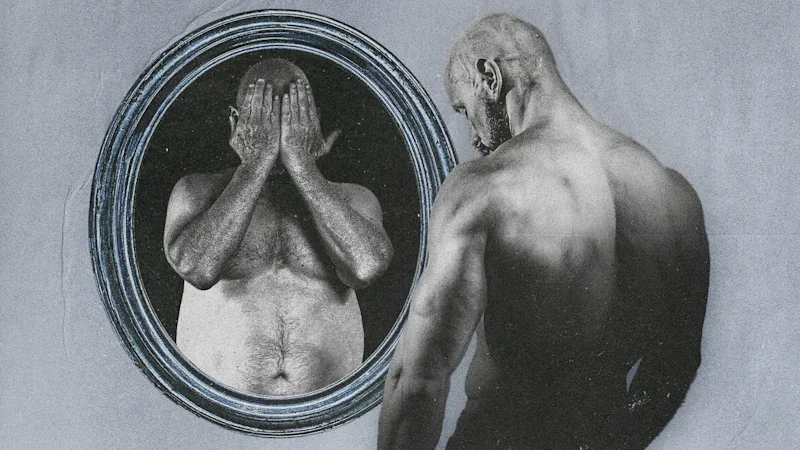
Melbourne man Wade Taylor has been in recovery from binge-eating disorder for more than a year; the 38-year-old says it began decades ago while he was at school.
“I developed an extreme form of body dysmorphia that stemmed from constant comments on my physical size from a young age, from family and friends … I then used food to regulate my emotions,” he says.
This became a “blueprint for all emotional regulation” as he got older, and it was exacerbated because he tied his self-worth to his appearance, particularly to stereotypes about the male body.
“I think my gender had one of the biggest impacts on the disorder,” he says.
“For my entire life it has been: ‘You could look like a beast if you just worked out.’ All the comments were always in regard to being a man.”
Describing it as being caught in “a vicious cycle of self-loathing”, Taylor says he continued to chase “the impossibility of the so-called ‘ideal physique’”.
“[This] led to disappointment, which led to sadness and anger and then binge eating to help regulate those emotions, which just led straight back to the disappointment ... and the cycle repeated.”
A silent but pervasive struggle
Taylor isn’t alone. Data from the Butterfly Foundation shows that an estimated 365,000 men in Australia are experiencing an eating disorder – about 46 per cent more than the number of men living with or beyond a prostate cancer diagnosis.
Sarah Cox, a clinical psychologist, and manager of the Butterfly National Helpline, says this statistic is probably higher, given the high rates of stigma and low levels of understanding among health professionals and the community about eating disorders and body issues in males.
“[They] often go under the radar because of misunderstanding and stigma in society that says eating disorders are ‘feminine’ issues only affecting young women,” she says.
“However, eating disorders do not discriminate, and can impact anyone, of any gender, weight or age.”
In fact, data suggests that the rate of eating disorders in men is rising faster than in women, with hospital admissions increasing at a higher rate than those for women across states and territories.
In Queensland, there was a sixfold increase in public hospital admissions for males with eating disorders from 2010 to 2019.
According to Butterfly, young men aged 15 to 19 are most affected, and the most common disorders are the same across genders.
The most common eating disorders are what the Diagnostic and Statistical Manual of Mental Disorders (DSM-5) categorise as “other specified feeding and eating disorders” and “unspecified feeding and eating disorders”.
“These refer to eating disorders where someone may present with symptoms of an eating disorder, for example, anorexia, bulimia or binge-eating disorder, but may not meet the full diagnostic criteria for a specific eating disorder,” says Cox.
Additionally, she says men are also more likely to develop muscularity-oriented disordered eating (MODE) concerns, which refers to eating behaviours motivated by the pursuit of muscularity.
“This may include ‘clean eating’, rigid requirements around protein intake, ‘bulking and cutting’ eating behaviours, avoiding certain food groups, counting calories or macronutrients, and eating past fullness,” Cox says.
Social media and masculinity
Dietitian and accredited eating disorder clinician Shane Jeffrey says that many of his male patients presenting with MODE have been influenced by social media messaging and trends.
“With the rise of social media, influencers, and a focus on ‘posting the best version of yourself’, this toxic messaging now has greater reach and sits in the palms of young boys and men through their phones,” he says.
“Not only are the messages contained to body image and diet, but they extend further into what it is to be a man, how men should behave, and what it takes to be successful across life, finances and relationships, with much of this being tied back to appearance.”
Ex-AFL player Brock McLean says that much of his self-worth was tied to masculine ideas of success, so when his coaches told him he would “be better off losing a few kilos”, McLean did what many professional athletes do: he followed their advice.
“I’d been traded to Carlton, and my first year there couldn’t have gone much worse,” the now 40-year-old says. “I had a number of injuries that kept me out for most of the year.”
Wanting to make a good impression at his new club and driven by what he describes as a “desperation” to get back to playing, other mental health issues, and a lack of self-worth, McLean went against a nutritionist’s advice and agreed.
“I developed a narrative in my head that if I didn’t say yes, they wouldn’t pick me and therefore, I wouldn’t be able to get my self-worth back,” he says.
Eventually, McLean developed bulimia nervosa, an eating disorder characterised by repeated episodes of binge eating followed by compensatory behaviours such as purging or excessive exercise.
Why asking for help is complicated for men
Data from Butterfly shows that men are four times more likely to live with an undiagnosed eating disorder, in part because of harmful stereotypes about who they affect and traditional stereotypes about masculinity, which can deter men from seeking help.
McLean, who is now in recovery, says that gender stereotypes delayed his seeking help for bulimia nervosa.
“I was convinced that if I sought help for all of my issues, it would be emasculating, and I would be weak for doing so,” he says.
“But it got to a point where I was so sick of feeling that way. Something needed to change.”
Taylor, who didn’t seek professional help until he was in his 30s, echoes McLean.
“Seeking support for these types of issues was always labelled as emasculating,” he says.
For both men, the recovery process is ongoing, with setbacks and obstacles, but they are happier than ever.
“I often use the scene from Shawshank Redemption to sum it up,” says McLean.
“Sometimes you have to crawl through 500 yards of shit, just to get to your place of happiness and freedom.”
For confidential & free support for eating disorders call the Butterfly National Helpline on 1800 ED HOPE (1800 33 4673) or visit www.butterfly.org.au to chat online or email.
Make the most of your health, relationships, fitness and nutrition with our Live Well newsletter. Get it in your inbox every Monday.