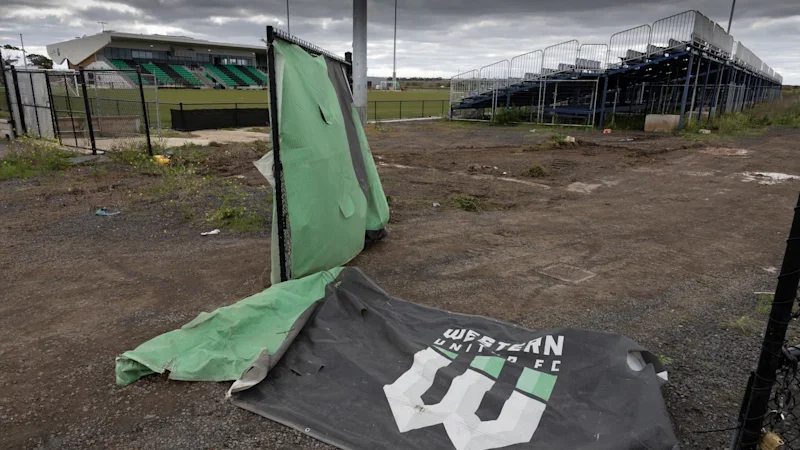
On a cold, grey day in Melbourne, between a cow paddock and a housing estate, the dream of an A-League soccer club for the west was being dismantled piece by piece.
Over the past year, Western United has rivalled Forty Winks for the number of times it has been declared on the brink of closing down, yet fans, staff and players have remained optimistic.
On Tuesday, the sword of Damocles finally dropped. The club was wound up in insolvency with a liquidator appointed in Federal Court, one day after the Australian Professional Leagues (APL) terminated its licence, citing several breaches to its participation agreement.
Within hours, removalists entered the club’s home ground in Tarneit, taking what they could on the instructions of receiver Alvarez and Marsal, which recently took control of Western United’s parent company, WMG Holdings, on behalf of Johnson Controls, which had lent money to the club’s owners and is now seeking to recoup costs.
Vusumizi Gumbo watched from the sidelines, shaking his head. His two sons, 16-year-old Akim and 12-year-old Amiel, were supposed to be training there that night as part of Western United’s academy – one of Victoria’s largest and most affordable elite soccer pathways – which has continued operating out of Ironbark Fields and competing in the Victorian Premier League (VPL) while the A-League men’s and women’s teams have been in hibernation.
Gumbo said the club had made a positive difference in Melbourne’s multicultural western suburbs.
“There are coaches here giving their time for free to coach these kids,” he said. “It’s not only about kicking football. They are trying to instil values that are important into the community.”
In recent weeks, as things have crumbled around them, the aspiring footballers have continued to train. People involved with the club have paid from their own pockets to keep the generators running.
Senior academy player Mark Leonard said it had been a strange year, with coaches and more than a dozen teammates leaving midway through, but several had stuck it out. “I think we’re 11th, but the past couple weeks we’ve been fighting, we’ve been doing really well for the situation we’ve been put in … I don’t think anyone expected us to keep up the fight,” the 20-year-old said.
When this masthead spoke to Leonard on Wednesday afternoon, he believed the team would be allowed to play out the remainder of the season, with only three matches left. But just a few hours later, academy players and their families received an email informing them they had played their last games together.
Football Victoria said that, as the club was being wound up in insolvency, a number of policies and regulations had been triggered that could not be overcome or breached.
“Ultimately, this means WUFC teams will not be able to play further FV competition fixtures this season or into the future, effective immediately,” Football Victoria’s chief executive Dan Birrell wrote. “We know this news marks the end of an era; but we know the friendships and bond of your football community will endure.”
Reacting to the news, Gumbo said he was devastated. “Tears in my house,” he said.
Loyal staff left out of pocket
Academy players, staff and fans have been in limbo this past year. While almost every external indicator has pointed to the club’s imminent collapse – the dissolution of its A-League teams, the dire financial situation of its parent company and directors – the club’s higher-ups reassured them time and again: Western United, a club that produced a champion men’s team and a grand finalist women’s team in just a few years, was here to stay.
As recently as last week, current and former employees – many of whom are owed more than six months’ worth of back pay – were holding out hope that one of several wealthy white knights who had expressed interest in buying the club might pull through with a rescue deal.
Even after the licence was terminated, Western United continued to push an optimistic narrative, releasing a statement on Monday saying that it marked “a significant moment in our history and the beginning of a new chapter”.
“Over recent months, we have worked closely with the APL on a pathway that gives the club the best opportunity to survive, rebuild and return to the A-League under new ownership,” it said.
“This creates an opportunity for new custodians, new investment and a fresh start. The objective must now be to preserve Western United’s identity in Melbourne’s west and work towards a return to the A-League for the 2027/28 season.”
Staff, however, took a less rosy view. While there is a strong possibility the APL could resell the licence to one of the buyers who had previously expressed interest, and potentially reboot Western United under the same name in the same location, former employees will remain out of pocket.
The club being wound up means staff have to recover lost entitlements via the federal government’s Fair Entitlements Guarantee. Under this scheme, they are entitled to recoup up to 13 weeks in unpaid wages, annual leave, long service leave, and a capped amount of redundancy pay. It does not cover unpaid superannuation, nor workers on temporary visas.
One employee, speaking on the condition of anonymity, said he had not been paid for about six months and was owed roughly $30,000, some of which he would not get back.
“Thankfully, I’m still living at home,” he said. “I don’t have bills, dependants, things like that, so aside from rapidly declining mental health, living-wise, I haven’t really been impacted. But others have. There are single parents, parents of young children, who have lost significant amounts in back pay and super.”
Another former staff member, also speaking on the condition of anonymity, said as much as she was frustrated by the situation, she felt Steve Horvat – the former Socceroo who founded the club and remained a director until the end – had been doing everything he could to keep the club together.
“Steve is probably wearing rose-coloured glasses. His dream has been this club,” she said.
“But then, we’ve been told for months and months it would be OK, so we didn’t go to media or get lawyers involved. And it’s like, are we being completely gaslit?
“And what was that statement? How can they say this isn’t the end for the club? Unless part of the plan is that Western [United] will continue under different ownership … It would be a weird situation if a billionaire takes over, and it’s bustling in the future and these 40-odd staff have just been screwed over … I feel for the fans, too. The fans we did have were so passionate … It was an important club for the west.”
Downfall of a dream
While Western United was Horvat’s dream, it was Jason Sourasis – then a player manager for athletes including AFL legend Scott Pendlebury – who was largely bankrolling the project, including the wider Wyndham Stadium Precinct that was central to the club’s long-term future.
Pitched as a combined sporting, entertainment, health and retail precinct in Melbourne’s west, featuring a 15,000-seat soccer stadium, it secured the backing of the City of Wyndham, which owns the land.
But WMG Holdings subsequently altered the proposal to be more within its means – changes the council rejected, issuing a default notice for its failure to deliver the precinct in line with what was agreed.
In a statement on Tuesday, Wyndham City’s director of corporate services, Mark Rossiter, said the council had gone “above and beyond” to afford the company “significant flexibility”, but it had failed to rectify the issues, which constituted a “serious breach” of the development agreement. He said the council had made the call to terminate the deal following the APL’s decision to pull the club’s licence.
With the club and precinct project both in tatters, it is still unclear exactly what went so badly wrong for the club and almost everyone affiliated with it to lose significant amounts of money. The co-directors of both parent company and club, Sourasis and Horvat, are also victims after borrowing money to prop up Western United.
As of March last year, Horvat owed the ATO close to $11 million – he never filed a defence and a default judgment was entered against him – while Sourasis has been embroiled in several lawsuits with angry creditors seeking recompense including Pendlebury, who alleges Sourasis invested his money in the club without his consent.
Sourasis denies the allegations and is defending the claims. Horvat declined to comment.
Alvarez and Marsal’s senior director of restructuring, Daniel Linaker, said the biggest asset the club owned was the licence, which was bought for about $18 million but was now worth about $10 million. With that terminated, he said, there were minimal assets that could be recovered.
Equipment collected from the club this week was worth up to $200,000, he said – small fry compared with the $74 million debt owed. Much of the club’s money was spent on infrastructure on council land which could not be extracted.
Linaker said it was highly likely the majority of money would not be recovered.
An APL spokesman said it had given the club as much time as it could to work through its financial, governance and legal matters. He said the governing body could not share specifics about the breaches mentioned in its statement that led to the club losing its licence.
As for the licence, the APL said its board was considering what to do with it.
Speculation regarding South Melbourne buying it have been dismissed by sources close to the APL. The National Soccer League club – which has faced its own financial battles over the years, including a period of voluntary administration – has been agitating for a seat at the table since the A-League was established two decades ago.
Despite everything that has occurred, and the ongoing questions around his team’s future, Leonard holds out hope.
“I still do have a lot of faith in that the club will return … My dream would be to play for Western United one day.”
More: