Sydney builder Christopher Ghaleb was convinced he was onto a winner. Cap in hand, he fronted the judges on Channel Ten’s Shark Tank to spruik his start-up in 2018.
Dubbed “Lifesize Plans”, it offered home owners a life-size version of their project to walk through before construction.
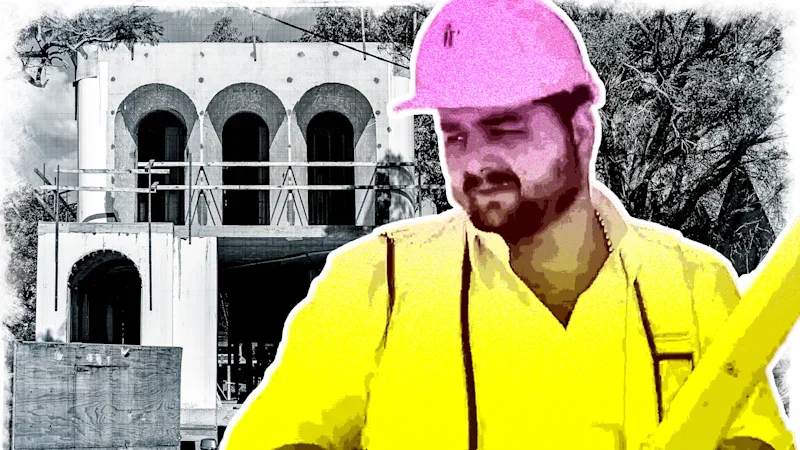
Sporting a hot pink hard hat as television cameras tailed him around his building site, Ghaleb explained it would resolve the same problem he encountered on almost every job: having to change things after they were already built.
But fast forward eight years, and the entrepreneurial builder’s own home on Strathfield’s “golden mile” has become a case study in the very problem he set out to avoid.
Ghaleb has agreed to demolish and rebuild parts of his dream home to resolve one arm of a court battle with Strathfield Council, which has accused him of building it without valid approvals and relying on a certifier with a conflict of interest.
The increasingly bitter brawl with the council has culminated in police applying for an apprehended violence order against Ghaleb to protect a senior council officer.
Ghaleb, 36, has been charged with stalking and intimidating Dylan Porter, the council’s former acting director of planning and environment.
It comes after a rapid rise for Ghaleb and his wife, Cindy, who have recently completed a series of high-end property redevelopments and now have a portfolio worth nearly $16 million.
The jewel in the crown is “Wellings”, labelled one of the inner west’s most significant heritage estates, bought by Cindy Ghaleb for $7.5 million in 2021.
Ghaleb would not comment on the AVO application and intimidation charges while they were before the courts, but defended his actions in relation to the Llandilo Avenue property.
“I think a couple of heritage houses next door, they didn’t want it, so they brought a fight to me,” he told the Herald.
Ghaleb said the court dispute over the development had been resolved because he had reached a compromise with the council in the Land and Environment Court in February.
Ghaleb said he agreed to “minor” changes to the home to keep the peace with the council.
“We agreed to lose less than 3 per cent of the floor area,” he said.
According to a court judgment, the changes include demolishing walls to increase setbacks, deleting the arch columns from the entryway, introducing additional landscaping and privacy treatments on the windows, and changing the finishes to complement the streetscape’s heritage.
But a Strathfield Council spokesperson denied the matters were resolved.
“The Class 4 proceedings regarding the same property have not been discontinued at this stage,” they said.
Class 4 proceedings are civil enforcement proceedings in which councils can ask the Land and Environment Court to remedy or restrain breaches of planning laws.
The spokesperson noted a Building Information Certificate (BIC) had been issued for the property in June. The certificates protect unauthorised works from demolition for seven years.
The saga has sparked anger and indignation on Llandilo Avenue, with several neighbours making public submissions to the council in protest.
They argued the house did not sit within the heritage fabric of the street, intruded on neighbours’ privacy and retrospective approvals should not be granted legitimising unlawful works.
The controversy is the latest flashpoint in an ongoing debate about whether the NSW planning regime does enough to prevent unauthorised development.
Just streets away, Strathfield Council has been fighting for years for the demolition of a mansion that was found to have been unlawfully built.
Critics argue the private certification system, together with building information certificates, can allow unauthorised building work to be carried out and remain standing even when councils argue it should never have been built in the first place.
Local Government NSW (LGNSW) represents the state’s councils, which are responsible for assessing the merits of BICs.
LGNSW has been lobbying the state government to review the framework for BICs, arguing growing numbers of home owners are misusing them for “approving” unauthorised works.
A Department of Planning spokesperson disputed that claim, saying statewide data showed no upward trend in BICs.
The spokesperson said recent reforms would ease the pressure on councils in relation to BICs by simplifying the process to make compliance easier and creating a clearer process for regulatory action and retrospective approval for unauthorised works, where appropriate.
“The reforms also introduce new offences for carrying out building work without an approval or contrary to an approval,” the spokesperson said, noting they carried maximum penalties of up to $220,000 for individuals and $1.1 million for businesses.
Asked about the use of BICs, Ghaleb said he was no longer involved in development work but said it had been common for builders to use them in the past.
“Builders would say, ‘I’ll do what I want,’ and then [get] a building information certificate,” he said.
“[I] wouldn’t be trying that these days, especially with Strathfield Council. They’re not there to muck around.”
Purple patch
While the Sharks failed to bite during Ghaleb’s television appearance, Lifesize Plans soon began to get noticed.
By 2021, the business was expanding overseas, attracting glowing press coverage and had collected high-profile board members. But within a few years the company was struggling to stay afloat: it entered voluntary administration at the end of 2024 and had to be salvaged via a deed of company arrangement.
In his report, administrator Daniel Frisken found the company became insolvent on June 30, 2023.
Frisken said the remaining sole director, Raymond Sheikh, had told him the business’s demise was due to the misappropriation of franchise deposits, excessive overspending, mismanagement of the company’s business and a claim brought by a creditor.
Frisken said the director had not substantiated those claims with documentation, but his review of the books and records indicated the company had traded at a loss since its incorporation.
Ghaleb has since attributed his business difficulties to severe personal trauma.
In March, he told the NSW Personal Injury Commission’s review panel that he “never returned to normal and never returned to work” after developing post-traumatic stress disorder from witnessing a fatal car accident at Huntleys Point in 2019.
Ghaleb told the Herald he had stepped away from the business due to personal issues and wasn’t involved in its failure.
“I wasn’t following their struggle too much at all,” he said.
Sheikh said it was unfair to attribute the company’s difficulties to one individual or to characterise what occurred solely as mismanagement.
He said the loss of Ghaleb’s active involvement following the accident had left those running the company with the difficult task of continuing a specialised concept “without full access to the person who had conceived [it]”.
Sheikh said that, since becoming involved in 2024, he had worked to settle debts, repay franchisees and put the company on a sustainable footing, with the rebuilding process now “progressing successfully”.
Splash in the neighbourhood
As his business fortunes faded, Ghaleb and his wife turned their attention to property redevelopment.
In 2024, Ghaleb arrived with a splash in the neighbourhood, paying $4.1 million for a knock-down rebuild on Llandilo Avenue.
Many of the street’s homes are a time capsule of the “Arts and Crafts” design era that championed natural materials and ornate details.
The homes still reflect “Strathfield’s legacy as a suburb of grand homes for Sydney’s elite”, a planning document said.
Ghaleb soon set about demolishing his home, which was at the end of a long driveway and tucked behind two heritage-listed mansions, one of which was designed by renowned architect Thomas Pollard Sampson.
To the astonishment of neighbours, a new home began to materialise where the driveway itself formerly stood.
It featured a Mediterranean-inspired aesthetic, embellished with rendered white archways.
Ghaleb’s consultants argued the nine-metre-wide street frontage could more than accommodate the new home, which was within a “streetscape that has undergone significant transformation due to the construction of contemporary dwellings”.
Ghaleb said he hadn’t broken any rules by relocating the house, but the decision had surprised the council.
“For the past 50 years [the house was] at the back,” he said. “They wouldn’t expect a house at the front.”
One neighbour was blindsided.
“When demolition commenced, I contacted council and was told no application for demolition or development was on record,” the neighbour said in a public submission.
The project has instead been approved by a private certifier under the state government’s fast-track complying development pathway.
Complying development certificates (CDCs) allow straightforward projects that meet prescribed standards to bypass the traditional development application process.
But Strathfield Council is now fighting to have the CDC declared invalid in the Land and Environment Court.
It issued a stop work order at the site in mid-2025 and filed documents with the court that have been obtained by the Herald.
In them, the council argued the dwelling failed to meet the gross floor area and minimum setbacks allowable under a CDC and its basement amounted to an unapproved third storey.
The council also alleged the CDC should be struck out because of a conflict of interest.
The certifier, Sandres Markhani, and his colleague, James Wardan, both presented themselves as employees of Sydney Wide Certifiers, according to the council.
However, Wardan prepared the architectural plans under a different company he owned and controlled called Syd Consulting Pty Ltd, the council alleged.
“A fair-minded observer might reasonably apprehend that because of Mr Markhani’s association with Mr Wardan, Mr Markhani might not bring an impartial mind to the determination of the application for the CDC,” the council said.
Neither Markhani nor Wardan responded to the Herald’s request for comment.
Ghaleb denied he used a certifier with a conflict of interest.
“People throw 300 things at something and hope two or three stick,” he said.
Private certifiers have a responsibility to take action if they identify unauthorised work, and the NSW Building Commission can take disciplinary action against them if they fail to do so.
In recent weeks, Ghaleb has been busy finishing the outstanding construction works, estimated to be worth nearly half a million dollars.
The stalking and intimidation matter returns to Burwood Local Court in October.
More: