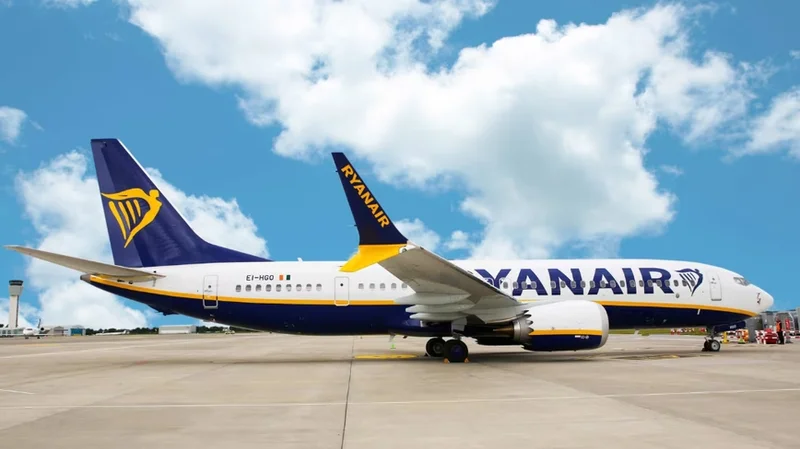
Ryanair has signed a five-year data and AI partnership with Google Cloud, rolling out Google Workspace and Google Cloud services to 35,000 employees and making Gemini Enterprise, Google’s agentic AI platform, the centrepiece of how Europe’s largest carrier intends to run itself.
The airline has tied the deal explicitly to its growth target of 300 million passengers a year by 2034, roughly a 44% increase on the 208.4 million it carried in the financial year to March.
Gemini Enterprise will be used, in the companies’ description, to automate decision-making, optimise flight crew logistics, and support corporate productivity generally.
Ryanair plans to use Google DeepMind models, naming AlphaEvolve and WeatherNext, to support fleet operations and maintenance scheduling.
WeatherNext is DeepMind’s forecasting family, which for an airline running around 3,900 flights a day out of 95 bases is not a peripheral application. It also plans to replace its existing collaboration systems outright with Workspace and Gemini.
Running underneath all of it is a resilience argument that Ryanair has put ahead of the AI one. The airline describes the arrangement as a “dual-cloud strategy”, in which Google Cloud helps build a system flexible enough that if one provider has problems, critical services keep running.
“Ryanair is on an incredible growth journey to 300 million passengers by 2034,” said Eddie Wilson, Ryanair’s chief executive.
- “To support this growth, we need to ensure we have excellent infrastructure resilience, and our new dual-cloud strategy provides this, alongside technology partners that match our speed and relentless focus on efficiency.”*
Maureen Costello, Google Cloud’s vice-president for the UK, Ireland, and sub-Saharan Africa, put the case in industry terms. “Aviation is an industry defined by precision, and Ryanair is a pioneer in operational execution,” she said.
“This agreement demonstrates how deploying generative AI at scale, coupled with modern collaboration tools for frontline workers, can help industry leaders scale securely, reduce operational costs, and redefine the travel experience.”
The scale Ryanair is buying for is real. It ended the last financial year with 647 aircraft, having taken delivery of all 210 Boeing 737-8200 Gamechangers, and has 300 737 MAX-10s on order, split evenly between firm orders and options.
Boeing expects certification of that aircraft late this summer, with the first fifteen due to Ryanair in spring 2027. Pre-exceptional profit after tax for the year was €2.26bn, up 40%.
What the release does not say is as notable as what it does. There is no named migration of specific workloads, no BigQuery or Vertex AI commitment, no disclosed contract value, and no timeline for when any of the AI applications reach production.
Airlines have been announcing operational AI for the better part of a decade; the difference here is the size of the seat count and the explicit link to a passenger target eight years out.
Ryanair is not new to building software, whatever its reputation for spending nothing.
It runs Ryanair Labs, an in-house technology operation with hubs in Dublin, Madrid, and Wrocław, and has spent years pushing passengers towards direct booking, a campaign that produced a €255m Italian antitrust fine in December 2025 over its treatment of online travel agents and a settlement with Booking Holdings the previous August.
It also runs against a current. Airbus is moving its most critical applications off AWS to a French sovereign cloud, a decision framed around European control of European infrastructure. Ryanair, characteristically, has gone the other way and bought the American stack twice over.
Get the TNW newsletter
Get the most important tech news in your inbox each week.