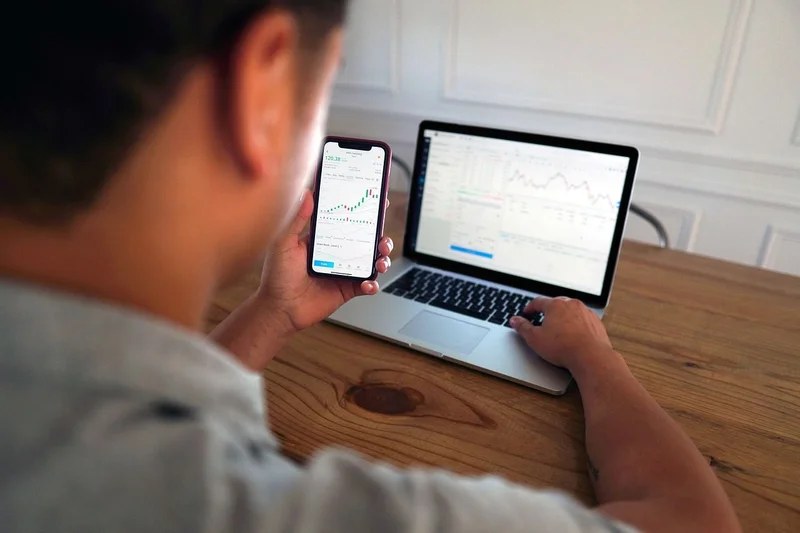
The first bot I ever took live had run clean on paper for five weeks. Day three of real money, it opened the same position twice inside forty seconds — a retry loop firing on an API timeout the demo environment had never once produced.
Paper trading didn't catch that. It couldn't. Nothing in a simulator times out.
Most traders use a demo account to answer one question: does this strategy work? That's the single question it's least equipped to answer, and the reason sits in how it fills you.
Look at what a paper account does with an order. Market orders fill at the last printed price. Limit orders fill the instant price touches your level. Stops fill exactly where you placed them, to the tick, and size is irrelevant — a $200 order and a $200,000 order both fill as though the book were bottomless.
Live markets don't behave that way. In calm, liquid conditions you'll typically give up somewhere around 0.01% to 0.03% per fill, which sounds like rounding error. During a fast move — precisely when a breakout system wants to be trading — that widens to roughly 0.1% to 0.5%, and larger orders start coming back partially filled or not at all.
Run the arithmetic on a system that round-trips once a week. At 0.2% slippage per fill, that's 0.4% a round trip, fifty times a year. Twenty percent of your return, gone before you count a single fee — and your paper account reported none of it while drawing you a smooth equity curve.
A profitable demo isn't evidence of an edge. It's evidence of a generous fill model.
The second thing paper trading can't do is rehearse the part that actually breaks people. You can't practice holding a loser when there's nothing to lose. Fear — the muscle that fails at 3am with 4% of your account underwater — is simply not in the room.
Traders who spend three months on a demo and then blow up in two weeks live aren't weak. They practiced the wrong thing.
Here's where I think the real mistake lives. Paper trading gets used as a substitute for the two things it can't replace: statistical evidence, which comes from a properly costed backtest, and emotional evidence, which only ever comes from real money. It sits between them and gets asked to do both jobs.
Then people graduate. Six profitable weeks on a demo feels like permission, so they go live at full size, skipping the one step where the strategy finally meets a real order book with real money behind it.
Use a demo account for exactly one thing: proving the plumbing works. Does the order arrive at the exchange with the right symbol, the right side, the right size? Does the stop attach, and does it survive a restart of the process?
What happens when the API returns a timeout instead of a fill — does the bot retry, and does the retry quietly double your position? Are your timestamps UTC on both ends, or is your backtest data in local time while the exchange feed isn't?
Boring questions. They also cause more live failures than bad strategy logic does. Data and timing bugs kill bots that had perfectly good signals.
So the sequence goes like this. A backtest tells you whether the edge survives costs. Paper tells you whether the wiring is correct.
Small real size — small enough that losing all of it changes nothing about your week — tells you what the fills genuinely cost and whether you can sit still while red numbers appear. Full size comes last, and only when the first three agree.
I'd give paper trading two weeks, and I'd score it on bugs found rather than profit made. Finish those two weeks unable to name a single thing you fixed, and you probably weren't looking hard enough.