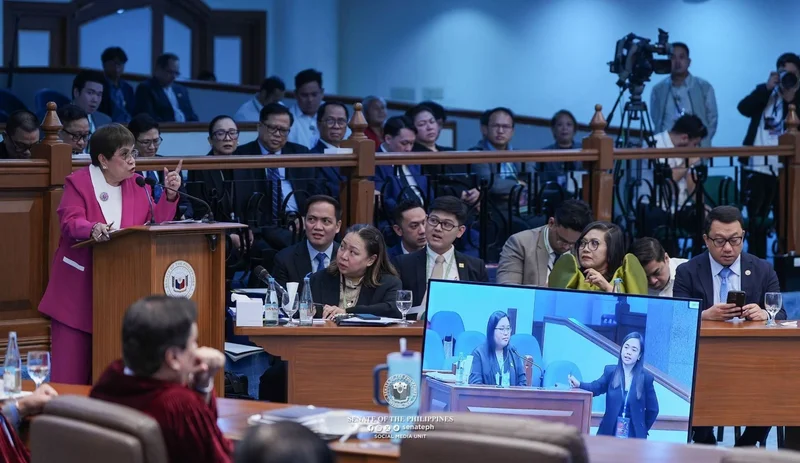
Sara Duterte trial recap, Aug. 12: Kapunan's wisecracks, counsels' clashes, arrest standard tested
MANILA, Philippines — What started as a disagreement over documents on Day 15 of Vice President Sara Duterte's impeachment trial turned into a sharp clash between the defense and the prosecution, with one moment spilling onto social media and prompting a stern warning from presiding officer Sen. Chiz Escudero.
Private prosecutor Lorna Kapunan and defense counsel Kristine Ferrer traded objections through most of the proceedings on Wednesday, August 12, at one point drawing an appeal from Escudero not to let a "seeming generational divide" raise tensions in the courtroom.
Today's impeachment proceedings largely saw Duterte's lawyers mount a takedown of the Commission on Audit's disallowance of the Office of the Vice President's confidential funds in 2022 and 2023.
State auditor Xylene del Campo was on the stand for the whole session, for the cross-examination, redirect, recross and one round of questions from senator-judges before being excused.
Here are the three highlights from today's proceedings.
1. 'Misleading questions are not allowed,' and the post that followed
Kapunan opened the session manifesting that the prosecution was "disturbed" by the defense's remarks yesterday implying the prosecution presented documents that were not authentic, specifically the Office of the Vice President's (OVP) acknowledgment receipts and their tabulations.
Tension reignited minutes later when Ferrer used the same documents for their cross-examination of Del Campo. This irked Kapunan, who said:
"They are now constrained to use our documents. This is what we wanted to avoid yesterday [...] So if it's the same, what's the objection to using the prosecution's document?"
Ferrer countered that Kapunan "cannot dictate how I will proceed with my cross-examination."
But the day’s sharpest exchange came when Kapunan accused Ferrer of constantly interrupting Del Campo mid-answer.
Ferrer repeatedly asked that Del Campo be directed to answer yes or no, saying the prosecution could draw out explanations on redirect. Kapunan objected just as often that the state auditor was being cut off mid-sentence and that "not all questions can be answered by yes or no."
"Never mind if you're on cross. There are limits to cross-examination. Misleading questions are not allowed," Kapunan said, adding she does not need to "lecture" the defense on that.
"They are allowed," Ferrer shot back.
Escudero appealed for calm, urging both lawyers not to let a "seeming generational divide" bring tensions into the courtroom.
Kapunan told the court she was "preventing myself from giving her a spanking." When Ferrer offered words of respect for the veteran litigator, Kapunan made another wisecrack for her to "end it there" as it "might sound like a eulogy ... I'm still very much alive."
Lead defense counsel Sheila Sison raised a manifestation over a social media post by private prosecutor Amando Virgil Ligutan that morning. Ligutan wrote that "a principal, a lawyer, and law students know by heart misleading questions are not allowed even in cross-examination."
Sison read the official transcript into the record, arguing the post mischaracterized the courtroom exchange, disrespected a fellow member of the bar, and violated Rule 18's ban on commenting on case merits publicly.
Escudero declined to hear Ligutan's response to that on the spot, but revealed he had directed the clerk of court to track all public statements of both sides the past week, noting that "one side has been crossing the line many times."
Reminding both panels of his advice two weeks ago to name spokespersons outside their legal teams, Escudero said he had already been drafting a formal ruling and warning.
"We have it all on tape. We have been monitoring everything," Escudero said, setting Ligutan's manifestation for Monday before issuing his ruling.
Another flashpoint was the defense's use of transcripts. When Ferrer read into the record statements made by COA's Gloria Camora at House hearings in 2024 and 2026, Kapunan interjected that Del Campo was being made to confirm other people's words: "If that is their intention, then they should present that witness here."
Escudero said he would have sustained it as an objection, recalling the same warning he gave the prosecution over the Lascañas affidavit during the grave threats charge.
The prosecution also bristled at the defense's turn to use the names in the OVP acknowledgment receipts. When Ferrer asked whether a funny-sounding name, such as those with "Piattos" or "Mayo" automatically means it is fictitious, Kapunan objected that the receipts were shown to demonstrate how the funds were used, not to mock the names.
"That the names were funny or fruit salady or names of congressmen or senators is immaterial," she said.
Escudero let the questioning proceed anyway with a jab: "In fairness, Attorney, you have to admit you had fun. You had fun with the names."
**2. Does COA's audit of rewards payments require an arrest as proof of success? Defense says no, auditor says it's based on professional evaluation **
Ferrer largely sought to challenge Del Campo on whether the 2015 joint circular governing confidential funds requires an arrest before a reward payment can be considered justified or having led to a "successful" operation.
The defense had Del Campo confirm that the circular says only "proof of success of information gathering and/or surveillance," and nothing about apprehensions, and no template for what such proof should look like.
Pressed on where the arrest standard came from, Del Campo said it was based on her professional judgment anchored on the circular. Escudero pushed further, asking whether this was established COA practice or her own reading.
"Sa akin po, 'yun po 'yung naging interpretation (With myself, that was my interpretation)," she said, adding that agencies she previously audited attached documents showing apprehensions to support reward payments, and that her findings passed review from her superiors at the COA Intelligence and Confidential Fund Audit Unit.
The defense's cross also largely relied on the OVP's protective intelligence operations reports.
Ferrer used these reports to argue that crime prevention is a legitimate purpose of confidential operations, beyond making arrests. Del Campo agreed "prevention" is covered, but held that the OVP's submitted reports and certifications remained insufficient proof of success for its millions in reward payments.
To recall, P132 million in the OVP's reward payments were flagged across both 2022 and 2023.
But Kapunan flipped the intel reports on redirect. Reading from the defense's own documents, she pointed out the reports narrate the accomplishments of the Vice Presidential Security Group, which she notes as government personnel paid from other funds.
Kapunan notes the joint circular bars charging salaries and benefits to confidential funds. She also had Del Campo read the portion which she says the defense had skipped: that such operations must be "done in coordination with the appropriate law enforcement agencies."
Del Campo told Kapunan that activities tied to the vice president's personal engagements are not chargeable to confidential funds, and that confidential operations are not part of the constitutional mandate of either a vice president or education secretary.
On recross, Ferrer sought to blunt the prosecution's argument by having the state auditor confirm that she made no finding that the VPSG received rewards or payments for purchase of information from either the OVP or DepEd's confidential funds.
**3. House hearings cast large shadow over trial **
Escudero, after reading the 2024 House good government committee hearing transcripts himself, surfaced what may be perceived as a gap in the COA's basis for its larger disallowance of the OVP's confidential funds.
The March 31, 2026 notice disallowing P375 million in 2023 confidential funds rested largely on House testimony that SDO Gina Acosta handed the money to then-VPSPG chief Col. Raymund Dante Lachica — an arrangement COA treated as breaking the chain of accountability.
But Escudero said the transcript does not clearly show that. Acosta was explicit about giving Lachica the P125 million for the fourth quarter of 2022, he said, but "it is not that clear" that she did the same for the first three quarters of 2023.
He asked Del Campo what document she relied on when she drafted the notice.
Del Campo pointed to Acosta's "general statement" that the confidential funds were given to Lachica. Escudero pressed: was that from the transcript, or from what she heard while attending the hearing?
"'Yung narinig ko po nung nandoon po ako (What I heard when I was there)," Del Campo answered, confirming she had not based it on the actual transcript.
The transcript, Escudero noted, "would likely be much clearer on this."
The exchange, which came at the tail-end of senators' questions, came after a related admission earlier in the day: the House good government committee transcripts were never part of the liquidation documents the OVP or DepEd submitted to COA.
Del Campo said auditors relied on them under the circular's clause allowing "other supporting documents" deemed necessary, and that COA never independently verified the statements made at those hearings.
Sen. Imee Marcos seized on that point and told Del Campo that if a compliance audit is limited to agency submissions, accepting congressional testimony changes its character.
"Kung may relevant sa diyaryo, tatanggapin rin ninyo na ebidensya?" she asked. "Parang lumalabo yata 'yung joint circular."
Earlier, Senate President Sherwin Gatchalian had used the same transcripts to press the opposite conclusion: that if handing money to Lachica justified disallowing the OVP's 2023 funds, the 2022 and DepEd allocations should follow. "Yes po. Tama po," Del Campo said, agreeing the full P612.5 million could be disallowed.
None of the disallowed money has been returned. The OVP's motion for reconsideration on the 2022 disallowance is pending before the commission proper, and it remains within its 180-day window to appeal the 2023 notice. No notice of finality has been issued for any of the funds.
The trial resumes Monday, August 17, at 10 a.m., with the prosecution set to present House Legislative Information Bureau director Marivic Pareja, followed by Acosta, Fajardo and OVP assistant chief of staff Lemuel Ortonio.
- Latest
- Trending