- READ MORE: Temperatures will drop by 'several degrees' during solar eclipse
- See more Daily Mail on Google - save us as a Preferred Source
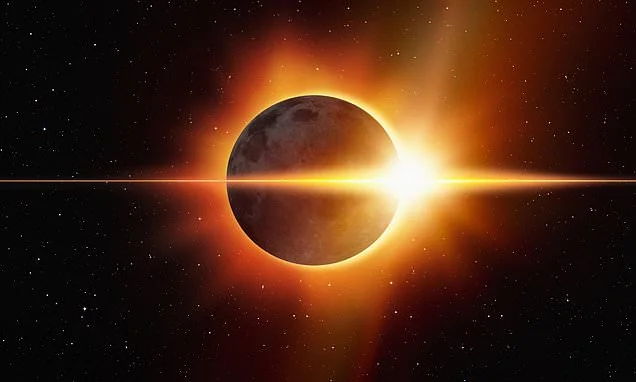
Millions of people will have their eyes to the skies tonight, as a solar eclipse sweeps across Europe.
Aside from being incredible to look at, solar eclipses are also known to spark cascades of strange events.
The unexpected darkness will disrupt many animals' internal clocks, leading to confusion and anxiety.
'Some animals rely even more heavily on light cues; birds are one example,' explained Dr Kristina Paradowski, a clinical assistant professor at the Texas A&M School of Veterinary Medicine & Biomedical Sciences.
'If a pet bird is out of its cage, it may go back in and find its perch as if it is nighttime.
'Pet birds in the path of totality will likely be more vocal in periods prior to and after the eclipse, but silent during the peak eclipse.'
Research has also shown that previous eclipses have led to a spike in traffic accidents.
What's more, a 2011 study found that even microbes get muddled during these celestial events – with some species changing shape during the peak.
Millions of people will have their eyes to the skies tonight, as a solar eclipse sweeps across Europe. Aside from being incredible to look at, solar eclipses are also known to spark cascades of strange events
1. Animals will act strangely
Unlike humans, animals can't read clocks, and instead rely on cues from nature to understand what time of day it is.
This means the darkened sky brought on by an eclipse can cause wildlife to shift their routines.
For example, during the 2017 total solar eclipse over the US, fireflies started flashing their lights when the eclipse hit its peak.
'The arrival of darkness triggers many species of firefly to produce a chemical reaction that lights up their abdomen. This light is a signal to attract potential mates,' the US Fish & Wildlife Service explained.
And during a 1991 total eclipse over Mexico, spiders were found to start taking their webs down, as if it were nighttime.
The US Fish & Wildlife Service added: 'After the sun reappeared, they began to rebuild their webs again like it was the start of a new day.'
And it's not just wild animals who will be confused during tonight's event.
According to Dr Paradowski, the eclipse could spark unusual reactions from pets
According to Dr Paradowski, the eclipse could also spark unusual reactions from pets.
'The sudden increase in darkness during what should be the middle of the day is puzzling and disorienting for pets,' she explained.
'Often, when darkness quickly increases during what should be daylight, storms follow.
'As a result, there may be a conditioned response in some animals to be expecting storms when the day suddenly darkens.
'This can be especially true in animals with storm anxiety.'
2. There will be a spike in traffic accidents
During the 2017 solar eclipse over the US, scientists from the University of Toronto charted a spike in road traffic accidents.
'We found a significant increase in traffic risk in the U.S. around the time of the total eclipse, averaging to one extra vehicle crash every 25 minutes and one extra crash fatality every 95 minutes,' said lead investigator, Professor Donald Redelmeier.
During the 2017 solar eclipse over the US, scientists from the University of Toronto charted a spike in road traffic accidents
'The total amounted to 46 extra deaths linked to the eclipse.'
While the reason for this spike remains unclear, the researchers say it's probably not down to the change of light itself.
Professor Redelmeier added: 'Instead, the findings likely derive from increased traffic, travel on unfamiliar routes, speeding to arrive on time, driver distraction by a celestial event, drug–or–alcohol–impairment from related celebrations, or eclipse viewing from unsafe roadside locations.'
3. It will suddenly get cooler
Temperatures across the UK will drop by several degrees tonight, thanks to the solar eclipse.
As the moon covers the sun – by up to 96 per cent in parts of Britain – it will not only get cooler, but winds will also drop.
However, there is a catch.
This relief from the heat will only last for around an hour.
Asked how cool it might get, a spokesperson for the Royal Astronomical Society told the Daily Mail: 'It's hard to say exactly as it depends on the time of day and amount of coverage of the Sun but usually about 1°C to 3°C during a partial solar eclipse and around 5°C during a total solar eclipse.
'These are averages though, it can be more or less.'
4. The wind will change direction
The 'eclipse wind' is a change in wind direction as the moon temporarily blocks out the sun.
In 2015, scientists from the University of Reading set up roadside weather sensors during a partial solar eclipse.
They found that the wind changes direction thanks to changes to the 'boundary layer' – the area of air that usually separates high–level winds from those at the ground.
Professor Giles Harrison, who organised the experiment, explained: 'As the sun disappears behind the moon the ground suddenly cools, just like at sunset.
'This means warm air stops rising from the ground, causing a drop in wind speed and a shift in its direction, as the slowing of the air by the Earth's surface changes.'
In 2015, scientists from the University of Reading set up roadside weather sensors during a partial solar eclipse. They found that the wind changes direction thanks to changes to the 'boundary layer' – the area of air that usually separates high–level winds from those at the ground
5. Microbes will shapeshift
In 2011, scientists from the Institute of Medical Sciences, Kuntikan, revealed how a solar eclipse the previous year had caused microorganisms to shapeshift.
The team studied bacteria and fungi before and after the event, and noted 'significant changes'.
'There was significant change observed during exposure to normal sunlight and eclipse phase,' they explained in their study, published in the Journal of Pharmacy and Bioallied Sciences.
'Bacterial colonies showed difference in morphology on smear examination and sensitivity pattern during this study.
'One fungal species and three bacterial isolates were studied and changes were recorded.
'Fungal species showed a definite change in their morphology on exposure to sunlight during eclipse.'