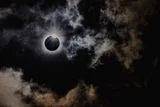
Aug. 12, 2026 marks one of the year’s most significant days astronomically speaking, thanks to the arrival of a total solar eclipse. The most spectacular sights will take place along the path of totality, where the moon will completely block the sun. This creates the impression that day has turned to night, with only the sun’s corona still visible.
Totality is an incredibly rare event. According to the National Solar Observatory (NSO), a total solar eclipse is visible from any one location just once about every 400 years.
While viewers in the U.S. will not be able to see it in full, NASA states that a partial eclipse will be visible in areas north of North Carolina.
Read More: 5 of the Longest, Shortest, and Most Important Solar Eclipses Ever Recorded
Where to See the Upcoming Total Solar Eclipse
In 2026, the path passes over the Arctic Ocean, Greenland, and Iceland before sweeping across the Atlantic Ocean and into parts of northern Portugal and Spain.
There will also be dramatic views across much of Europe and North Africa, where upwards of 80 and 90 percent of the sun will be obscured.
The eclipse will be visible from some parts of the U.S., although not to the same extent. Alaska will see some of the most dramatic darkening — in Fairbanks, up to 37 percent of the sun will be covered at its peak, according to NASA.
Those who do not get to experience the event in person can stream the event live via the space agency’s online channels.
Read More: Not Every Solar Eclipse Brings Darkness — Here's Why Every Eclipse Is Unique
When To See The Total Solar Eclipse
The eclipse will take place on Wednesday, Aug. 12, 2026, but the exact timing will vary depending on where you are viewing it from.
It will first be visible from a remote region of northern Russia, starting at midday local time, before moving towards northern Europe. According to NASA, viewers in Reykjavik, Iceland, will experience totality from 5:48 p.m. local time. Those in León, Zaragoza and Valencia (all Spain) will witness totality from 8:28 p.m., 8:29 p.m. and 8:32 p.m. respectively.
Alaskans will be the first to view the eclipse from the U.S. It will peak at 8:21 a.m. for those in Anchorage and 8:27 a.m. for those in Fairbanks.
Read More: Why Some Eclipse Maps May Miss the True Edge of Totality During the 2026 Solar Eclipse
Meanwhile, viewers on the East Coast will be able to see a partial eclipse shortly after noon. For those in Portland, Maine, the sky will start to darken at 12:57 p.m. before the eclipse peaks at 1:53 p.m., at which point almost a quarter of the sun will be covered. In Boston, Massachusetts, there will be a maximum coverage of 16 percent at 1:55 p.m.
Viewers in Michigan, New York, Pennsylvania and Washington will experience the eclipse at a similar time but to a lesser extent, with a maximum coverage of 3 percent, 9 percent, 7 percent and 4 percent respectively.
Read More: When a Total Solar Eclipse Darkened an Empty Zoo, Macaques Climbed and Zebras Ran
How to See the Total Solar Eclipse
It is never safe to look at the sun directly, and that remains the case during an eclipse. Other than when the sun is (for the briefest of moments) completely obscured by the moon, safe viewing requires specialized eye protection. According to NASA, this means using safe viewing glasses (“eclipse glasses”) or a safe handheld solar viewer. These are thousands of times darker than sunglasses.
The space agency’s advice is to always check protection before use and discard it if scratched or in any way damaged. It also warns against looking at the sun through binoculars, a telescope, or a camera lens — even with eclipse glasses or a handheld solar viewer — as concentrated solar rays can burn through the filter and result in a serious eye injury.
As the U.S. is not on the path of totality and the sun will not be fully covered at any point during the eclipse, specialized eye protection will be needed throughout. Alternatively, it is possible to view the eclipse indirectly — for example, by holding up a colander and watching its shadow.
Read More: As the 2026 Solar Eclipse Peaks, Here's How to Plan for the 2027 'Eclipse of the Century'
Article Sources
Our writers at Discovermagazine.com use peer-reviewed studies and high-quality sources for our articles, and our editors review for scientific accuracy and editorial standards. Review the sources used below for this article:
- This article references information from the National Solar Observatory (NSO): Total Solar Eclipse – August 12
- This article references information from NASA: August 12, 2026 Total Solar Eclipse
- This article references information from NASA: Eclipse Safety