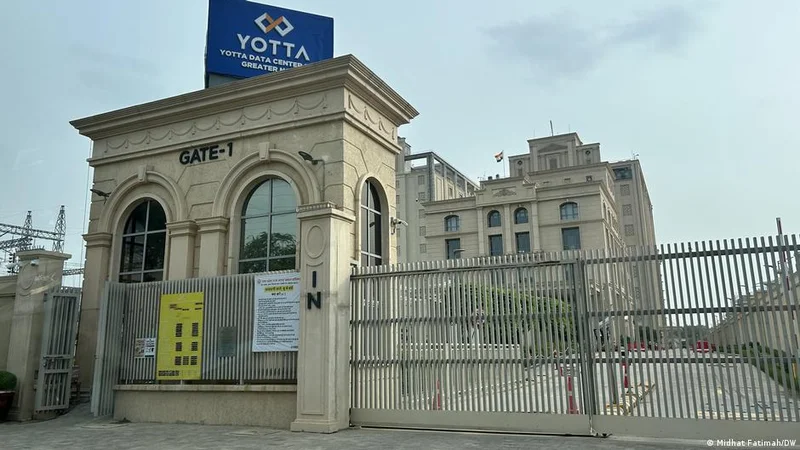
Residents of Khora, a densely populated area in the city of Ghaziabad, just outside New Delhi, have long struggled to obtain a reliable water supply.
"We are dependent on groundwater. In some parts, one has to dig 1,000-1,200 feet (305-366 meters) to extract water," said Deepak Joshi, President of the Khora Residents' Association.
"The residents have been trying to get the water issue in Khora resolved for the last 10 years, but nothing has changed," he told DW.
Now, several data centers have been built in the area. Companies around the world are still scrambling to set up new AI infrastructure and India is increasingly positioning itself as a data center hub — but the new sites demand enormous quantities of water to cool the servers.
Many of India's water-stressed regions, including Khora, are feeling the bite.
Paying for well access
Carpenter Naeemuddin Saifi has been living in Khora colony for the last 35 years, but he still does not own his water connection. Like many in the locality, he relies on a shared borewell connection and pays 1,000-1,200 rupees ($10.5-$12.5, €9.1-€10.9) every month for it.
"I cannot afford it alone," he said.
Joshi says each borewell costs around half a million rupees, or some $5,250. Many families here simply don't have that kind of money.
"Even a borewell is not a permanent solution. The levels of water could drop anytime. Maybe in two months, or it could take six months; we don't know," Joshi said.
The situation is so dire that many families have moved out, according to Joshi.
Water extraction at over 270% of recommended level
More than half of India's data centers are located in water-stressed regions, according to a recent report by World Resources Institute (WRI) India.
The city of Ghaziabad is one of the regions where groundwater remains overexploited.
According to the Central Ground Water Board, its annual extractable groundwater resources stood at around 2,714 hectare metres (ham), but the amount of water taken out in 2024-2025 was around 272% of the recommended share.
"When the Ghaziabad and Noida region started urbanizing, the biggest thing that they started marketing … is that there is an abundance of water because of the canal water, the river water, and the groundwater," Ranjana Ray Chaudhuri, head of the Department of Natural and Applied Sciences at TERI University, said.
But rapid urbanization has changed the equation, she said.
Now, the region is also required to support data centers, which need substantial cooling, and the heat expunged by cooling systems can affect the local microclimate, she said. Higher temperatures could in turn increase air-conditioning demand in surrounding buildings.
"Overall, there is an increase in the use of water, and that water use is not just groundwater use, it is also because of the surrounding areas needing to use more water," Chaudhuri said.
At the same time, Chaudhuri cautioned there is still not enough data to fully assess the local impact of large data centers.
Uttar Pradesh pledges uninterrupted water supply for data centers
In 2025, the authorities officially called off a long-demanded project which would have rerouted some of the Ganges water directly to Khora. An executive officer in Ghaziabad Municipal Council told DW an alternative water project was in the works.
But Joshi says residents received no updates on the alternative solution.
Meanwhile, just a few minutes' drive from Khora, the new and shiny AdaniConnex data center stands tall. DW asked the facility, which is a 50:50 joint venture between India's Adani Group and the United States-based global data center operator EdgeConneX, about its water consumption, but received no reply by the time of publication.
AdaniConnex is one of over 20 such facilities in Noida, an industrial city bordering Ghaziabad on the outskirts of New Delhi. And, as per Uttar Pradesh 2026 Data Center Policy Draft, the state government has promised an "uninterrupted 24x7" water supply to data centers.
"[In Noida] the water stress is particularly high because urban demand has grown quickly and groundwater has remained an important source," said Prateek Aggarwal, a senior representative of the Council on Energy, Environment and Water (CEEW), a well-established non-profit research institution in Asia.
There is no official estimate of how much water data centers currently consume across the National Capital Region, Aggarwal said.
No transparency mandate for data centers
India's total data center capacity has increased by a factor of four since the start of the decade, jumping from about 375 megawatts in 2020 to around 1,500 megawatts in 2025, according to the Ministry of Electronics and Information Technology.
As of today, there are 305 data centers across India, according to the Data Center Map. They consumed around 150 million tons of water last year, and some estimates say this will double by 2030.
On top of the concerns triggered by the sheer volume of water consumption, there is also the issue of how that consumption is monitored and regulated.
Gayatri Naik, co-director of the Center for Environmental Law, Education, Research and Advocacy at the National Law School of India University, described India's approach as fragmented.
"We don't have a conclusive regulatory aspect with regard to governing any of the water uses by these data centers," she said.
Commercial entities are required to obtain a no-objection certificate to extract groundwater, she said, and the permission specifies how much water can be extracted. But companies are not generally required to publish regular monthly or annual figures showing their actual consumption.
Who gets water when supply runs low?
Comparing India's policy with those in European countries, Naik said the EU requires data centers to disclose their water consumption — a requirement that is absent in India.
Also, under EU rules, data centers with an IT power capacity of at least 500 kW are required to report key sustainability data to a European database.
CEEW activist Aggarwal agrees mandatory disclosure should be the first step.
"Energy, water, and carbon use reported every year, including exactly where the water comes from and how much gets recycled," he said.
He also called for phased efficiency standards for water and power, and for decision makers to also consider water availability alongside land and electricity infrastructure before approving a data center.
"The real strain in a place like National Capital Region comes from many facilities sharing one aquifer, not any single project," Aggarwal said.
Naik said the issue ultimately raises a broader question about who gets priority when water is scarce.
"How will you bring a balance between this water that is required for drinking as well as the water demands by these companies who are extracting the water from a water scarce area?" she asked.
"So this can lead to social and distributive injustice."
Edited by: Darko Janjevic