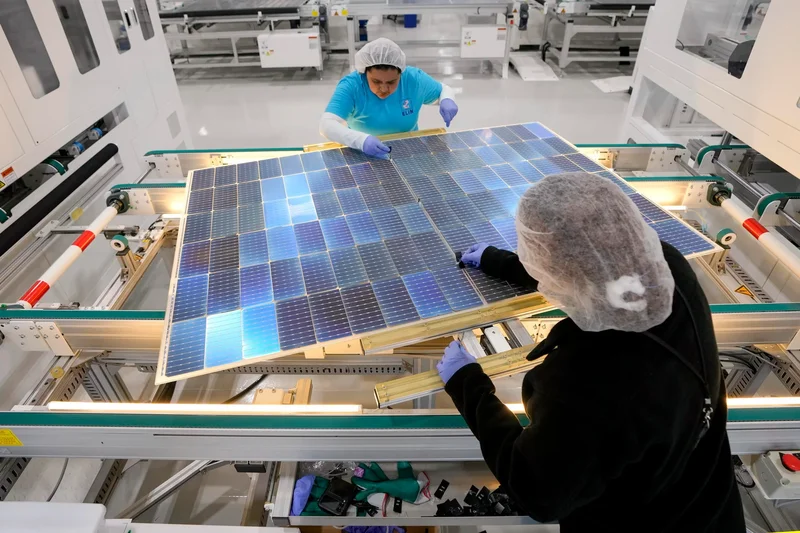
On August 7, the Trump administration put new tariffs on the raw materials that go into solar panels and set a price floor: imported panels can't sell for less than 38 cents a watt, plus a 15% tax on top, starting December 4. The White House's reasoning is national security: it says the U.S. relies almost entirely on other countries for that material, and wants it built here instead.
That points to the real question: if panels are cheap, they roll out faster. So does the U.S. actually need to make its own solar panels, or is it better off just buying them wherever they're cheapest? Developers focus on getting ahead of higher prices before they hit. My interest is broader: what this means for investors, policymakers and anyone trying to guess where electricity prices are headed.
At its core, this isn't just a domestic policy debate; it's a high-stakes geopolitical trade-off. Does the U.S. treat solar hardware as an ultra-cheap commodity to power the grid as fast as possible, or as critical infrastructure that cannot be left vulnerable to foreign weaponized supply chains?
"As far as the overall market, tariffs hurt the market—they reduce demand," Aaron Hall, president of Anza Renewables, told me. "That's a higher price of energy compared to oil and gas, and so you buy less solar. That's definitely happening with these tariffs."
That tension—between propping up domestic manufacturing and keeping solar cheap enough to matter—is the real story, and the numbers show why. Module prices fell from 40 to 50 cents a watt in 2022 to roughly 28 cents a watt by early 2024, and have stayed near that low for more than two years, according to Anza. Analysts expect the tax to push module costs up 10 to 14 cents a watt in December, adding $4 to $5 per megawatt-hour to what developers charge utilities.
That cost increase lands at an inconvenient moment for an industry that's already the biggest driver of new U.S. power capacity. Solar supplied about 8.5% of all U.S. electricity in 2025, and solar generation grew 27% year over year — enough to cover 61% of the total growth in the country's electricity demand that year, according to power-market tracker Ember.
The Energy Information Administration expects developers to bring on a record 43.4 gigawatts of new utility-scale solar in 2026, or 51% of all new generating capacity added this year. That’s more than gas, wind and battery storage combined. Solar isn't marginal anymore; it's the fastest way to add the massive volume of power data centers are demanding. Pricier inputs mean pricier power.
Locking In Today's Prices
Developers aren't waiting for a domestic supply chain to catch up. They're racing to lock in today's cheap, imported modules before the new price floor arrives.
“Electricity demand continues to grow rapidly, driven by data centers, electrification, EVs and economic growth,” Allon Raveh, CEO of Nofar USA/BlueSky Utility, told me in an email. "Delaying projects only increases the risk of supply shortages and higher costs, making continued development essential despite policy uncertainty."
Thomas Leahy, president of Nadara North America, made a similar point with me about why his company keeps building through the uncertainty rather than pausing for it: state renewable mandates and corporate sustainability commitments "don't depend on where federal policy lands. The demand is there now, and if we wait for certainty before building, we fail to meet it."
To be sure, the case for building solar's supply chain here isn't purely political theater. The administration's own justification—that the country has almost no domestic capacity for the raw material and half-finished parts that go into a panel—is accurate. Years of cheap, tariff-dodging imports, routed through Southeast Asia and eventually Africa, made it unprofitable to build that capacity here.
The underlying leverage is the real geopolitical fear. Beijing currently controls 90% of global solar ingot and wafer capacity—the foundational raw materials that go into solar cells, of which the U.S. has almost no capacity. Relying on overseas suppliers for finished panels is an economic gamble; relying on them for raw silicon inputs means a strategic rival holds a structural chokepoint over the energy hardware that powers America's data centers and technological infrastructure.
Inflation Reduction Act incentives already worked: the U.S. now has 74.1 gigawatts of finished-panel assembly capacity, enough to supply the entire domestic market, and solar-cell manufacturing was reshored in 2024 for the first time since 2019. There's a national-security case for not leaving a strategic energy technology entirely in the hands of overseas suppliers no matter how cheap.
But that argument falls apart on closer inspection: America already has more than enough factories to assemble finished panels for the entire domestic market. And it isn't starting from zero on raw materials: two U.S. plants, Hemlock Semiconductor in Michigan and Wacker Chemie in Tennessee, already refine silicon into solar-grade polysilicon, though together they supply only about 13 gigawatts' worth of panels a year, far short of the 43 gigawatts the country plans to install in 2026.
The Policy Contradiction
The real gap is the next step, turning that polysilicon into ingots and wafers. A Corning plant in Michigan, online since 2025, is essentially the country's first meaningful entrant. The new tariff raises import prices for everyone, including domestic assemblers who still depend on imported ingots and wafers.
But there is a major contradiction: the same administration betting on tariffs to build domestic solar manufacturing has also let the investment tax credit's 2027 phase-out stand, and narrowed the safe-harbor rules that gave manufacturers more time to plan. If Washington were serious about building solar panels in America, why cut the legs out from under the IRA credits that got manufacturers building here in the first place?
"We've seen tariffs come and go," Hall says. "If it's a suppressing tide, then it reduces all. You can't forget about that." Without a durable carrot to match the stick, a 15% duty is more likely to raise costs now than build a self-sufficient supply chain anytime soon.
Back to the simple economics: solar's growth this decade has been driven by price, not where the panel was made. Cheap imported panels are what let developers meet demand—from state mandates, corporate buyers and now data centers—faster than any other power source can. As Leahy put it, the need for electricity "is the one thing that does not move," no matter which administration or tariff regime is in charge at the moment.
The U.S. doesn't need a fully homegrown solar industry to hit its power goals; it needs abundant, affordable capacity. For now, importing panels still gets more solar built, faster, than waiting on a domestic supply chain that's still just getting started. Whether that changes depends on how fast the country's new material and component plants scale, and whether Washington gives manufacturers durable policy on both tariffs and credits. Until then, price will keep mattering more than where the panel was made.