Nearly three decades ago, we sat in an English literature class, encountering novels, movies and plays that, except for titles from the African Writers Series, seemed, at that age, determined to confuse rather than enlighten us. We were made to watch and analyse movies like the Repo Man, which made absolutely no sense for us who did matric at Gingqimboza and other township high schools. We easily identified with Ngugi wa Thiong'o and Micere Githae Mugo's The Trial of Dedan Kimathi because the context and content were relatable to the struggle against colonial oppression. Then came Luigi Pirandello’s Six Characters in Search of an Author, plunging us into a complete literary blackout.
Besides its intriguing title and chaotic storyline, Six Characters in Search of an Author was almost completely meaningless to most, if not all, of us. I do not recall any of my classmates buying a copy or borrowing one from the library to read it as required or to flaunt it, as our friend, Muvo Zama, would pick up random thick Chemistry books to capture the attention of beauties attracted to Nerds. I never knew the experiences of other Nerds, such as Bongani Ngqulunga and Vusi Gumede, in the same course, as they opted for a different stream that required them to read a tome called Ulysses, which was big enough to invite wonder. There was a consolation, though. We were told that we would be examined on two plays between Woza Albert, Six Characters in Search of an Author or The Trial of Dedan Kimathi. We avoided the Italian play. And so, Six Characters disappeared from our intellectual radar.
Years later, while browsing Oxfam’s second-hand bookshop, I came across a copy of Pirandello’s collection containing Six Characters and picked it up for one pound. Reading it out of curiosity, without academic pressure, was an altogether different experience. What had seemed chaotic began to make sense; absurdity had method and the confusion had a philosophical purpose. I was probably also old enough by then to understand that people can inhabit the same events and emerge from them carrying remarkably different truths. What follows, then, draws as much on that personal and belated reading of Pirandello as it does on anything the play states on its own terms.
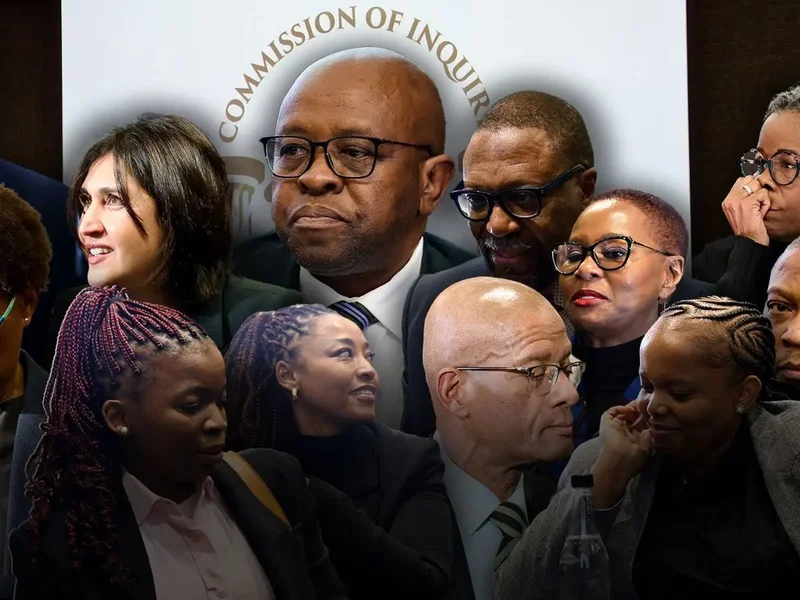
Like an actor rushing onto the stage before their cue, the book has suddenly resurfaced from the garage rubble. I swear it must have been my gods trying to rescue me from the anguish of following the Madlanga Judicial Commission of Inquiry into Criminality, Political Interference and Corruption in the Criminal Justice System. Of particular interest is the jaw-dropping testimony concerning the Investigating Directorate Against Corruption (IDAC) and its alleged targeting of Crime Intelligence.
The IDAC testimonies, despite remaining allegations until fully tested, have been extraordinary as a public spectacle. Each new witness seems to arrive with another piece of the story and, quite often, another understanding of what the story really is. In social media, South Africans have naturally dubbed IDAC revelations at the Madlanga Commission “drama”. They see the commission as a “movie” and a “stage”, complete with plot points, protagonists, antagonists, unexpected entrances, cliffhangers and twists that leave the audience eagerly anticipating the next sitting. The recurring meme is that “South Africa is a movie”. One can understand why. When a witness appears to have connected the dots, another arrives and rearranges them, manifesting ‘the decay of lying’, as Oscar Wilde called it.
That is where Six Characters in Search of an Author connects with the Madlanga Commission.
Pirandello’s play begins on an ordinary theatre stage where a company of actors is rehearsing another play. Into this unfinished rehearsal, six strangers walk in, announcing that they are characters in search of an author.
When the angry and astonished producer (as we have sometimes witnessed in Madlanga when people lie or display disregard for the law) demands to know what author they are looking for, the Father answers: “Any author, sir.” They carry, he insists, a painful drama that needs to be told.
The intriguing part of Pirandello's composition comes through when the Producer asks the obvious question: “And where’s the script?” The Father’s answer dispenses with the need for one at all. “The drama is in us; we are it! And we are desperate to get it out and put it on the stage. It’s a compulsion, a passion!” Isn’t that what we have witnessed at the commission, desperation, through all the nauseating testimonies?
The Madlanga Commission witnesses are not characters in the fictional sense, of course, and the allegations before the commission concern matters far too serious to be trivialised as entertainment and exam avoidance by the matriculants of Gingqimboza. The comparison I am making is literary rather than evidential and it draws as much on my own reading of Pirandello as on evidence.
Yet the likeness is hard to miss. The hearing at the Bridget Mabandla Justice College provides the stage. Witnesses, including those testifying about IDAC, bring their own versions of the script. Documents, affidavits, hyperbole, tears, messages and other evidence provide the props against which versions are tested. Cross-examination interrupts the narrative. Then another witness enters the fray carrying another script, equally convinced that theirs explains what actually happened.
Stealing the show from the earlier exposés about the Tshwane and Ekurhuleni municipalities, the IDAC-related testimony has provided some of the commission’s most compelling plot points. At its centre are allegations and counter-allegations about investigations involving Crime Intelligence, their origins, their purposes, the conduct of those involved and the larger question of whether what occurred amounted to legitimate criminal investigation, institutional contestation or something else altogether. What further fascinates is the confidence with which each witness inhabits their own version, even where documents or cross-examination appear to put parts of it under intense scrutiny.
This does not necessarily reduce the contest to a simple choice between liars and truth-tellers. Pirandello’s insight is subtler than that. His characters inhabit the same drama but experience it from different positions, each defending themselves against the others’ recriminations. In his own introduction to the play, Pirandello describes the resulting problem as the failure of mutual understanding through words, compounded by the multiple nature of human personality. At one point, the Stepdaughter cries, “The truth! Only the truth!”, certain that her version settles the matter. The Producer’s reply is the line that matters the most in this article’s context: “Well, I don’t deny this may well be the truth… and I understand, I understand how horrifying all this must have been for you but I urge you to see that it’s just not possible to put this stuff on the stage!”
Her ‘truth’ cannot simply monopolise the stage because there are other characters, each carrying an inner life and an account that must somehow be accommodated. This is not very far from the problem in this commission of inquiry. What a witness says always depends on where they were standing. A witness tells what they saw, understood, believed or did. Another witness may sincerely understand the same sequence of events differently. Neither conviction nor dramatic force settles the matter. In the end, as Justice Mbuyiseli Madlanga has stated, the commission must decide what the evidence allows it to find.
Turning to us, the audience, we draw conclusions about the IDAC rot as the movie unfolds, noting that each day’s testimony adds spice to the Madlanga plot. A revelation appears to resolve yesterday’s mystery, only for cross-examination to complicate it. An unexpected document or damning WhatsApp exchange appears.
A new name enters the story, perhaps destined to become a witness later. An allegation is disputed, sometimes even when the evidence looks, at least to the watching public, hard to explain away. They either concede or lie under oath. Someone previously on the margins of the story suddenly moves towards its centre, as we saw recently with one IDAC prosecutor, a witness whom the public expected to provide answers but who instead produced more questions. The day’s sitting adjourns at the point where every good dramatist would place the interval.
Pirandello understood the seduction of this perfectly. His Producer eventually becomes absorbed by the Characters’ competing stories and wants to transform them into a coherent production. But he runs into the same problem any storyteller does: the need to take the facts and shape and squeeze them into a plot that holds together.
That is where the comparison must end because Justice Madlanga is not a playwright and the commission is not in the business of manufacturing a satisfying plot. Its Terms of Reference provide the framework for questions to be asked, including serious allegations concerning criminal infiltration, political interference and the integrity of parts of the criminal justice system. The Terms of Reference do not hand the Madlanga Commission a ready-made story; it must build its findings from what survives the far less entertaining work of evidence, corroboration and cross-examination.
This difference between Six Characters and the Madlanga Commission matters because drama tends to favour the best story, while law and public inquiry must favour the one that the evidence can carry. Pirandello’s Producer can select, rearrange and compress scenes and acts. A commission cannot make inconvenient evidence disappear merely because it ruins the plot, which is why the commissioners have stressed that their questioning of IDAC's motive against the police top brass does not exonerate the latter from any possible wrongdoing. Neither can the audience’s favourite character determine the ending. In fact, whilst the memes call the commission drama, its rubric runs counter to drama; it must resist the pull of personality, performance, revelation and cliffhanger until the evidence can corroborate a conclusion.
Pirandello leaves us with an even more intriguing question about authorship. His six characters arrive, searching for an author because they possess a drama but no one can give it its final form. At the Madlanga Commission, the problem appears inverted. There is no shortage of prospective authors, from Nhlanhla Mkhwanazi, Brian Mogotsi and Andrea Johnson.
Every witness arrives, metaphorically speaking, carrying a version of the script and believing that version to be true. The commission has to work out which parts of these overlapping scripts the evidence supports, which parts contradict one another and whether, taken together, they add up to a larger institutional story.
In terms of IDAC vs Crime Intelligence, the real question is not only what happened but who was behind it, for what reason and towards what end, if what is alleged holds up. Here Pirandello’s question becomes almost literal: was there an author at all or has the audience gone looking for a single hand behind events that several hands, each working from a different script, may have shaped? The temptation of the audience is to name the author before the play has finished. The commission has to do the opposite.
Perhaps, then, South Africans are right that the Madlanga Commission has become a drama, although not quite in the way the memes suggest. Its fascination does not lie simply in colourful witnesses, astonishing allegations or daily cliffhangers. It lies in watching competing versions of reality colliding before our eyes while knowing that, somewhere beyond the performance, evidence must eventually separate what can be established from what is merely alleged.Pirandello’s character, Father, puts his characters’ condition more starkly than anyone else could. “What other reality could we have?” he asks the Producer. “What for you is an illusion, that has got to be created, for us is our only reality.” More than a century later, on an altogether different stage and under circumstances Pirandello could never have imagined, that dilemma feels strangely familiar.
South Africa may indeed be a movie. But movies usually have an author who already knows how the story ends. At the Madlanga Commission, everyone appears to know the story, everyone seems certain of their part in it and everyone has a version of who wrote the script. The commission’s task is altogether less theatrical; it seeks to discover whether there was an author of it all.
Busani Ngcaweni is the director of the Centre for Public Policy and African Studies at the University of Johannesburg.