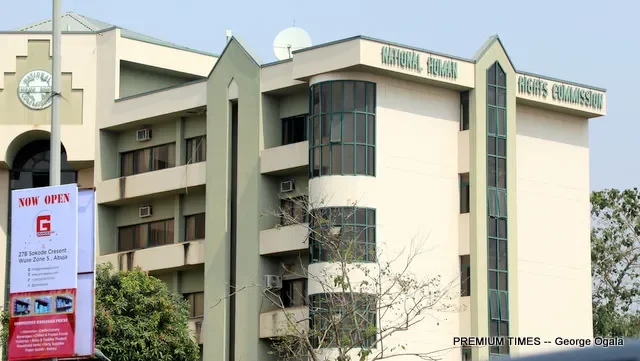
The National Human Rights Commission (NHRC) on Wednesday called for the suspension and arrest of the senator representing Osun East Senatorial District, Francis Fadahunsi, for issuing death threats to members of the Accord Party found in Ilesa ahead of Saturday’s Osun State governorship election.
“The Senate leadership is hereby called upon to suspend Senator Fadahunsi immediately pending conclusive investigation by the police,” the Executive Secretary, Tony Ojukwu, said in a statement.
“The Police and DSS must also arrest, investigate, and prosecute him now. We cannot wait until blood is spilt in Osun before we act. Prevention is the duty of the state, and the leadership of the NASS is part of the state.”
Fadahunsi’s threat
On Tuesday, Mr Fadahunsi, speaking in the Yoruba language, threatened members of the Accord Party in a viral video.
| | |
|---|
Addressing supporters at the palace of the Owa Obokun of Ijesaland, the All Progressives Congress (APC) senator condemned the alleged persistent killings of APC members in the area. He attributed the killings to members of the Accord Party.
Mr Fadahunsi said, “The cap they wear – it is a Yellow Fever cap, it is the cap of an animal,” referring to the Accord Party’s yellow brand.
He continued, “It is an animal that kills. Have you ever heard that APC killed anyone? Are those being killed not your people?
“So, we have come to tell you, up till the day of the election, if we see them, it is killing.”
The NHRC also referred to other remarks attributed to the senator.
“From now on, whenever you see Accord members, kill them. I authorise you to kill them. They have wives and children too. This is a federal government election. On election day, even if they come with voter cards, we won’t allow them to vote,” Mr Fadahunsi was quoted as saying.
However, Mr Fadahunsi subsequently walked back his statement, saying he did not literally called for the killing of the rival Accord Party members.
He said he rather made a call to “supporters to overwhelmingly reject the Accord Party at the ballot box through lawful, peaceful and democratic means during the August 15 governorship election.”
In the statement refuting the narratives about the senator’s remarks, his media office appealed to members of the public “not to misinterpret or deliberately distort the Senator’s comments, as they were clearly intended to encourage electoral victory through the power of the ballot and not through violence.”
But the NHRC insisted on Wednesday that the senator’s controversial remarks were an incitement to murder, electoral violence, and voter intimidation.
Mr Ojukwu stressed that such cannot be tolerated and called on law enforcement officers to act.
“This is not politics. This is a licence to kill. A public officer who tells citizens to murder other citizens because of party affiliation must not be allowed to remain in office for one more day,” Mr Ojukwu said.
Police invite senator
The police have invited the senator for interrogation over his remarks.
According to The Cable, the invitation, dated 11 August (Wednesday) and signed by Samuel Erale Etaifo, the Commissioner of Police overseeing the Osun State election, said the police required Mr Fadahunsi to clarify the circumstances surrounding the statement, which it described as potentially “threatening, inciting and intimidating.”
“The invitation is premised on information in possession of the Nigeria Police alleging that during your address at the aforementioned programme, you made statements considered to be threatening, inciting and intimidating in nature, and the statement has already been in circulation on various electronic and social media platforms,” the statement reads.
Need for urgent investigation
The NHRC noted on Wednesday that Mr Fadahunsi’s threat in the viral video was too weighty and needed urgent investigation. It also demanded a desist from all harmful and inciting statements ahead of elections.
This latest incident adds to the growing security concern surrounding the Osun State governorship election slated for 15 August.
Concerns
A report by Kimpact Development Initiative (KDI), a pro-democracy and electoral reforms advocacy organisation, said on Monday that no fewer than 73 election-related violent incidents resulting in 29 deaths have been recorded in the build-up to the 15 August governorship election in the state.
Amnesty International also noted that it had received reports of violence, arrests of Osun government officials and alleged plans to “influence the elections.”
Nigerian singer David “Davido” Adeleke also appealed to US President Donald Trump and the international community to closely monitor the forthcoming Osun State governorship election.
Amnesty International also called on security agencies and the Nigerian government at all levels to be neutral and protect the rights of the Osun State people to vote freely in Saturday’s governorship election.
For months, Governor Ademola Adeleke, who is seeking a second term in office, and his party, the Accord Party, have questioned the neutrality of federal institutions, particularly the police command in the state, ahead of Saturday’s election.
Among Mr Adeleke’s main challenger is Bola Oyebamiji, the candidate of the All Progressives Congress (APC), the party in control of the federal government.
Concerns about the neutrality of the police and key federal agencies have intensified in the past weeks following the controversial arrest of the Secretary to the Government of Osun State, Teslim Igbalaye, over unsubstantiated vote-buying allegations.
Barely a week after Mr Igbalaye’s arrest, the Economic and Financial Crimes Commission (EFCC) froze three bank accounts of the Osun State Government in what it said was necessary to stop a fraudulent diversion of the funds belonging to the state.
President Bola Tinubu, who also belongs to the APC, which is fielding a frontline candidate in the forthcoming Osun election, said he was embarrassed by the timing of the steps taken by EFCC and directed the commission to immediately take steps to lift the freeze order on the state’s bank accounts.