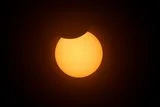
A total solar eclipse is always a spectacular event. At the point of totality, the moon covers the sun, causing a period of temporary darkness with just the sun’s corona peeking through. It is perhaps no wonder that they have been a source of awe and fear for millennia.
Still, some eclipses are particularly noteworthy for their duration, their historical significance, or their contribution to science. As the Aug. 12, 2026 solar eclipse takes place, we can reflect on the most extraordinary solar eclipses in history.
Read More: The 2026 Total Solar Eclipse Is Here — How and Where to See It, and Why Totality Is a Rare Event
1. 3340 B.C.E., Ireland: The Oldest Eclipse On Record (Maybe)
Thanks to modern-day technology, astronomers can accurately predict eclipses far into the future and determine with high precision the timings and movements of eclipses long in the past. What is rarer and more exciting is to see evidence of a historic eclipse from the people who saw it first-hand.
There is some debate over the oldest record of an eclipse. Some point to a collection of ancient rock carvings in County Meath, Ireland, which are said to document an eclipse that occurred in 3340 B.C.E. in a series of overlapping circles. However, the true meaning of the petroglyphs, found at the Loughcrew Megalithic Monument, continues to be contested.
In contrast, a clay tablet discovered in the remains of Ugarit, an ancient city in modern-day Syria, provided stronger evidence of a solar eclipse. The date of the eclipse was originally pegged to May 3, 1375 B.C.E., though later historical dating and a reference to Mars’ visibility have led to a re-evaluation, and most now believe it took place in 1223 B.C.E, according to the National Science Foundation.
According to NASA, the tablets describe the eclipse poetically: “On the day of the new moon, in the month of Hiyar, the Sun was put to shame, and went down in the daytime, with Mars in attendance.”
2. 743 B.C.E., Central Africa: The Longest Eclipse
The most impressive moment of a solar eclipse is the moment of totality, but this moment can range quite significantly, from a few seconds to several minutes. According to NASA, the longest solar eclipse of the last 6,000 years took place approximately 3,500 years ago and passed through parts of Central Africa. During the eclipse of June 15, 743 B.C.E., totality lasted for a full 7 minutes and 28 seconds.
However, this record is set to be literally eclipsed on July 16, 2186 C.E., when totality will last 7 minutes and 29 seconds. That will make it the longest eclipse to take place between 4000 B.C.E. and 8000 C.E., according to NASA’s calculations.
In contrast, the world’s shortest eclipse – which took place on Feb 3, 919 C.E. lasted a measly 9 seconds.
3. 1851, Prussia: The First Total Eclipse Ever Photographed
No doubt there will be hundreds if not thousands of photos of this year’s eclipse taken from different locations and stages. But historically speaking, it was not that long ago that a total eclipse was captured on camera for the first time.
The photograph was taken on July 28, 1851 C.E. by Johann Julius Friedrich Berkowski at the Royal Observatory in Königsberg, Prussia, in what is today Kaliningrad, Russia.
4. 1919, Brazil and Principe: The Eclipse That Helped Prove Einstein’s Theory Of Relativity
Some eclipses are extraordinary not because of their appearance, but because of their scientific significance. One of those is the 1919 C.E. eclipse, which took place on May 29 and helped to prove Einstein’s theory of relativity.
Albert Einstein had devised the theory in 1915, stating that gravity is the warping of time and space. He had already completed the first of three tests to prove the theory, showing it explained an anomaly in Mercury’s orbit. The eclipse was the second, demonstrating how the gravity of massive objects like the sun can bend light.
With data collected in Sobral, Brazil, and the African island of Principe during the eclipse, astronomers were able to show the light of distant stars curved as they passed the sun, as predicted. According to a paper published in The Royal Society, it led to the replacement of Newton’s theory of gravity with Einstein’s theory of general relativity in November of that year. Scientists later completed the third of the three tests in the 1960s.
Read More: 2,700-Year-Old Total Solar Eclipse Observations Give Insight to Our Ancient Solar System
5. 2024: The Most Recent Total Eclipse Seen From The U.S.
The last time the U.S. experienced totality was on April 8, 2024. The eclipse entered the country from Mexico, before passing through several states, including Texas, Oklahoma, Arkansas, Missouri, Ohio, Pennsylvania, New York, Vermont, New Hampshire, and Maine. It then continued into Canada.
The last total eclipse visible from North America took place just seven years prior, in 2017. But the U.S. will have to wait two decades for the next one, which is due in 2044 and will be visible from just two states: Montana and North Dakota, according to NASA.
Read More: A Total Solar Eclipse and the Perseids Meteor Shower Will Share the Sky in August 2026
Article Sources
Our writers at Discovermagazine.com use peer-reviewed studies and high-quality sources for our articles, and our editors review for scientific accuracy and editorial standards. Review the sources used below for this article:
- This article references information from NASA: History of Eclipses
- This article references information from NASA: Eclipses: Frequently Asked Questions
- This article references information from NASA: NASA Eclipse Website
- This article references information from NASA: 2024 Total Eclipse: Where and When
- This article references information from a study published in The Royal Society: The 1919 eclipse results that verified general relativity and their later detractors: a story re-told
- This article references information from the NSF: Solar Physics Historical Timeline (1223 BC - 200 BC)