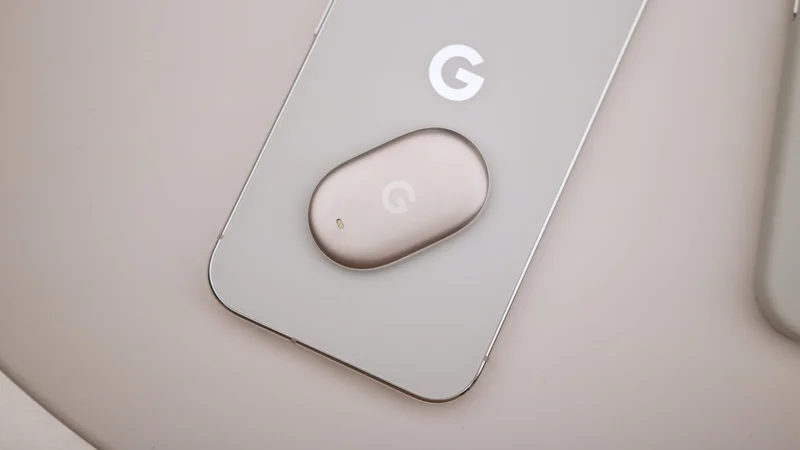
Google's new Pixel Tag is the AirTag rival Android users have been waiting for
Aug 12, 2026 — 10:00 AM ET
- Google’s Pixel Tag is finally here, bringing a first-party AirTag rival to Pixel owners with Android Find Hub integration and an oblong design.
- UWB-powered Precision Finding is the big draw, offering directional arrows for accurately locating lost items.
- The Pixel Tag costs $29, and $99 for a four-pack, but won’t hit shelves until November 11.
Google has finally taken the wraps off the Pixel 11 series, but the phones weren’t the only interesting thing to come out of the Made by Google event. After years of leaving Pixel owners to shop elsewhere for a Bluetooth tracker, Google finally has one of its own: the Pixel Tag. And frankly, it’s about time. The Pixel Tag is essentially Google’s answer to the AirTag, built to work with Android’s Find Hub network. That alone makes it an interesting addition to the Pixel family.
As for the design, the company has given its tracker a very different personality. Rather than going circular like the AirTag or adopting a squarish shape used by plenty of other trackers, the Pixel Tag has an oblong design. There’s just one slightly baffling problem: it doesn’t have a built-in hole for attaching it to anything. That’s a strange decision for a gadget designed almost entirely around being attached to things. So, if you want one hanging from your keys, you’ll need a separate holder or key ring. Buying an accessory for your accessory isn’t exactly the frictionless experience you’d hope for.
Get past that peculiarity, though, and the Pixel Tag starts sounding much more interesting. It works with compatible Android devices running Android 9.0 or newer with Bluetooth 6.0 or later. More importantly, Google isn’t relying solely on Bluetooth to help you find something nearby. The Pixel Tag supports Ultra Wideband (UWB) for Precision Finding, which could make those frantic searches considerably less frustrating.
For instance, if you lose your keys, knowing they’re nearby only gets you so far when nearby could mean under the couch, inside your jeans, or behind a cushion. Precision Finding can instead give you directional guidance, including arrows that point you toward the Tag. Rather than playing a game of hot-or-cold with Bluetooth, your phone can actually help lead you to what you’re looking for. That’s the feature I really wanted Google to include, and thankfully, it has.
There’s an accelerometer inside the Pixel Tag as well, allowing it to detect when the item it’s attached to starts or stops moving. That information can be used for motion alerts on a connected phone, adding another layer of awareness.
There are some neat ecosystem tricks, too. You can use a compatible Pixel Watch or Pixel Buds to locate and ring your Pixel Tag, so finding your keys doesn’t always have to begin with pulling your phone out. If you’re already wearing your watch while rushing out the door, being able to make the tracker chirp from your wrist could save a few frantic minutes.
Additionally, keeping it running shouldn’t require much attention. Much like Apple’s AirTag, the Pixel Tag uses a replaceable CR2032 coin-cell battery that can last for more than a year. Once it eventually runs out, you can pop in a fresh battery and carry on.
The Pixel Tag costs $29 for one or $99 for a four-pack, putting it right in AirTag territory. There is a catch, though: you won’t be able to buy one until November 11. That’s a surprisingly long wait, especially considering Pixel owners have already been waiting years for Google to make one in the first place.
Of course, we’ll only know how good the Pixel Tag really is once we start using it. AirTags have had years to prove their worth, whether that’s finding keys buried somewhere or keeping tabs on your luggage. Google is arriving very late to that party, but at least it doesn’t seem to be showing up empty-handed. So, if Find Hub and Precision Finding deliver when something actually goes missing, Apple may finally have a serious AirTag rival on its hands.