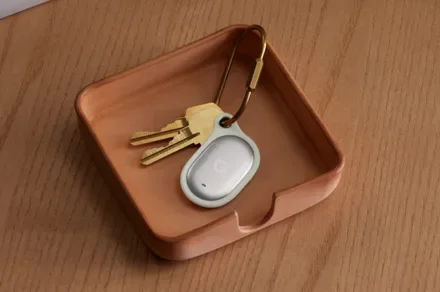
I’ll admit, tile-style trackers rarely excite me, primarily because most just copy the AirTag and call it a day. Google’s first swing at the category breaks that pattern a little.
The Pixel Tag launched today as the slimmest tracker on the market, backed by a Bluetooth trick neither Apple nor Samsung currently offers.
So what’s actually new about the Pixel Tag?
Shaped like a smooth, elongated capsule rather than a coin, the Pixel Tag measures 46.1mm by 28mm and just 5.4mm thick. That thinness matters more than it sounds. Both the AirTag 2 and Galaxy SmartTag 2 are around 8mm thick.
So Google’s tag is roughly a third slimmer. In other words, it disappears into a wallet or passport sleeve instead of poking out. Thickness aside, the device is wrapped in a soft Fog-colored polycarbonate shell with a metal panel on the back stamped with Google’s G logo.
The bigger story, though, is its dual-tracking capability, headlined by Bluetooth Channel Sounding (which requires Android 16 and Bluetooth 6.0). Rather than guessing distance from signal strength, a method easily fooled by physical obstacles or body interference, Bluetooth 6.0 measures distance using radio phase shifts, unlocking a higher (sub-meter) accuracy.
What about battery life and durability?
This allows Android phones that lack a dedicated Ultra Wideband (UWB) chip but feature Bluetooth v6.0 to achieve precise close-range finding while making signal-spoofing and relay attacks significantly harder.
Google kept the rest of the specs close to the established Apple playbook. A user-swappable CR2032 coin cell powers the tag for over a year. Further, an IP67 rating protects it against dust and dunks in up to one meter of water for 30 minutes.
It ships exclusively in the Fog finish. The device is available to pre-order with the rest of the Pixel 11 lineup from August 12, 2026, while in-store availability begins August 20, 2026.