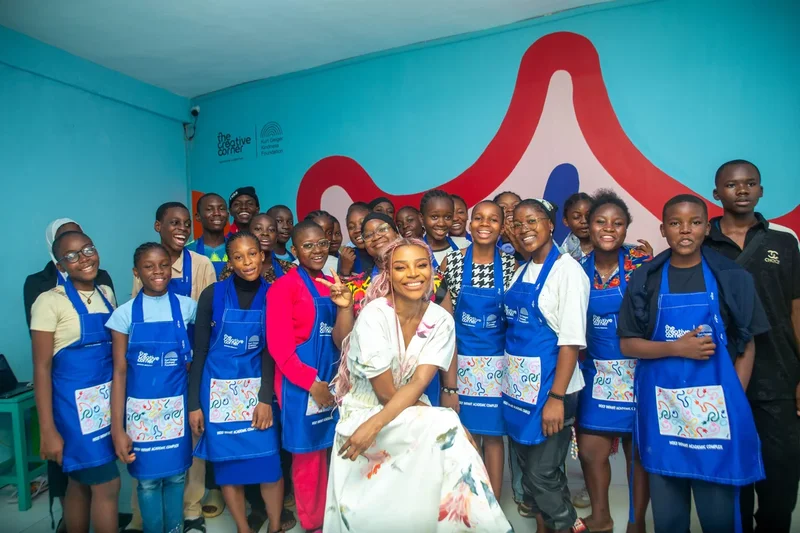
On Saturday mornings at Holy Infant School in Yaoundé, Cameroon, a classroom of teenagers gathers around raffia fibres, leather, weaving looms and shoemaking tools. These are not lessons in trend forecasting or digital design. Instead, students aged 13 to 17 learn where materials come from, how they are transformed by hand and why every stage of making matters.
A raffia handbag begins not with a finished product but with the raffia plant itself. Students prepare the fibres before weaving them into fabric. Shoes are taken apart and rebuilt piece by piece. Jewellery, printmaking and leatherwork are taught by local artisans whose knowledge has been passed through generations.
In many parts of the world, creativity isn't separated from everyday life. Skills are shared within communities, objects are repaired, materials are reused and young people grow up understanding how things are made. This isn't sustainability as a trend, it's a response to scarcity and an understanding of value.
For an industry searching for technical solutions to the climate crisis through recycled fibres and lower-carbon manufacturing, perhaps one of fashion's most overlooked climate solutions has been sitting in communities all along, passing creative knowledge from one generation to the next.
The Creative Corner is the brainchild of British-Cameroonian creative consultant Juliette Foxx, who returned to Cameroon in 2023 for the first time since leaving at the age of 12.
"I felt like I needed to put my foot on Cameroon soil," she says. "I missed it. It's always my favourite place in the world."
Visiting Holy Infant School, built by her father in 1994, she found it had grown from just eight pupils to more than 3,000. As she walked through the classrooms, one question kept coming back.
"I love what you do. I love fashion too. How can I get into fashion?"
"In London," Foxx explains, "that's a question I've heard a lot throughout my career. And I have a great answer for it, there's a clear way if you want to get into fashion. But when I was at the school with all these young people asking me, I was looking at them, I don't think you can."
The realisation stayed with her.
"It made me feel really lucky, blessed, privileged, sad."
For the first time, she stopped thinking about her own career and began thinking about everyone in her home town.
"What have I done for all the other people that come from where I come from? I was so hell bent on making it, but I never stopped to think, what about other people?"
That moment became the foundation of The Creative Corner, built on one simple belief that creativity is everywhere, but opportunity is not.
Back in London, Foxx approached long-time collaborators Kurt Geiger after attending the graduation of the company's Business by Design programme, which supports young people entering the creative industries.
Neil Clifford, Kurt Geiger's CEO, spoke about taking the initiative beyond Britain.
"I was thinking, Cameroon is part of the world," Foxx recalls. "I spoke to Neil, I have an idea about doing something in Cameroon. Is that something you'd be interested in? He said yes on the spot. 'Let's do it.'"
The Creative Corner opened in June 2026.
"The first day they came in, they were so nervous," Foxx says. "We had Kurt Geiger pieces in the room.. The kids were saying, 'I don't understand how a shoe works.' I said, 'Don't worry. We'll take this entire shoe apart, then you'll put it back together and make yours.'"
"By the end of this," she told them, "you will be shoemakers."
While conversations around sustainable fashion often celebrate repair and upcycling, Foxx is careful not to romanticise the reality.
"It's important not to romanticise the whole repairing or remaking things," she says. "It doesn't come from trend. It comes from necessity.. When you have less resources. you have to repair, reuse, remaster, do whatever you can."
Britain, she believes, faces the opposite challenge.
"We're not lacking for anything. There's almost too much. When you have so much choice, it's so easy to just want all of the things.”
It's a perspective that speaks directly to fashion's climate challenge. Overconsumption isn't simply driven by poor choices but by abundance. When clothing is endlessly available, understanding the time, skill and materials behind each garment becomes increasingly rare.
Pascale Montaner, Executive Director of the Kurt Geiger Kindness Foundation, says the project offered an opportunity to adapt the Business by Design model to Cameroon while responding to local culture rather than imposing an external solution.
"When Juliette attended our Business by Design graduation event she immediately expressed her wish that a creative space like this existed in Cameroon," she says. "Together, we saw the potential to develop a similar initiative while adapting it to the local context of Yaoundé."
For Montaner, the project's greatest strength lies in preserving knowledge.
"What I find especially powerful is the emphasis on connection and the transmission of savoir-faire. Young people learn that their heritage and creative abilities have real value, while experienced artisans are recognised as teachers and mentors whose expertise can shape the next generation."
That exchange of knowledge is equally important to Foxx.
"It was really important to bring back what I've learned in the UK in a way that felt like it was helping without feeling preachy," she says. "We're not teaching anything new. We're going back to the local core skills that already exist and saying, here's how you can take it further, here's how you can think globally."