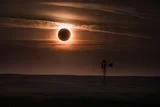
The next total solar eclipse, on Aug. 12, 2026, will darken skies across Spain, Portugal, and Iceland. It will also be visible as a partial eclipse across other parts of Europe.
Skywatchers gearing up for the celestial event might not be too fussed. After all, the 21st century will feature 224 solar eclipses; at least two every single year. But a total solar eclipse passing through your region of the world is a far rarer event, and not every single one is the same.
Read More: The 2026 Total Solar Eclipse Is Here — How and Where to See It, and Why Totality Is a Rare Event
The Key Types of Solar Eclipse
During a solar eclipse, the moon passes in between the sun and the Earth, blotting out our star’s light. This is only possible because, by a quirk of star-crossed fate, the sun is both 400 times larger than the moon and 400 times further away, meaning that the moon appears to be the same size in the sky as the sun. When the moon’s orbit is at the right angle, the two bodies overlap, and we see an eclipse.
But there are three types of solar eclipses, and only one of them produces dramatic darkening of the sky, according to NASA.
- The Annular Solar Eclipse:In an annular eclipse, the moon covers the sun at a point in the satellite’s orbit when it is at its furthest from Earth. This makes it look smaller in the sky, too small to block out the sun. In an annular eclipse, the sun’s rim is still visible. The sky remains bright, and the sun appears as a glowing ring.
- A Partial Solar Eclipse:During a partial eclipse, the moon doesn’t fully cover the sun, but instead takes a chunk out of it, turning it into a crescent in the sky. Once again, the sky doesn’t go dark. Remember that for annular and partial eclipses, looking directly at the sun is a big no-no, as the sun’s light will still damage your eyes. Instead, use special eclipse glasses to view these events.
- The Total Solar Eclipse:The most dramatic type of eclipse, a total eclipse, will only happen 68 times this century. During a total eclipse, the moon completely obscures the sun, turning day to night. Such an eclipse usually only happens on a small path across the Earth’s surface, which is usually only a few hundred miles wide. In a wider area outside this path, a partial eclipse is observed instead.
- The Hybrid Solar Eclipse:NASA also points out that there is a fourth type of eclipse known as a Hybrid Solar Eclipse. In some cases, because of the Earth's curved surface, a solar eclipse can shift between a total and an annular eclipse as the moon's shadow drifts across our planet.
It’s still sensible to have eclipse glasses on hand during a total eclipse. NASA states that it is safe to view the sun during totality, when the moon fully obscures it. Remember that this period is likely to last only a few minutes, so you’ll still need eclipse glasses for the rest of your eclipse viewing session.
Read More: 5 of the Longest, Shortest, and Most Important Solar Eclipses Ever Recorded
What Makes Each Eclipse Unique?
As each eclipse occurs when the moon, Earth, and sun are in slightly different positions relative to each other, the total eclipse’s path is different each time.
For example, the last total solar eclipse to occur, on April 8, 2024, was only visible if you were standing in a stretch of land about 124 miles wide that wound its way across North America.
The Dec. 26, 2057 total eclipse will only be visible if you happen to be standing in the center of Antarctica.
In short, each eclipse is unique, and the number of eclipses that a particular viewer may actually have a chance to see in their lifetime is far smaller than the 224 that will cross the Earth’s surface this century.
Read More: A Total Solar Eclipse and the Perseids Meteor Shower Will Share the Sky in August 2026
Article Sources
Our writers at Discovermagazine.com use peer-reviewed studies and high-quality sources for our articles, and our editors review for scientific accuracy and editorial standards. Review the sources used below for this article:
- This article references information from NASA: Types of Solar Eclipses
- This article references information from NASA: Eclipse Safety