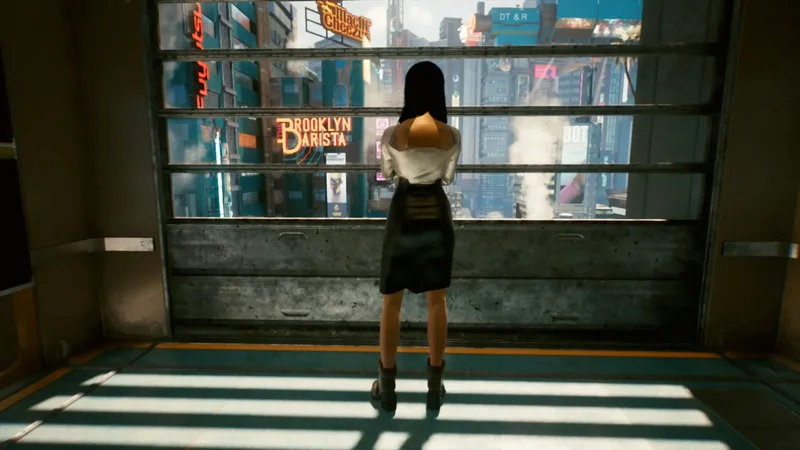
Night City won’t let go of you easily. Nor is Cyberpunk 2077 a game you’ll soon forget. The neon and chrome aesthetic, the pervading corporate rot, and V’s Keanu-Reeves-assisted identity crisis are more than enough to build a dystopia that sticks in your mind. Once you’ve left it, you might even miss it.
If you’re experiencing post-Cyberpunk 2077 blues, you’re in the right place. Its developer, CD Projekt Red, did not invent dystopian neon, and there are many titles out there that either show up in full cyberpunk gear or have a similar feel – including these eight games like Cyberpunk 2077. Some are closer to Night City than others. All are full of bad systems, worse people, and reasons to keep playing anyway.
1 Deus Ex: Mankind Divided
What you’ll like about it: It’s rife with corporate conspiracies, it grapples with augmentation ethics, and it’s got a body arguing with its owner, too.
Where to play: PC, PS4, Xbox One
In Deus Ex: Mankind Divided, set in the far-off future year 2029, Adam Jensen is thrown into a mission to stop a group of rogue arms dealers from selling weapons and augmentations. Unfortunately, that mission doesn’t end well, thanks to a band of murderous mercenaries in creepy gold masks who crash the deal and turn the whole thing into a firefight.
There’s the Illuminati. There’s also an underground hacker group. And there’s Prague, where you’ll spend your time ducking through subway stations, sneaking into corporate offices, and wondering which conspiracy is actually the conspiracy you need to focus on. You start the game in an abandoned Dubai luxury resort…during a sandstorm. As your character learns that terrorist groups are purposely performing violent acts to keep the human race divided and scared, you’ll need to decide: What, if anything, can Jensen do to keep society together when the augmented terrorists have very different plans?
2 Watch Dogs: Legion
What you’ll like about it: Here, you’ve got the control and paranoia, just not the RPG.
Where to play: PC, PS4, PS5, Xbox One, Xbox Series X
A mysterious group, Zero Day, has just framed the resistance hacker syndicate DedSec for lethal bombings in London. DedSec’s got to clear its name, then rebuild itself from the ground up. Unfortunately, London is now in an authoritarian surveillance state, and DedSec is public enemy number one. Time to go talk to your fellow citizens to see if you can free your city.
That concept of nameless citizens banding together to save London defines the game, including character creation: Instead of being Cyberpunk 2077’s V, a character with a defined spot in the story, Watch Dogs: Legion casts you as anyone. In both games, you’ll use hacking skills, stealth, and gunplay. But only in Watch Dogs: Legion can you recruit basically anybody on the street, then send your brand-new spy into combat with an invisible spy car.
3 The Witcher 3: Wild Hunt
What you’ll like about it: It’s got similar no-clean-choices bones, but in a fantasy skin.
Where to play: PC, PS4, PS5, Switch, Xbox One, Xbox Series X
The Witcher 3: Wild Hunt’s main story follows a mutant monster hunter, Geralt of Rivia, as he looks for his daughter, Ciri. She’s on the run because she has powers that the Wild Hunt, a ghostly army, desperately wants. Will Geralt find Ciri before the Wild Hunt does? Luckily, his ex, the sorceress Yennefer, is ready to help…
This clearly is not a genre match for Cyberpunk 2077, as a medieval fantasy instead of a futuristic dystopia. But both were created by the same developer, CD Projekt Red – and both feature dark stories and complex scheming behind the scenes. Do you prefer traveling by horse or motorcycle? Feel better wielding a firearm or sword? You don’t have to choose. Playing both is a great way to discover that CD Projekt Red considers “good choice” a deeply negotiable concept.
4 The Ascent
What you’ll like about it: Corporate collapse. And lots (and lots) of gunfights.
Where to play: PC, PS4, PS5, Xbox One, Xbox Series X
The Ascent Group is a mega-corporation that runs a city-sized tower on the planet Veles. You’re an indentured worker for them at the beginning of the game – sorry! – and are stuck doing maintenance work in the grimiest level of the tower, a place charmingly known as the deepStink. All your foreseeable future holds is rebooting the broken waste-management system…until the Ascent Group very suddenly goes bankrupt and the tower shuts down overnight. Why did it shut down? You don’t know, but you’ve got to find out, and you’ve got to do it fast, before the corporate anarchy surrounding you turns lethal.
If you played Cyberpunk 2077 for its futuristic city aesthetic and commentary on corporate monopolies, you’ll be right at home here. The Ascent does use a top-down isometric view, and it’s much tighter in scope when compared to Cyberpunk 2077’s massive open world, but you still get the satisfying experience of walking into a neon-lit neighborhood and immediately finding 700 people who want to shoot you.
5 Cloudpunk
What you’ll like about it: While there’s zero gunfire, you’ll never forget what this delivery route through an always-listening city feels like.
Where to play: PC, PS4, PS5, Switch, Xbox One, Xbox Series X
Do not miss a delivery, and never open the package. As a mail carrier for Cloudpunk, an illicit delivery service, these are the rules you live by. Your character, Rania, is just trying to eke out a living following these rules when on her very first night working for Cloudpunk, she gets assigned a series of increasingly shady tasks – and winds up finding out firsthand just how precarious her city’s infrastructure really is.
Cyberpunk 2077’s V may not have to deal with property seizure by DebtCorp, but both V and Rania do navigate dark, vertical sci-fi cities festering with high-tech corruption and bright holograms. There’s no fighting in Cloudpunk – again, you are just here to deliver packages, you cannot overstate that enough – but both games do have you asking questions like whether technology actually makes life better when the people controlling it have no interest in you.
6 Ghostwire: Tokyo
What you’ll like about it: It’s also got a broken city set in the near future…just something different lurking just underneath it.
Where to play: PC, PS5, Xbox Series X
When Ghostwire: Tokyo’s protagonist, Akito, is fatally hurt in a bike crash, he survives for one reason: A nearby displaced spectral detective, KK, revives and possesses him. This isn’t necessarily an arrangement to either’s liking, but they decide to make it work – and it’s a good thing they do. Shortly after this possession, an occultist triggers a thick, deadly fog that rolls across the city, turning people into piles of clothes and loose spirits. Thanks to KK’s intervention, Akito survives. The two entities team up to figure out what’s happened – and save Akito’s sister Mari from becoming fuel for more of the occultist’s nefarious plans.
Ghostwire: Tokyo is less a takedown of corporate greed and more about urban legends come to life. In both Cyberpunk 2077 and Ghostwire: Tokyo, you’ll explore dense, futuristic environments and use advanced tech or magic in combat. But in the latter, you get to use stealth ninja skills, too.
7 Observer
What you’ll like about it: The detective who’s jacking into corpses’ minds.
Where to play: PC, PS4, PS5, Switch, Xbox One, Xbox Series X
Observer begins when Daniel Lazarski, a neural detective (or “Observer”) gets a distress call from his estranged son. Daniel’s able to trace the call to an apartment, but when he gets there, the building goes into full lockdown.
The world of Observer has seen better days. A digital plague known as the nanophage has ravaged the globe. Post-war society follows a strict class system, and a cybernetically augmented police force investigates the constant violent crimes by hacking into people’s minds. Daniel, while trapped in his son’s apartment building, starts to investigate a murder so he can find his son. That leads him to jack into the minds of the building’s residents – including the dead – and experience their memories as surreal, horrifying hallucinations. Observer and Cyberpunk 2077 differ mechanically; Observer is a first-person psychological horror game, and Cyberpunk 2077 is an open-world RPG. But in both, you’ll be asked to consider just how much of yourself you can replace before you stop being yourself.
8 VA-11 HALL-A
What you’ll like about it: The ability to bartend your way through the apocalypse.
Where to play: PC, PS4, Switch
Jill Stingray – your player character – is an empathetic but cynical bartender at VA-11 HALL-A, a dive bar in Glitch City. The story here is intimate: You’re not trying to become a legend in Night City or save the world. Instead, you’re listening to the various hopes and tragedies of the regulars and strangers who take a seat at your bar.
The setting is familiar and bleak: In Glitch City, human life is a nightmare. Nanomachines control every facet of human life. But here, the visceral reality of the issues facing Jill and those she serves – they’re struggling to pay bills, they’re lonely, they’re dealing with heartbreak – draws you in, in a way that only a slice-of-life game can. This game is also a bartender sim. Jill influences the other characters’ outcomes by figuring out what they actually want to drink and mixing it for them…sometimes even when their order isn't quite what they asked for.
None of these games will give you Night City back – but they will give you other dystopian worlds to lose yourself in. Trade corporate conspiracies for occult ones, V for a bartender, Johnny Silverhand for a dead detective’s memories; then hack, shoot, sneak, deliver packages, or just pour someone a drink and listen to them complain about their life. After all, that’s what keeps drawing us back to the cyberpunk genre: Seeing what happens to ordinary people when the future gets very, very weird.