Residents of Osun State will go to the polls on Saturday to elect their governor for the next four years. The off-cycle election appears to be shaping up as one of the most competitive political contests in Nigeria since the 2023 general elections.
A total of 15 candidates have been cleared by the Independent National Electoral Commission (INEC). However, the APGA candidate, Adesina Adeyemi-Doro, announced he was withdrawing from the race to support the APC candidate. He is, however, still expected to be on the ballot.
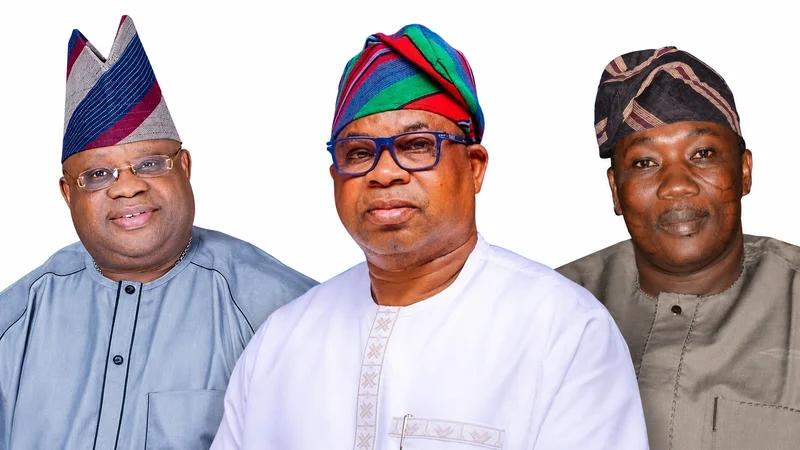
The three major contenders are Governor Ademola Adeleke of the Accord Party, who is seeking a second term in office; a former Commissioner for Finance, Bola Oyebamiji, of the All Progressives Congress (APC); and Najeem Salaam, a former speaker of the state House of Assembly, who is running on the ticket of the African Democratic Congress (ADC).
The others are Olanrewaju Farinloye (AA); Esan Olajide (AAC); Adeagbo Opawoye (ADP); Adewale Adebayo (APM); Clement Adesuyi (APP); Masilo Adeleke (BP); Taofeek Adeleke (NNPP); Saliu Oyelami (PRP); Ogunsakin Olalekan (YPP); and Adefemi Adesuyi (ZLP).
| | |
|---|
The PDP, Mr Adeleke’s former party, which ruled the state under former Governor Olagunsoye Oyinlola and on which platform Mr Adeleke was elected in 2022, is not fielding any candidate due to a leadership crisis at the national level. The governor dumped the party for Accord last December.
Issues shaping the poll
The race is intriguing, first, because Mr Adeleke’s party does not control the state’s local government structure, which is particularly important. After all, local governments are often regarded as the grassroots foundation of Nigerian politics. The leadership of the 30 local government areas in the state remain in dispute, although many people believe that they are currently controlled by the APC, Mr Oyebamiji’s party, which has chairpersons in all the councils.
After Mr Adeleke won the 2022 governorship election, the then outgoing governor, Gboyega Oyetola, conducted the local government elections, with his party, the APC, sweeping the poll. When the former assumed office, he dissolved the councils and held new elections, all of which were won by his own party, the PDP.
The local government dispute subsequently became the subject of a prolonged legal battle. After the courts declared the removal of the elected APC council chairpersons as illegal, and the Court of Appeal restrained the state government from removing them, the federal government withheld allocations to the councils. The Supreme Court later dismissed a suit filed by the state government over the withheld council allocations. The apex court ruled that only the local governments had the legal standing to bring such actions.
The judgments effectively restored the APC chairpersons to office, although the state government still refused to recognise them. The state government also argues that even if the council chairpersons were returned, their tenures have lapsed and they should not remain in office. The councils’ situation may impact Saturday’s polls.
Another factor that makes the race particularly interesting is that the faction of the transport union currently controlling motor parks across the state has sympathy for the APC. Politicians use the union members as enforcers during elections. Aside from that, some members of the National Union of Road Transport Workers (NURTW) will be responsible for moving election materials from Registration Area Centres (RACs) to polling units and, subsequently, to collation centres on election day.
The faction forcefully took control of the motor parks about two weeks ago, with the support of the national leadership of the transport union, displacing the faction recognised by the state government.
These two developments have altered the political calculations in Osun State ahead of the off-cycle poll. In previous elections, control of the local government structure was a critical factor. Successive governors have typically sought to deploy local government machinery during election periods.
With the APC controlling the local government structures and the NURTW faction playing a role in moving election materials on election day, Mr Adeleke’s party faces an unusual challenge.
Despite being the incumbent party, the Accord Party appears overwhelmed at the grassroots and is now forced to navigate an electoral environment in which key structures traditionally controlled by the party in power are largely outside its control.
Battle of the West
Another unusual feature of the election is that the three leading candidates are all from the Osun West Senatorial District. Mr Adeleke is from Ede, Mr Oyebamiji is from Ikire in Irewole Local Government Area, while Mr Salaam hails from Ejigbo.
The district has historically been a battleground in Osun governorship elections. It comprises 10 local government areas, namely Aiyedaade, Aiyedire, Ede North, Ede South, Egbedore, Ejigbo, Irewole, Isokan, Iwo and Ola-Oluwa, and has a substantial voting population.
The 2022 election illustrates its importance. Mr Adeleke won Osun West with 144,558 votes, representing 53.49 per cent of the valid votes cast in the district, while Mr Oyetola polled 116,860 votes, or 43.24 per cent. Mr Adeleke’s particularly strong performances in his home councils, Ede North and Ede South, contributed significantly to his advantage in the district.
The western district has not, however, been a permanent stronghold of any single party. In the 2014 election, Mr Aregbesola won several councils in Osun West, including Ede North, Ede South, Irewole, Egbedore, Iwo and Ejigbo, even though some councils in the district were won by his main challenger, Iyiola Omisore. Mr Aregbesola eventually won 22 of the state’s 30 local government areas and secured re-election.
The 2018 election further demonstrated how closely fought elections in the district and the state could be. Mr Adeleke initially emerged with a 353-vote advantage over Mr Oyetola statewide, scoring 254,698 votes against Mr Oyetola’s 254,345. Following the supplementary election, however, Mr Oyetola overtook Mr Adeleke and won by just 482 votes.
The presence of three major candidates from Osun West, therefore, creates a different electoral calculation. Rather than the district serving primarily as a two-way battleground, votes that might previously have consolidated behind one of the major candidates will now be divided among three candidates.
Who’s feeling the heat?
Although Mr Adeleke enters the race with the strongest advantage of incumbency, including greater visibility through capital projects and welfare initiatives, the reality is that he does not control some of the state structures that could have strengthened his chances of winning. These include the security apparatus, as well as the local government and transport union structures.
The governor had planned to mobilise personnel of Amotekun, the state-owned security outfit, to monitor the election in collaboration with the police, the Nigeria Security and Civil Defence Corps (NSCDC) and other security agencies. The police have rejected that move and banned Amotekun and other such paramilitary outfits from election duty. The police have also deployed 15,000 officers for the election.
Mr Adeleke’s campaign organisation, popularly known as the Imole Campaign Council, has repeatedly accused the police in Osun State of intimidating and harassing its supporters. The police have denied the allegations.
Bamidele Sallam, a federal lawmaker and chairman of the media and publicity sub-committee of the campaign council, said more than 60 leaders and members of the governor’s party are currently in police detention.
The campaign spokesperson, Pelumi Olajengbesi, also alleged that the governor’s supporters were arrested without justification and transferred to the Force Headquarters in Abuja. On 3 August, the campaign council petitioned the National Human Rights Commission (NHRC), seeking the unconditional release of its supporters, who it said had been arrested and detained by the police.
The allegations escalated recently when the police raided the Osogbo residence of the Secretary to the State Government (SSG), Teslim Igbalaye, and arrested him alongside five others over alleged vote-buying.
The police said they recovered N4.8 million in cash, a Dynabook laptop, a photocopying machine, a printer, two voter cards and a voters’ register covering Wards 1 to 15 in Osogbo Local Government Area.
Mr Igbalaye was later released after the state government and the state House of Assembly intervened.
Amid the allegations and counter-allegations, some residents believe the police are being influenced by individuals within the Presidency to frustrate Mr Adeleke’s administration. However, no independent evidence is presented in these accounts to substantiate the allegation of presidential interference.
Isaika Osuntogun, a commercial driver in Osogbo, said many of his passengers believed the APC was using federal power to wrest control of Osun State from the opposition.
“The APC is using federal power to victimise Ademola. They want to deploy every means to hijack the state from the opposition. Ademola has really tried for us in Osun compared to what the APC left. That is what many people are saying,” he said.
Fatimah Irewole, a secondary school teacher in the Ife area of the state, shared the same sentiment. “The pressure is too much on Governor Ademola Adeleke. I don’t like how the Presidency has been victimising him. This is democracy; every candidate should test their popularity not through victimising.”
Mr Adeleke’s strengths
Mr Adeleke has significant visibility in capital projects, particularly road infrastructure, across the state’s three senatorial districts. In agriculture and food security, his administration has expanded support for rural farming by providing agricultural inputs and encouraging farmers to increase production.
The administration has also maintained a relatively cordial relationship with civil servants by ensuring timely salary payments, improving career progression, and regularly paying outstanding pension arrears.
Civil servants constitute arguably Mr Adeleke’s strongest support base ahead of the election. Although there is no single official, publicly available figure for the number of civil servants in Osun State, government payroll estimates and state data generally put the active workforce and other public-sector employees at approximately 35,000. The governor may benefit from a bloc vote from the workers.
Mr Adeleke also retains strong support in Ede, his hometown, and across significant parts of the Osun West political bloc. His administration’s populist, accessible and media-friendly style continues to resonate with many voters, particularly young people and civil servants, who prefer it to the technocratic style associated with previous APC administrations.
The governor’s dancing at public events resonates with the people, though the elite sees him as unserious.
Another factor that could benefit Mr Adeleke is the fragmentation of opposition votes. If the ADC succeeds in its perceived spoiler role by taking votes from the APC, Mr Adeleke could emerge victorious without securing an overwhelming majority.
Despite these drawbacks, the governor, who recently defected from the PDP to Accord because of the leadership crisis in the former, says he will win.
“Forget about me losing this election, I am confident I will win,” he told Arise TV in an interview.
In another interview, he said, “I’m so confident I’m going to win. If I could defeat an incumbent and now that I’m the governor, within two years, it’s unprecedented what we have achieved. I’m so confident that nobody can beat us there.”
APC’s strengths and weaknesses
Mr Oyebamiji, popularly known as AMBO, resigned as the managing director and chief executive officer of the National Inland Waterways Authority to pursue his governorship ambition.
His candidacy benefits from several factors. First is the federal advantage associated with the APC at the national level. Osun is believed to be the ancestral home of President Bola Tinubu. Consequently, there appears to be desperation on the part of the Presidency and the APC to win the state at all costs to avoid humiliating the president.
Second is the campaign structure built over the years by the APC and Mr Oyetola, under whom Mr Oyebamiji served as Commissioner for Finance during his single term as governor. Third is his access to influential business and political networks within Osun State.
However, Mr Oyebamiji’s biggest challenge may ironically come from Osogbo, the state capital, because of his link with the minister.
Some political actors in Osogbo believe that while he was governor, Mr Oyetola, who is President Tinubu’s cousin, failed to identify with the state capital. One frequently referenced example is the controversy surrounding the proposed siting of an army barracks in Osogbo. There were reports that the project could have been relocated to Iragbiji, Mr Oyetola’s hometown, before Osogbo leaders intervened and insisted that it remained in the state capital.
The episode has contributed to lingering suspicions among some political stakeholders that Mr Oyetola was averse to developing the state capital.
There are also deeper cultural and emotional grievances against the Oyetola political tendency. Critics accuse him of maintaining a distant political style, unlike former governor Rauf Aregbesola, who cultivated strong grassroots loyalty through regular interactions with traders, artisans, drummers and informal community groups. Accounts of Mr Oyetola’s perceived reluctance to give money generously during public engagements have also continued to shape his image at the grassroots.
The APC is also still dealing with the unresolved fallout between Mr Oyetola and Mr Aregbesola. Some supporters believe the two should have reconciled much earlier, given the influence and respect Mr Aregbesola continues to command among ordinary party loyalists.
Mr Oyebamiji, meanwhile, will need to demonstrate that his Ikire roots and the APC’s political structure can translate into votes across the wider district rather than only in his immediate base.
The former commissioner says he will win convincingly without rigging, as alleged by Mr Adeleke.
“Adeleke is already reading defeat on the wall. We have been to all the local governments, and we have entered into agreement with the people on inclusive government, and I am sure if the election holds today, I will win,” he said.
Mr Oyebamiji added, “Governor Adeleke is confused; that is why he is shouting about rigging. We are not like them in 2022 when they rigged the APC out through internal sabotage. This time, he should know that the people of Osun are the ones who will vote for APC and send him packing on August 15.
“My administration will put an end to lack of seriousness in government. We will make every kobo we invest in the development of Osun worth it and transform the lives of the people.”
The Aregbesola factor, Salaam’s gain
Mr Aregbesola remains one of the most influential political figures in Osun. He served two terms as governor and later served as Minister of Interior under the APC before defecting to the ADC, where he was appointed National Secretary of the faction led by former Senate President David Mark.
His supporters dominate several local political networks, especially among the youth and ward mobilisers.
If these loyalists fully align with the ADC, both Messrs Adeleke and Oyebamiji could lose significant votes in core progressive strongholds.
Still, Mr Oyebamiji’s camp retains support from important Osogbo stakeholders such as Olatunde Badmus, popularly known as Baba Twins, whose philanthropic reputation and influence among traditional rulers and federal appointees remain politically significant.
Mr Salaam, a former speaker of the state House of Assembly, may not enter the race as the outright favourite, but his candidacy remains unpredictable.
The ADC’s greatest strength lies in protest votes and anti-establishment sentiment. Many voters frustrated with both the Adeleke dynasty and the APC establishment may see Mr Salaam as a compromise candidate.
His strongest advantage is likely to come from the Aregbesola political machine. Such support would instantly transform the party from a fringe platform into a formidable statewide structure.
However, Mr Salaam, a doctoral degree holder, said some may vote for him because of the former governor, while others will not.
“I’m not Aregbesola’s man. Just because I know that people are myopic in their thinking, people think I do not know my worth. I can stand on my own, and I have been here since grassroots – local government, House of Assembly, speaker, I am not a dullard.
“I am proud to be with him, and I am not regretting it. With my level of exposure, I have a clear objective of what I want to do with my 10-point agenda. Some will vote for me because of Aregbesola. Some will not. People know me. They know my quality. On my own, I will be a man of myself,” he said.
The ADC may also benefit from younger voters, politically displaced APC members, and sections of Osogbo elites searching for a fresh political arrangement.
However, Mr Salaam faces serious obstacles. The ADC lacks the electoral infrastructure of the APC and the Adeleke political network. Its funding capacity may also be comparatively weaker. In addition, many voters may still perceive the election as essentially a contest between Mr Adeleke and the APC, while strategic voting could hurt the ADC if opposition voters fear splitting anti-incumbent votes.
Who has the best chance?
At the moment, Mr Adeleke appears to have a slight advantage. His incumbency, combined with the fragmentation of the opposition, remains a significant electoral asset. His populist image and strong statewide name recognition also give him an edge.
The governor could also benefit from tactical support in Osogbo. Osogbo and Olorunda Local Government Areas, both in Osun Central Senatorial District, have historically recorded some of the highest vote counts in the state, reflecting their large urban populations, concentration of civil servants, and significance as the state capital.
Osogbo and Olorunda could also prove crucial to the 2026 contest. The two local government areas have historically been important electoral strongholds for the APC, particularly during the Aregbesola administration.
In the 2014 governorship election, Mr Aregbesola polled 39,983 votes in Osogbo against Mr Omisore’s 11,513, while in Olorunda, he scored 26,551 votes against 8,483 for Mr Omisore. The two councils, therefore, gave the APC a combined margin of more than 46,000 votes.
Osogbo was also Mr Aregbesola’s highest-voting local government area in that election, underscoring the electoral importance of the state capital.
However, the historical pattern is not entirely fixed. The 2022 election showed that Mr Adeleke could make significant inroads into areas previously regarded as APC strongholds. This makes Osogbo and Olorunda particularly important in the current contest, as the APC seeks to reclaim its traditional advantage while the incumbent tries to consolidate the gains made in 2022.
For Mr Oyebamiji, a strong performance in the two councils could provide the APC with the kind of urban vote margin it has historically relied on. For Mr Adeleke, maintaining or improving on his 2022 performance there could compensate for any weakness elsewhere. With the election expected to be closely fought, even relatively modest changes in the voting pattern of Osogbo and Olorunda could have consequences for the statewide result.
Nevertheless, the APC could underperform in Osun Central if grievances against Mr Oyetola persist. Mr Oyebamiji’s chances will, therefore, depend largely on his ability to reconcile internal divisions within the party, rebuild its emotional connection with grassroots voters and prevent significant vote leakage to the ADC.