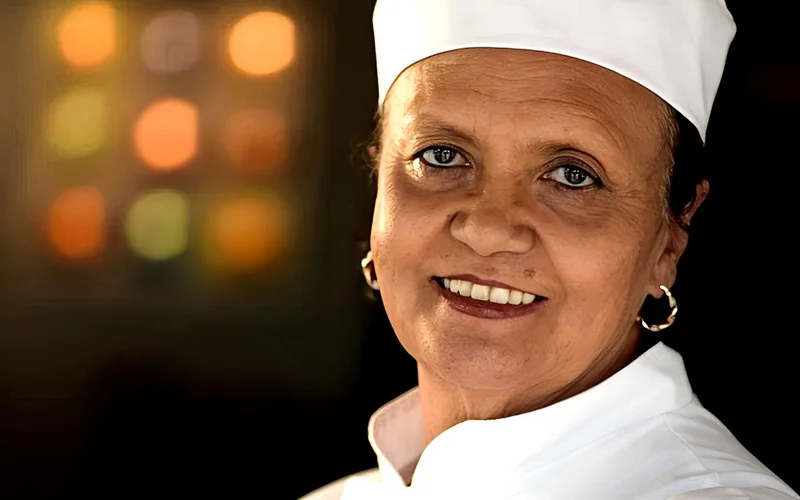
The Danes implied that her food was âpig foodâ and second class. Cass Abrahams proved them, and many others, wrong.
She was a woman of colour in a male-dominated food industry, in a segregated South Africa, where people like her had little cachet and were expected to remain in the background. Abrahams would have none of that, she stepped into the foreground and stayed there. For four decades, this self-taught cook championed Cape Malay cuisine until it could no longer be overlooked. She died in Cape Town on 8 August 2026.
Nelson Mandela walked past the head table and went straight to the kitchen. It was the early 1990s, not long after his release from Robben Island, and Cass Abrahams was standing over a pot of tomato bredie she had made for a dinner hosted by the businessman Raymond Ackerman for a group of Dutch guests.
The kitchen staff froze. Mandela wanted to thank them before he greeted anyone else in the room.
âThat took the staff by surprise,â Abrahams said. âWe were so excited, so touched.â
It was a story she told often, and it said something about how she saw her own work. Cooking was never just cooking. It was who got fed, who got credit, and who got left out of the record.
For four decades Abrahams pushed against that last one, moving between kitchens, classrooms, cookbooks and television screens to make sure Cape Muslim food had a written history and a named author. Cass Abrahams died on 8 August 2026 at Vincent Pallotti Hospital in Pinelands, Cape Town, at the age of 82.
Izak de Vries writes in an In Memoriam for LitNet, that she was born Cassandra Magnolia Dorothea Weimers in Gauteng on 3 April 1944. Her godfather was Yusuf Dadoo, chairperson of the Indian National Congress in the 1940s and a friend of the family.
Her motherâs family could be traced back to a German settler named Jegels, who had two wives. One was Zulu or Xhosa. The other, Hendrika Jegels, was Khoi, and she was Cassâ grandmother. Hendrika later had a brief affair with a Frenchman. He fathered Cassâ mother, Gwendoline, then vanished. She came from a masala of German, Khoi, African and French ancestry, and those ingredients caught fire in Cass.
To add more spice to the mix, Cassâ father was an Afrikaans teacher. For a while the family did well. They had a car, and her mother rubbed hand cream into the childrenâs hands and feet, telling them it would make them just as beautiful as she was. The Jegels family was even invited to the Communist Partyâs multiracial parties in the 1940s, the same parties Nelson Mandela sometimes attended.
Then her father lost his job, though Abrahams never learned why, and the family lost the house and the car with it, De Vriesâ account continues. They moved to a mud hut in Moroka township outside Soweto.
Her mother began brewing and selling illegal alcohol, since the law barred black people from buying it at shops or restaurants, and the police raided the house more than once. Her father eventually made friends in the police force, who tipped the family off before each raid.
Things turned again when a wealthy family, the Mias, offered her father a teaching post at the Waterfall Islamic Institute in Halfway House, near Midrand. The family moved into a brick house and her father bought what Abrahams remembered as a fancy long-nosed green Citroën.
When Cass was 11, De Vries says, a man of 43 asked her parents for permission to marry her under a traditional arrangement. Her parents sent her away instead, to St Vincent, a Catholic boarding school in Tongaat, and later to St Augustineâs High School in Parow. For her final school year she was moved again, to Sacred Heart High School in Cradock, now Nxuba. Then her father was shot dead under mysterious circumstances.
His death ended any plan she had of becoming a doctor. The nuns at Sacred Heart worried that their outspoken pupil might get into trouble if she stayed in SA, and pushed her instead toward the University of Pius XII in Basutoland, a Catholic institution now known as the University of Lesotho.
She won a scholarship and was happier there than she had been anywhere. There was no segregation on campus. Students ate with lecturers and even the rector, and argued through meals about politics and ideas.
âIt was the sixties, the era of the flower children,â she said, describing her years there. âI became a fully fledged hippie.â
She earned a Bachelor of Science degree, majoring in biology, then returned to SA to train as a teacher at the University of the Western Cape. The change in atmosphere was brutal. Women had to wear dresses and stockings, men had to wear ties, and a rector once called her into his office to complain about her clothes.
âMiss Weimers,â he said. âHow can you come to class dressed like this? In denims?â She bought a pipe and started smoking it on campus. When a lecturer summoned her mother to discuss her wardrobe, Abrahams arrived at class barefoot the next day in protest.
It was also at the University of the Western Cape, among classmates who included the future academic and activist Jakes Gerwel and the poet Adam Small, that she met Yusuf Abrahams. He pulled up next to her one afternoon while she was hitchhiking and asked where she was going, she told the journalist Ishay Govender in a 2019 interview for New Frame.
âWhere are you going?â she asked back. âAnywhere youâre going,â he said, and she got in.
âHe was very good looking, and I thought: âOoh, good genes. Heâs studying at the university as well so he is probably intelligent,â and that was it, I had made up my mind then,â she said.
Her mother was less impressed.
âThatâs Jowa,â she warned her daughter. âAnd heâs Muslim.â Jowa Abrahams was already known as a formidable rugby player, good enough that after apartheid ended the South African Rugby Union presented him, decades late, with the Springbok jacket that the colour bar had denied him as a young man.
The couple married in 1969 and Cass moved into the Abrahams family home in Wetton. She could not speak Afrikaans and could not cook, two failures the Cape Malay community she had married into noticed immediately. Jowaâs grandmother took pity on her and taught her the first dish of her married life, green bean bredie.
When Cass converted to Islam she needed a Muslim name and settled on Cashifa, meaning revealer, a word she chose because it sounded closest to her old nickname, Cassandra or Sandra. Her new family shortened it back to something familiar and started calling her Cass, and the name stuck for the rest of her life.
âI will never forget the day I first ate traditional Cape Muslim food,â she wrote later. âI could never have guessed that it would be Jowaâs Muslim culture that would begin my great love affair with food.â
For years, food stayed a private education rather than a public one. Abrahams taught science and biology for 17 years, at Trafalgar and Bridgetown among other schools, and doubled as an unofficial school psychologist after finishing a further degree in social science with honours in psychology.
She built teaching models so that blind pupils could learn anatomy by touch. Her husband was principal of Lavender Hill High School for many years and later headed public relations at Pentech.
During the political unrest of the 1970s and 1980s she was regularly called on to bail her own students out of police custody, and the strain eventually caught up with her.
âMy teaching suffered and one day I just snapped and couldnât do it any more,â she said.
She was 38 when she answered a newspaper advertisement for in-store promoters at Tastic Rice in 1983, she told Taste magazine in a 2016 interview. She left her two degrees off the application and told the company she had only a Grade seven education, certain that two degrees would count against her.
Tastic flew her to Johannesburg to meet its management anyway and offered her the post of home economist, wanting someone who represented the âcolouredâ community of the Western Cape. She had no training as a cook. She had grown up watching relatives in the kitchen and had spent more than a decade learning Cape Muslim dishes from her husbandâs family, and that was what she brought to the demonstrations.
Her white colleagues at Tastic had a vocabulary she did not, terms like julienne, sauté and brunoise picked up from French culinary training. Abrahams, holding two degrees she had not mentioned, felt out of place until the late restaurateur and mentor Peter Veldsman told her the knowledge she already carried was enough.
âWhat I can bring to the table is an education about the culture behind the cuisine,â she decided.
She travelled the country demonstrating bobotie, bredies and breyani, often on weekends, to church halls and to the Suid-Afrikaanse Vroue Landbou-Unie. White Afrikaners took to her immediately, a contradiction during apartheid if ever there was one.
Women who looked like Evita Bezuidenhout oohed and aahed over her, while their moustached husbands nodded in admiration. In time, she won the hearts of just about every corner of the country.
Her chicken-and-yoghurt curry became a demonstration favourite; shops that stocked enough chicken breasts, in her words, to feed the whole country, would sell out before noon. Working within a company that would not let a âcolouredâ woman appear in its advertising, she still used the demonstrations to explain customs that white South Africans knew nothing about, from burial rites to why a Muslim guest might quietly pack away a serviette after a meal, taking it as their own once the host had made niyyat, or intention, over the food.
Learning the recipes themselves had not been simple. Cape Muslim cooks measured nothing, and when Abrahams pressed relatives for exact quantities they would often leave an ingredient out, protecting a piece of the knowledge that gave them standing in the community.
âThey didnât know how we baptised our children or what the Qurâan was about, how we buried our dead,â she said of the wider misunderstanding she was working against. When she began writing her first cookbook, her publisher sat in her kitchen for three weeks, physically grabbing her hand each time she reached for a spice so she could measure out what Abrahams had only ever judged by eye.
That first book, published in 1995, appeared under the title Cass Abrahams Cooks Cape Malay: Food from Africa, according to Ishay Govender writing for New Frame, and became the first cookbook by a South African Muslim author to argue that Cape Malay food was African before it was anything else, shaped as much by the Khoekhoen people already living at the Cape as by the enslaved cooks brought from Java and beyond.
The literary scholar Gabeba Baderoon, in her book Regarding Muslims: From Slavery to Post-Apartheid, quoted in that same New Frame profile, wrote that Abrahamsâ contribution to South African food writing was to insist on that African character, rather than folding the cuisine into a purely Asian history.
The book made her, in the words of one Cape Town food group, close to a folk hero.
âHer cookbook was such a success that she joked that it became the most stolen cookbook in the Western Cape,â says Pamela McOnie, founder of the Cape Town Eats Group.
McOnie remembers the community gossip that greeted the newcomer decades earlier: âPoor Jowa, she does not know how to cook.â Abrahams, she says, turned that embarrassment into a research method, going door to door in what was then still called a âcolouredâ area, drinking tea with older women and coaxing out recipes one cup at a time.
âShe became a warrior fighting to keep the cuisine alive.â
By the time she opened her first restaurant, De Waterblommetjie, in the grounds of the Castle of Good Hope, Abrahams was already using the kitchen to correct the record on a bigger scale. She served Cape Muslim dishes alongside Xhosa food such as samp and beans, at a time when no one else in Cape Town was doing either.
A second restaurant followed at the Seidelberg Wine Estate in Paarl. Restaurant hours, six in the morning to as late as three the next, wore her down by her seventies, and she retired from that side of the business, though she kept teaching cooking classes from her home in Retreat almost to the end.
Television found her too, through the kykNET programme Cass se Kombuis, and after 1994 so did the world. With her first passport in hand she was sent as a culinary ambassador to France, the United States, Germany and Denmark, cooking bobotie, bredies and umngqusho, the samp and beans dish she liked to call diamonds and pearls, for audiences who had never tasted them.
In Denmark, she told the Daily Maverickâs Yolisa Qunta, a catering team supplied everything she asked for except pumpkin, which they told her was pig food, unfit for people. She went on Danish television and informed them about their culinary error.
âBefore long I was on TV in Denmark telling them how stupid they are for ignoring this vegetable,â she said, and made pumpkin soup, pumpkin fritters and pumpkin bredie until the country came round. âNow people eat pumpkin in Denmark, and that is the mark that I made.â
The passport itself was problematic, she told Qunta. Under apartheid Abrahams had been refused one, so when South African embassies abroad wanted someone to cook local dishes for visiting dignitaries, they sent a white academic, Renata Coetzee, who had written extensively about South African food history but could barely cook.
Coetzee came to Abrahamsâ kitchen to learn the dishes she would later serve overseas and take credit for.
âFor years I had been teaching white representatives how to make Cape Malay dishes that they would replicate for our embassies overseas and get all the credit for,â Abrahams said. âNow, it was my turn.â
She never made peace with the Chefs Association of South Africa, which she told Daily Maverick she had accused for decades of erasing indigenous food from the countryâs culinary image. She traced the associationâs roots to an apartheid-era government policy that imported European chefs, mostly from Britain, because Afrikaner men considered kitchen work beneath them, and the imported male chefs knew nothing of local food.
When the associationâs president told a radio interviewer that his favourite dish was apple strudel, Abrahams rang the station to complain.
âI stripped my moer,â she said. âI was so angry I was shaking.â The president brushed her off. âOh, thatâs just Cass again, she gets upset.â She did not stop being upset about it.
She was equally firm on smaller matters of taste. At the first South African People of Colour At The Table Conference in Cape Town, a gathering of chefs, producers and food writers of colour from across the industry, Abrahams declared flatly that no such dish existed as vegetarian breyani, then walked past a fellow diner eating with her hands and remarked approvingly on how civilised it looked next to cutlery, Qunta recalled in the Daily Maverick. She trusted her nose over any recipe.
âMy sense of smell,â she said. âI can smell if you left something out in one of my dishes, from outside. And I will tell you exactly what it is.â
Chef and cookbook writer Faldela Williams had already done important work in documenting and popularising Cape Malay cooking, including publishing The Cape Malay Cookbook in 1988. Cass Abrahams came later, and it would be overstating her role to suggest that she invented, defined or âcementedâ the cuisine.
Her contribution was different. She became a highly visible ambassador for Cape Malay cooking, taking it into spaces and audiences that had previously known little about it. Through her demonstrations, television appearances, international competitions and books, she helped move a cuisine that had largely remained within Cape Muslim homes into the wider South African culinary conversation.
That distinction matters. Cass did not create Cape Malay cuisine, nor was she the first to document it. What she did was give it a new public profile and make it accessible to people who might otherwise never have encountered it. Her influence was less about changing the food itself than about changing who was paying attention to it.
Politics ran through the family kitchen as much as spice did. Her eldest daughter, Rehane, was active in the anti-apartheid protests of the 1980s and would come home tear-gassed and marked with paint from riot police.
âI remember pleading with her that she might get killed,â Abrahams said. âShe was radical, she still is. And she yelled: âWhat makes me so special? Remember other peopleâs children are also dying.ââ
Rehane Abrahams went on to become a writer and performer, co-creating the feminist play Womb of Fire, which Abrahams traced directly back to those arguments in the kitchen.
Her younger daughter, Shakira, followed her into food rather than theatre. Shakira says her mother never had a single favourite dish of her own, treating a plate of KFC mash with the same interest as a meal at a fine restaurant, and disliked the idea of any cuisine being closed off or gatekept.
âI donât think there was any food my mom didnât like,â Shakira says. âShe was incredibly generous with her praise of peopleâs cooking and food and always had positive things to say about that.â Shakira now works to fold her motherâs recipes, many reworked as vegetarian versions, into her own cooking, and describes her mother as a lifelong advocate for womenâs place as innovators in a kitchen culture that for a long time credited men.
Cookbook author Vickie de Beer trained under Abrahams as a young chef.
âShe taught me so much, not only about spices and how to use them, but also about the incredible and rich history and heritage of Cape Malay cuisine,â De Beer says. âThe beautiful aromas of your spices will always live on in my kitchen.â
Food journalist Arina du Plessis Huysamer first interviewed Abrahams in 2006, shortly after De Waterblommetjie opened, and kept notes from that day for the rest of her career.
âMost people are afraid of spices and donât use them properly,â Abrahams told her.
âThey become intimidated or discouraged when a recipe calls for 15 spices. But to cook with spices, you have to understand spices. Iâm talking about layers of flavour. Sautéing certain spices with the onions at the beginning, then adding others with the meat, and then others again at the end, once the meat is cooked. The layers of spices donât make the food hot and overpowering, as many people think.
âThey make it flavourful. Thatâs why I say a good curry is a work of art.â Du Plessis Huysamer calls her the queen of Cape Malay cuisine and says Abrahams believed boeber, a sweet spiced milk dish served at Ramadan, was the best medicine for a broken heart.
Abrahams, in the Taste magazine interview, often described breyani as the dish that separated a real cook from an imitator, precisely because it forgives no shortcuts. It is never stirred, she said, always built in layers, rice and lentils timed so neither is overdone, meat and potato steamed through without opening the pot to check.
The test comes at the very end, when the dish is turned out onto a platter and the layers are finally visible, the rice on top gone dark and crisp from the steam trapped beneath it.
âThereâs nothing better than eating that crust,â she said.
Cass Abrahams is survived by her husband, Yusuf âJowaâ Abrahams, who turns 84 in November, and their children, Rehane, Shakira and Zaid Abrahams, and grandchildren Danyal, Rumi and Amir. Her janazah left from Woodstock on the morning of 9 August for the Azzavia Mosque, and she was buried at Mowbray Makbara according to Muslim rites.
She spent much of her career insisting that a countryâs food told the truth about its history, whether or not that history was flattering. Her own recipes, passed down the way she once refused to let others pass them down to her, unmeasured and vague on purpose, are now written out in exact cups and teaspoons in books that sit on shelves across the country, and occasionally go missing from libraries, too.
What she never got handed, she wrote down instead, so no one else would have to ask twice. DM