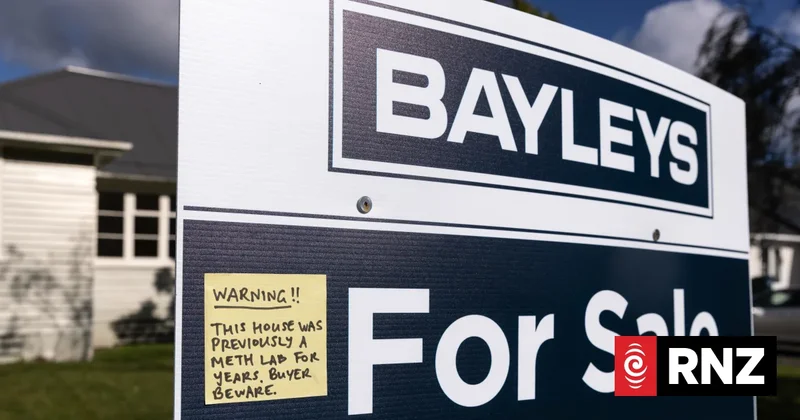
Neighbours who say they were terrorised by the former occupants of a Kāinga Ora house fear prospective buyers haven't been told about the home's history as a "meth lab".
The deadline sale for the two-bedroom Kāinga Ora property in the Lower Hutt suburb of Naenae closed on Tuesday, but Langford Street's residents say its chequered past hasn't been disclosed.
The 1940s home was billed as a "project you don't want to miss" and being offered for sale on an "as-is, where-is basis".
On Monday, a post-it note was plastered on the 'for sale' sign on the property's front lawn and across half a dozen of the home's windows and doors: "Warning. This house was previously a meth lab for years. Buyer beware."
Neighbours say crews arrived in "hazmat suits" a year ago to strip and clean the property, with Kāinga Ora confirming the home has undergone remediation for methamphetamine contamination.
Regional director for Greater Wellington Sarah Willson said the relevant reports were given to the listing agent, but a neighbour said they've received no toxicology reports despite multiple requests.
Bayleys residential sales manager Bhakti Mistry declined to comment.
'A terrifying time'
The Kāinga Ora house was the target of a drive-by shooting and multiple police raids, according to neighbours, before it was vacated about 18 months ago.
For a period of a couple of years, they said people would come and go from the home at all hours of the day and night and described drug deals, fights, and a rotating cast of gang members at the property.
Kāinga Ora said it couldn't comment on previous tenancies due to privacy considerations.
Barry - a resident on the street for 30 years - said it was a "terrible" and "frightening" time, with the occupants making no effort to hide what was going on.
"I see cars pull up. They'd ... tap on the window. People would pass out the drugs ... and they would drive off. This would happen continuously, a dozen times a day," he said.
"It's hard to describe just how bad it was. It was not just a simple drug-dealing house. It was a place where everyone hung out and parked on the berms ... just total chaos."
The problematic behaviour culminated in a drive-by shooting one night, he said, describing the noise of the gun as "incredible," and showing RNZ what he claimed were multiple bullet holes in the Kāinga Ora home.
He said the spray of bullets also caught the house next-door.
Another neighbour, Benjamin said he remembered picking up casings in the aftermath and maintained it was luck no-one was hit.
"Honestly, it was a terrifying time. We didn't know what was going to happen next. We didn't know whether there was going to be an all out gun fight on the front lawn across the street and our kids would be collateral damage.
"We didn't know if the next drive-by they'd just shoot in our direction."
Three of the street's residents said crews in head-to-toe protective gear arrived to strip and clean the home once it was empty, with Benjamin saying they were at pains to protect themselves.
"They're putting on their hazmat suits and getting fully kitted-up."
Barry said the cleaners were at the property "on and off" for about two months, scrubbing walls and removing gib.
"I spoke to [one of the cleaners] and he said it's really bad, one of the worst he's seen.
"Whatever drugs they were cooking up ... [it's] penetrated throughout the whole house."
Meth remediation completed - Kāinga Ora
The neighbours told RNZ they were concerned that prospective buyers could be in the dark about the home's history.
Benjamin said it's been close to two weeks since he requested to see reports about methamphetamine contamination and remediation, but they have not been provided.
In a text exchange seen by RNZ, the agent said they did not have a toxicology report, but had requested it.
Bayleys declined to comment, directing RNZ to Kāinga Ora.
Willson said following the previous tenancy ending, the property was tested for methamphetamine contamination and specialist contractors completed remediation work.
"We advised the listing agent that the property had undergone methamphetamine remediation and have provided the relevant remediation reports to support the sale process."
Kāinga Ora declined to answer RNZ's follow-up question about when those reports were provided.
Director at law firm Pidgeon and Judd, Joanna Pidgeon said years ago there had been "massive issues" with methamphetamine contamination, with companies testing for meth also providing remediation service, giving them a "nice little income stream".
She said legislation fixed that issue and in 2018, former chief science advisor Sir Peter Gluckman established guidelines for acceptable levels of meth contamination in the home - below 15μg per 100cm2 where the drug had been smoked, and below 1.5μg per 100cm2 for manufacturing.
Pidgeon said if a meth-contaminated home had been remediated to below those levels, there was no obligation for the listing agent to disclose it to prospective buyers - unless specifically asked.
"Then they have to tell you the answer."
She said if the vendor had a report but didn't provide it, they would be implicated in the non-disclosure.
Pidgeon said information about contamination could affect whether someone was willing to buy the property and for what price, and said for one of her clients it was a deal-breaker.
"They just couldn't bear the thought of their baby...crawling around on floor that may or may not have some contamination. It wasn't something that they were prepared to deal with, but their agreement was conditional on it, so they were able to exit on that basis."
Pidgeon said if purchasers learned of contamination after signing an agreement, exiting it or negotiating the price was possible, but would depend on factors such as the level of contamination and context around whether it should have been disclosed.
Bad reputation
Benjamin stressed he had no idea how contaminated the house was or still is, but said that was the problem. Someone trying to do their due diligence could be just as clueless as him, he said.
"They may have done an excellent remediation job and it's completely removed all contamination - and that would be amazing. It's just that we don't have that information."
Barry said regardless of the contamination, he didn't think the home was fit-for-purpose and wanted to see it bowled.
"It's got that bad a reputation. I wouldn't want to see a family in it with people still wanting to turn up and thinking it's a viable drug house.
"I think the real estate [agent] or Housing New Zealand should tell everybody its history. If there's a leaky house, you have to let people know. Why not let them know that it's this type of house?"