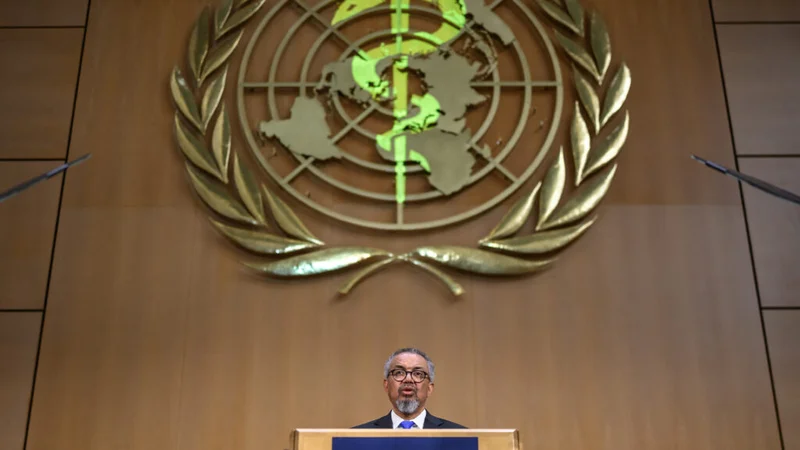
Senior officials of the World Health Organization, including Director-General Tedros Adhanom Ghebreyesus, criticized the Trump administration’s newest attempt to trigger an overhaul of U.S. vaccination policy on Wednesday, calling it politically motivated and contradictory to the best available science.
The critique was aimed at an executive order signed by President Trump on Monday. It calls for a reduction in the number of vaccinations recommended for all children in the U.S., and for the use of vaccines targeting single pathogens rather than the combination vaccines now in use, starting with the measles, mumps, and rubella shot.
The changes being pushed by the executive order are predicated on the disproven claim that the increased use of vaccines is behind the rising rates of autism in the U.S.
“Vaccines, including the MMR vaccine, are safe, and do not cause autism,” Tedros said during a press conference. “Delaying vaccines or separating doses unnecessarily does not make vaccinations safer and can leave children unprotected.”
“Vaccination policy should be guided by rigorous, independent, and transparent review of the best available science and not by political influence,” the director-general said.
The executive order does not automatically change policy; it signals Trump’s interest in seeing fewer vaccines recommended for all children, an effort the administration insists would bring the U.S. in line with peer nations in Europe. But a STAT analysis of vaccine recommendations of other countries showed that by lowering the number of recommended vaccinations, the U.S. would actually be an outlier, as is Denmark, the country it seeks to emulate.
One way that is clear is in the recommendation that the country move away from bundling vaccines into combination shots, which limit the number of needle pricks children must receive, making the vaccination process easier on babies and their parents. The executive order recommends that the process start with the MMR vaccine, but should also include other vaccines given in multi-pathogen formats.
Brigitte Giersing, unit head for vaccine research, development, and policy for WHO’s department of immunization, vaccines and biologicals, said only 15 of the global health agency’s 194 member states vaccinate against measles, mumps, and rubella using monovalent vaccines; all the others use the combined MMR.
“The MMR schedule is a 2-dose schedule with those three vaccines, and if we break that up, that … would actually increase the number of injections and the complexity of the schedule,” Giersing noted, suggesting the combination shots are more acceptable to most parents and physicians.
Currently there are no monovalent vaccines targeting measles, mumps and rubella licensed in the U.S. And early indications are that manufacturers aren’t inclined to move to monovalent shots, believing the hefty cost of bringing such products through licensure would not be justified by the anticipated market for them.
Jeremy Farrar, assistant director-general for health promotion and disease prevention and care, said requiring children to get more shots runs the risk that fewer will get vaccinated against pathogens that can cause serious illness.
“If you break up these vaccines and force people to go back with their children to six or seven clinics to get a series of vaccines, the reality is many will not return for those subsequent vaccines, and children at their most vulnerable stage for these diseases will get infected,” he said.
Farrar stressed that measles, mumps, and rubella are not trivial diseases. “They have severe complications. If anybody has seen a child post measles with encephalitis” — inflammation of the brain — “you remember it for the rest of your life.”
There is overwhelming evidence of the safety of delivering these vaccines in combination formats, and that making vaccinations easier to get actually increases uptake, said Kate O’Brien, director of WHO’s department of immunization, vaccines and biological.
“This is going in exactly the wrong direction. And there is no evidence that would drive this decision,” O’Brien said. “We know that the more you can enable families to be able to do what they want to do, the higher the coverage is and the protection of children.”