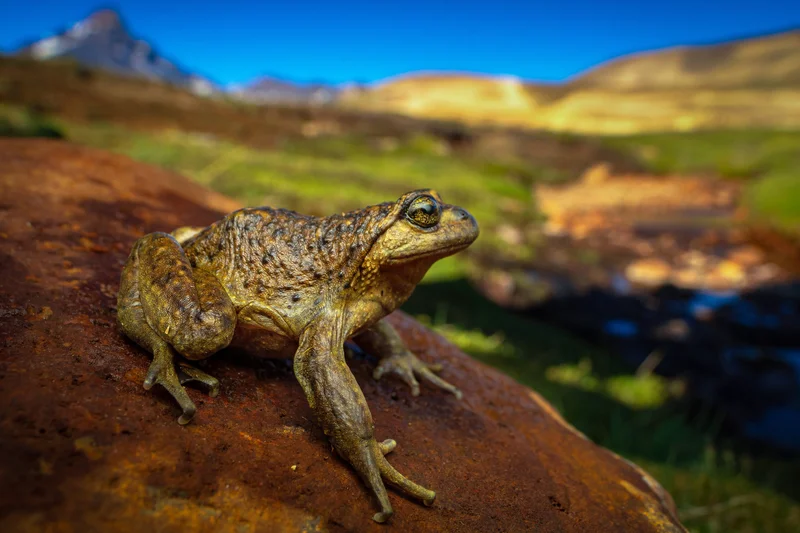
Actor and environmental activist Leonardo DiCaprio has come out in defense of the Pehuenche frog (Alsodes pehuenche), an amphibian listed as critically endangered, amid concerns that the Los Cóndores-Río Diamante power transmission project in Chile’s Maule region could threaten the species’ survival.
In an Instagram post on Sunday, in which he tagged the Chilean Herpetological Network and shared photographs of the frog and its habitat, the Titanic star warned that fewer than 1,000 individuals remain. He said Chile could approve “ a catastrophic plan to destroy the heart of their only known habitat.”
DiCaprio stressed, however, that his appeal is not aimed at halting the project altogether. “Conservationists are not asking for the transmission project to be stopped,” he wrote, but rather for it to be built in a location that would not expose the species to greater risk.
The project referenced by DiCaprio, developed by Enel Generación Chile, involves the construction of a 500-kilovolt power transmission line designed to interconnect the energy grids of Chile and Argentina. On the Chilean side alone, the plan calls for a 26.6-kilometer overhead transmission line and 72 high-voltage towers, infrastructure that would cut directly through the habitat of the Pehuenche frog.
A key milestone for the project had been scheduled for Monday, when the Environmental Assessment Commission (COEVA) was due to rule on a report by the Environmental Assessment Service (SEA) recommending its approval. However, following DiCaprio’s message, the session was suspended. No public explanation has been given for the postponement, nor has a new date been announced, Claudio Azat, director of the One Health Institute and co-chair of the International Union for Conservation of Nature’s (IUCN) amphibian specialist group, told EL PAÍS.
The Chilean government of José Antonio Kast responded to the actor’s comments. Environment Minister Francisca Toledo told Radio ADN that DiCaprio’s message referred to a project that remains under environmental review and therefore declined to comment on its merits while the process is ongoing. Instead, she defended Chile’s environmental institutions, saying: “Chile has a robust environmental framework in which all the evidence is examined and weighed as part of environmental assessments.”
The Pehuenche frog exists nowhere else in the world except the high Andes of Chile and Argentina. The person who helped bring the species’ plight to the attention of Re:wild, the conservation organization co-founded by DiCaprio, was Chilean biologist Claudio Azat.
“It is a little-known species. It was described by science about three or four decades ago,” Azat explained. “We know it has a very restricted distribution and that its main threat is the international highway that connects the Chilean city of Talca with Malargüe in Argentina.”
This amphibian is distinguished by the fact that, during the breeding season, males develop patches of gelatinous spines on their chests and fingers. They are also known as “Popeye frogs” after the famous cartoon character because their forearms become enlarged, allowing them to hold onto females during mating.
The species was classified as critically endangered in 2018 and has yet to recover from that status. “It is a species found only in the Alto Maule region, in the Pehuenche Valley, inhabiting small streams and wetlands fed by snowmelt and glaciers high in the central Andes, at elevations above 2,000 meters [6,500 feet],” Azat explained. “Its population numbers around 1,000 individuals.”
The conservationist acknowledges that, although campaigners had been raising concerns about the frog’s plight for years, the visibility generated by DiCaprio’s message has provided a decisive boost. “This is the second time he has supported a species in Chile. In 2019, he posted about the campaign to save the Loa frog, which was very positive because it changed the situation for that species,” Azat concluded.