Your support helps us to tell the story
From reproductive rights to climate change to Big Tech, The Independent is on the ground when the story is developing. Whether it's investigating the financials of Elon Musk's pro-Trump PAC or producing our latest documentary, 'The A Word', which shines a light on the American women fighting for reproductive rights, we know how important it is to parse out the facts from the messaging.
At such a critical moment in US history, we need reporters on the ground. Your donation allows us to keep sending journalists to speak to both sides of the story.
The Independent is trusted by Americans across the entire political spectrum. And unlike many other quality news outlets, we choose not to lock Americans out of our reporting and analysis with paywalls. We believe quality journalism should be available to everyone, paid for by those who can afford it.
Your support makes all the difference.
Read more
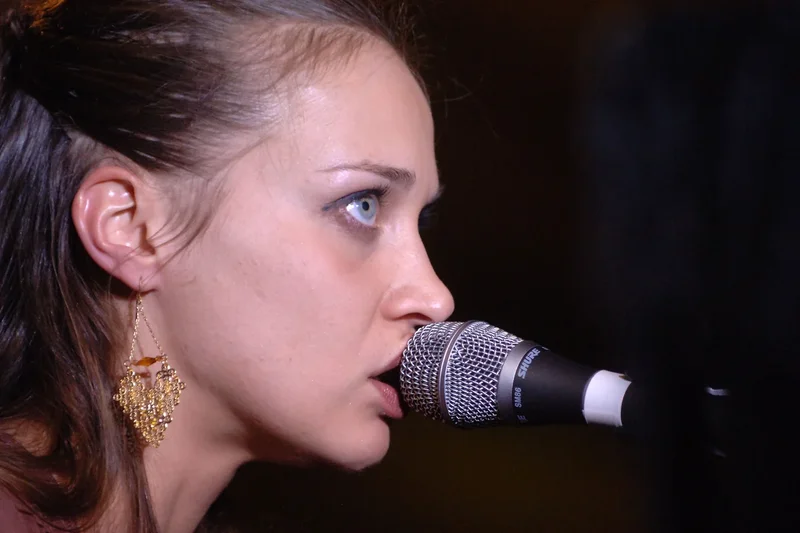
The year is 1996. You pull Fiona Apple’s debut album, Tidal, out of its CD case as her icy blue eyes stare at you from the front cover. She sings over moody jazz rhythms, her words as sharp as a knife’s edge: “I tell you how I feel, but you don’t care/ I say tell me the truth, but you don’t dare/ You say love is a hell you cannot bear/ And I say gimme mine back and then go there for all I care.”
Thirty years since its release, Tidal continues to influence new generations of confessional songwriters, while Apple is adored by everyone from Olivia Rodrigo to Lady Gaga. Alongside its genre-upending sound and poetic moodiness, her unflinching honesty helped build the foundations of pop music as we know it today.
“Fiona’s writing changed my life,” pop singer Sara Bareilles tells me. “I had never heard a young woman sing with such clarity about the howling ache and deep angst of growing up, all filtered through her intelligence and poetry. Her fearless pursuit of capturing truth, even when it was grotesque, was a revelation. Tidal is a masterpiece.”
Apple’s debut arrived on a scene dominated by cookie-cutter pop and testosterone-fueled hip-hop. The summer of 1996 was soundtracked by radio hits like “Always Be My Baby” by Mariah Carey, while hip-hop’s bicoastal rivalry bristled with new albums from Tupac and Nas. Male-led alternative rock bands like the Goo Goo Dolls were inescapable, but artists like Alanis Morissette and Tori Amos had also created a rebellious rock movement that set the scene for Apple.
Her writing changed my life
Sara Bareilles
She came out swinging, unafraid to speak about her feelings of fear, isolation and self-loathing. “Sleep to Dream” rips apart an ex-lover for disrespecting her and wasting her time:“I got my own hell to raise.” Then, “Sullen Girl” confronts the depression that Apple dealt with throughout her adolescence after she was raped in a corridor outside her family’s apartment, aged 12. “They don't know I used to sail the tranquil sea/ But he washed me 'shore/ And he took my pearl/ And left an empty shell of me,” she sings.
'Tidal' by Fiona Apple was released July 23, 1996 (Sony Music Entertainment)
Apple’s suffering struck a chord among her listeners. Music critic Jenn Pelly wrote in her 2017 retrospective review of the album for Pitchfork: “The songs collectively unpack the pain that hardens young women to the world – revealing Fiona’s thick skin and what she endured to build it; fight songs, and why she fights. It is often merciless.”
Fiona’s music gave me confidence at a time when I really needed it
Music critic Jenn Pelly
The mercilessness is perhaps most evident in the album’s biggest radio hit, “Criminal,” which Apple famously wrote in just 45 minutes after being challenged to write something new. “I’ve been a bad, bad girl,” she confesses in a languorous drawl over choppy piano notes, “I’ve been careless with a delicate man.” Her supposed guilt at using her sexuality this way is undermined somewhat by such sultry instrumentation; Apple is a master of subversion.
“Fiona’s music gave me confidence at a time when I really needed it,” Pelly tells me, “and her lyrics showed me how language could help me access that confidence. I imagine it has done the same for many contemporary songwriters.”
Tidal sold two million copies and went platinum in its first year, but still, it was not an easy pill for the music industry to swallow. Because she refused to fit neatly into a pop singer or rockstar mold — defying genre by combining classical and rock influences, as well as refusing to promote her new releases — Apple was mocked in the mainstream media. The general public deemed her songwriting hysterical, and the unsmiling singer was labeled a bitch by the tabloids.
She became even more ostracized from the entertainment industry following her unscripted rant after winning Best New Artist at the 1997 Grammys. The 19-year-old Apple declared during her acceptance speech, “This world is bulls***,” and urged people not to model their lives after anyone. Backlash after the on-air moment painted Apple as volatile and ungrateful for her success.
It’s a testament to Apple’s self-conviction that she didn’t let the skeptics silence her. She has continued to speak out against the music industry, and against war and abuses of power, even while living off-grid and with virtually no public presence since releasing her 2020 album, Fetch the Bolt Cutters. Most recently, she shared a video through her roommate’s Instagram account in which she told fans that she is trying to write about the “endless barrage of horrors” in modern society, but that she is “really struggling.”
“If you're writing about yourself, it's one thing,” she said. “Nobody can tell you that you're saying it wrong, nobody can get let down. You're the authority. But when it concerns what's happening to other people, it just becomes so important.” She continued: “I know that there's other things to do other than writing songs and I'm doing what I can elsewhere, but this is my job, to show what's going on. That's what I want to try to do. I'm going to keep trying.”
Tidal was the first mirror Apple held to the world, reflecting even the most uncomfortable truths. “She cast an incisive gaze onto the world as a teenager, which has only grown braver and bolder with time,” Pelly says. And it’s easy to find traces of that same honesty in today’s pop landscape, from Olivia Rodrigo narrating the naive, giddy bliss of early romance and then its devastating demise, to Adrianne Lenker’s devastating reflections on grief, loss and nature.
It’s not just Apple’s songwriting that inspires. The way she moved through the world under such scrutiny at such a young age has surely influenced those after her. Would Chappell Roan be setting the same boundaries with fans if Apple hadn’t first forged the path for an “unlikeable” pop star? Without Apple, would Florence and the Machine sing songs of such rage against men and their egos?
“What I think is so special about her is there’s this stereotype of women’s emotions – the idea of the hysterical woman – and that has been weaponized against women forever from the beginning of time,” Katie Crutchfield of Waxahatchee told Rolling Stone in 2021. “And she takes that idea and she turns it into this superpower. She takes this thing used as a negative against women and just flips it completely on its head and makes it powerful and very relatable.”
Defending her controversial Grammys speech in a 1998 interview, Apple said: “I just had something on my mind and I just said it. And that's really the foreshadowing of my entire career and my entire life. When I have something to say, I'll say it.” For that, we are thankful.