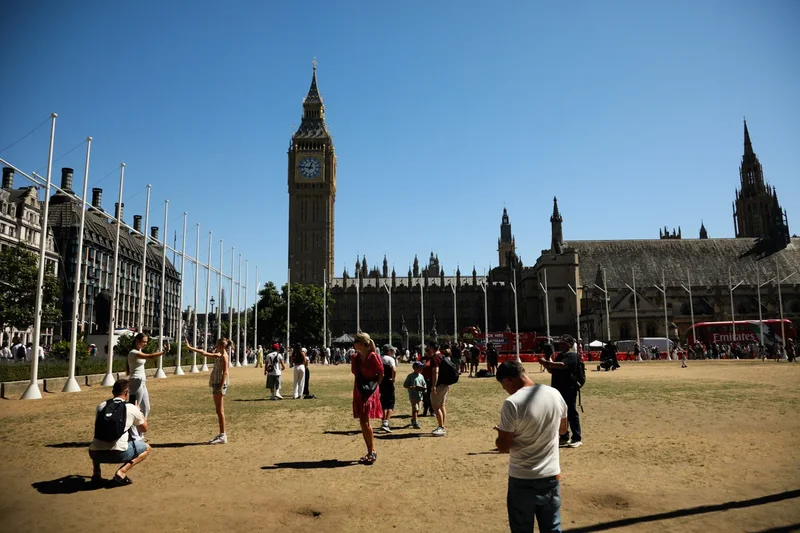
The British are famed for making small talk about the weather. Now it’s time for some rather more consequential discussions. Andy Burnham, ever the metro mayor, has called a Cobra meeting to plan for the current emergency and, no doubt, show that he is alive to the public’s concern about the continuing drought.
In fact, the heatwave has been going on for so long, virtually uninterrupted, that it’s easily forgotten that it was the previous prime minister, Sir Keir Starmer, who convened a weather-based Cobra first, when the Met Office issued its first red alerts in late June. Since then, of course, there has been no let-up, and the global consequences of climate change have been brought home with all the power that our damaged ecosystem possesses.
For the long term, everyone realises what needs to be done: achieve net zero emissions of greenhouse gases. In the case of the UK, that has to be on track for 2050, even if other nations, at a different stage of industrial development, take longer. How we get there is also broadly obvious: replace fossil fuels with clean renewables and some nuclear power. Who pays and how for this national and international transition is highly contested, but at least the appropriate measures are clear enough.
We need more electric vehicles, more heat pumps and solar panels for homes and businesses (which can also power air conditioning systems), less meat consumption (livestock farming produces massive greenhouse gas emissions, especially methane from cows and sheep, and requires vast amounts of land that could otherwise be used to store carbon through reforestation) and cutting down on air travel. None of this will be easy to achieve, but there has been progress.
It is also fair to add a more optimistic note: the weight of evidence of climate change is now so painfully apparent that the climate-deniers, the net zero sceptics and the fossil fuel lobby have gone rather quiet lately. The scientific arguments on limiting the increase in the global temperature are being won as never before, and with them the political climate is also usefully changing.
That, however, is not at the top of the Cobra agenda for now. More urgent problems are upon us. Immensely damaging wildfires. Fragile heathlands, for example, are already being destroyed and will take decades to recover. The harm caused to wildlife, biodiversity and, indeed, the danger to human life, buildings, farms and even motorways has also grown more obvious. In this context, the suggested complete ban on disposable BBQs is a step that should have been taken before, and the penalties for their improper use must act as a deterrent.
Public education is also a perennial issue. The fire service is right to ask for more resources – such as helicopters with which to douse the flames. The NHS and care homes also need backing to cope with the extra demands; some smart “nudge” is needed to encourage the public to put their sun cream on.
With most of England now officially in drought conditions, water has to be preserved. As with most commodities, the surest way to do so normally would be by price – increase its cost and expand the coverage of water meters. However, for obvious reasons of health and sanitation, let alone the cost of living crisis, this is a difficult remedy to implement. Resorting to moral persuasion, as with a hosepipe ban, is always an uncertain solution.
As a practical imperative for the southern counties, and as a necessary precaution elsewhere, statutory drought orders should be issued, at least across England, imposing restrictions on swimming pools, hosepipes, car washes and the like. That would forestall or, preferably, avoid physical rationing – street standpipes, mobile water tanks or bottled water deliveries.
The biggest economic and human impact of the drought will be on farmers, and for some another year of failed harvest will push them to the wall. Since Brexit, agricultural businesses have been deprived of the financial support available from the European Union that offered them more resilience in difficult years. Food prices are certain to rise and the UK will inevitably have to import more foodstuffs as autumn approaches.
There will be demands on the Treasury for financial support. At a time when the public finances remain under strain, it will be difficult to offer all the financial assistance required. Mr Burnham and his ministers will need to revisit the present system of farm subsidies, biased as they are towards environmental rather than production objectives, with the very real risk that many otherwise profitable farms will go under. If these drought conditions become more normal, they face an extremely uncertain future.
One option would be to partner with rural businesses and take an equity stake or lend them the funds so that they can adapt to more drought-resistant crops (for example chickpeas), or else diversify. That would be an investment that the government should consider in the national interest. But if climate change is giving Britain wetter winters and long, hot and dry summers, then an even more difficult national conversation about the future will need to be had. For now, the nation’s lawns and parks will just have to stay parched.