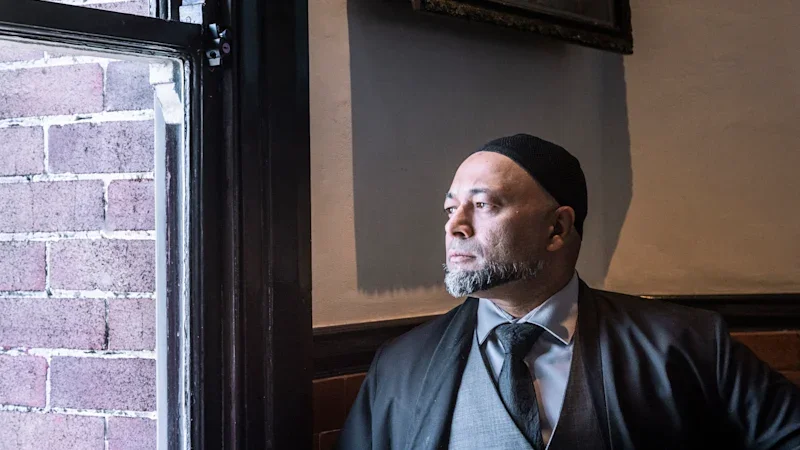
A reformed extremist has warned that terror groups including Islamic State will exploit the anger and grievance felt over war in the Middle East in an attempt to fracture Australian society and inspire more attacks like the one in Bondi.
The former radical turned undercover counter-terror agent, and now deradicalisation expert, is urging Australia to understand how young people are ensnared by dangerous ideologies, and help them to escape.
Mubin Shaikh will on Thursday tell the Royal Commission on Antisemitism and Social Cohesion how he grew up in a “chill” Muslim family in Canada and lived a largely secular life.
That was until an out-of-control teenage party put Shaikh in the crosshairs of his conservative uncle. Shaikh decided to “get religious” to salvage his reputation within his family, and travelled to his family’s homeland of India and then Pakistan to undergo religious study.
It was 1995 when Shaikh had a chance encounter with the Taliban in their stronghold city of Quetta, Pakistan, and he was enamoured.
“I was open to influences coming my way, and it was the Taliban influence,” he said on Wednesday.
“I hated the West and non-Muslims, and people who were Muslim but not Muslim enough.”
Then the attacks of September 11, 2001, cast Shaikh into a world of doubt. Flying planes into buildings in New York and Washington didn’t make sense to him, so he moved to Syria to delve deeper into religious study.
But by 2004 he had turned his back on his old politics, returned to Canada, and ultimately worked for intelligence agencies in North America, infiltrating extremist cells.
Two decades later, Shaikh watched with resignation as two allegedly IS-inspired Australian men of Indian descent opened fire on Jewish families on Bondi Beach.
“I was not surprised at all,” he said. “It was inevitable.”
Shaikh pointed to attacks elsewhere in the West inspired by conflicts such as in Gaza and Iran, the Manchester synagogue in October 2025, and a series of arson and shooting attacks on Jewish schools in Canada.
“The wars continue, you see the videos of dead kids. It makes you angry, it makes you sad, it makes you want to put a stop to it, and extremist ideology says ‘You want to do something? Here’s what you do’,” Shaikh said.
“It will persist as long as the grievances persist. You’re going to keep seeing [these attacks].”
Shaikh works to help families deradicalise loved ones, and had been in Sydney just a few weeks before the December attack on Bondi Beach. He warned then about how social division plays into the hands of extremism.
“If you show sympathy for the Jewish community, given the anger about what’s happening in Gaza, people say you’re waving the other team’s flag,” he said.
“People thought ISIS had been beaten back and lost their motivation, but it was wrong thinking, and it was our mistake.”
When Shaikh speaks at the royal commission, he will be speaking to a changed Australia.
But his message remains the same. Learn the trajectory of radicalisation and respond, rather than pit one group against the other.
“This is breaking up society, and that’s what our adversaries want,” he said.
“An attack will happen and for the far-right agitators it’s red meat. They say it’s Islam, it’s immigration.
“Certain politicians become relevant again.
“It didn’t matter it was a Muslim guy who stopped the attacker at Bondi.”