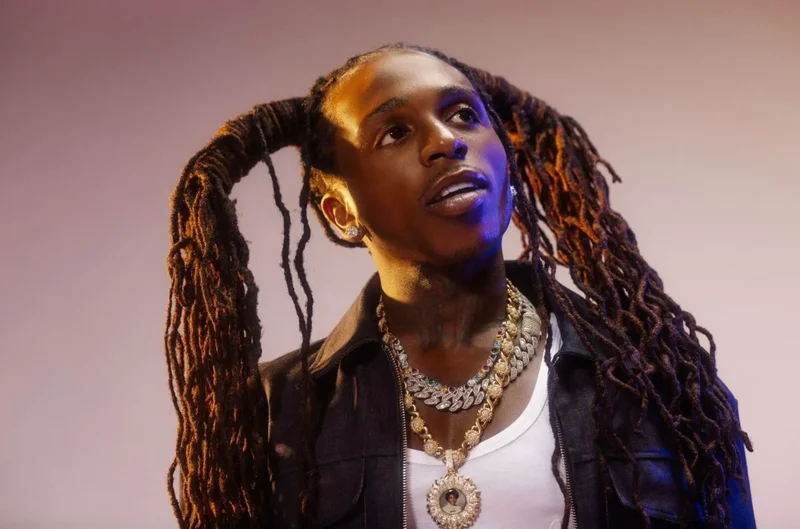
There’s a certain kind of nostalgia that lives in R&B—the kind that lingers after the song ends, like the last note of a slow jam playing long after midnight. For Jacquees, that feeling has never just been music. It’s been a way of telling the truth.
Now, more than 15 years after a young artist from Decatur, Georgia, dreamed of hearing his voice on the radio, Jacquees is returning to the project that captured a younger version of his heart. His 22-track album Mood 2, released July 31, 2026, is more than a sequel. It’s a grown-man conversation with the past: a decade later, the love is deeper, the lessons are different and the questions have evolved. He doesn’t just revisit a feeling. He lets us hear how it changed.
Before The Fame, Jacquees Was Just Listening For His Voice
For Jacquees, the timing of the project’s release feels almost too perfect to have been planned. “It was God, honestly,” he says. And maybe that’s the point. Mood 2 isn’t simply a sequel; it’s a conversation between the artist he was and the man he has become.
Long before streaming could turn a song into a global moment overnight, or TikTok could send a chorus around the world in seconds, Jacquees had a simpler definition of success.
“Hearing yourself on the radio was one of the big things,” he recalls. “I always used to want to see myself on TV. I used to feel like that was…making it.” Television would eventually come after he signed with Cash Money, but radio was the first milestone that felt tangible. It meant somebody, somewhere, was listening.
In Decatur, Jacquees Heard The Dream Getting Louder
Growing up in Decatur, Jacquees was watching the music industry take shape around him—and, in some ways, watching his own future come into view. He appeared as a child in Jeezy’s “My President Is Black” video, a moment he remembers as being “super cool in the city.” But perhaps even more influential was seeing artists from his own orbit begin to break through. Travis Porter was one of them.
“I thought it was one person,” Jacquees says, laughing as he remembers first hearing the group’s name. Members of Travis Porter were connected to places he already knew—his school, his barber shop, his neighborhood. One member’s grandmother even lived across the street from his school.
Watching them rise gave the young artist something more powerful than inspiration: proof that the dream could happen close to home. “When I was seeing them come up, I was like, ‘Okay, I know I can make it,’” he says.
That belief has followed him for years. It’s also what makes this return feel less like revisiting an old chapter and more like opening a letter from his younger self—the kid from Decatur who was still learning just how much was possible.
The ‘Mood’ Returns, But The Man Has Changed
The original Mood arrived in 2016, when Jacquees was still stepping deeper into the spotlight. By 2023, he already knew he was working on a follow-up. That it would ultimately arrive during the project’s 10-year anniversary wasn’t necessarily part of the original plan. It was simply how the timing came together.
Now, the original project is available on streaming alongside its successor, allowing listeners to hear the evolution almost side by side. And growth, in this case, isn’t just about a bigger catalog or a longer career. It’s about perspective—the difference between who you were when you first sang about love and who you become after living through it.
When Love Gets Complicated, Jacquees Keeps It Real
If there is one subject that has followed Jacquees through every era, it’s love. But on Mood 2, love doesn’t arrive as one neat emotion. It comes with doubt, desire, insecurity, confidence and all the complicated spaces in between.
On “Accuse Me,” one of the project’s more vulnerable moments, he explores trust and insecurity. Elsewhere, including on “No Heartbreak,” he leans into romance and sensuality, carrying forward an R&B tradition that gives men room to be both confident and emotionally vulnerable.
Now, he recognizes that the rules around love have changed—or, perhaps more accurately, that the distractions have. “The older generation may understand more about love, real love, than us,” he says. “They didn’t have Instagram, they didn’t have social media.”
He isn’t romanticizing the past for nostalgia’s sake. It’s about access—and how having too much of it can sometimes make attachment feel less meaningful. “Their person was their person,” he says. “They couldn’t go on their phone and see somebody from Florida.” That constant access, Jacquees believes, can make connection feel disposable.
Still, he isn’t writing off his generation. He believes some people still choose depth over convenience. “If we could just get back to caring and loving people for who they are and not what they have, then we’ll be all right.” Beneath the confidence is someone still looking for the kind of love R&B was built to sing about: real, present and felt.
Jacquees Still Has His Eyes On The King Of R&B Crown
Jacquees has never shied away from confidence. If anything, he has embraced it loudly enough to make it part of the cultural conversation around him. Few moments demonstrated that more clearly than the infamous “King of R&B” debate. Looking back, he doesn’t describe the moment as pressure; he describes it as confirmation.
“Honestly, it just let me know that people were paying attention to me in the genre,” he says. There were critics, supporters, memes and arguments, but the conversation itself proved something: Jacquees had become significant enough within R&B for people to have an opinion about where he stood.
And he hasn’t changed his mind. “Of course, I am the King of R&B of my generation,” he says. “I’m never taking that back. I’m never, never taking back my statement. It is what it is. It’s up and it's stuck.”
That bravado coexists with a softer understanding of himself. Jacquees says music is how he expresses love—and sometimes, listening to the artists who came before him reminds him why he loves in the first place.
He points to soulful icons like Teddy Pendergrass, whose music still shapes the way he understands the emotion. “When I listen to people like him, it makes me want to love more,” he reveals. “Because of the feels that it gives and the conversation.”
His own love language? “Words of affirmation.” For an artist who has spent years turning passion into melodies, there’s something fitting about that answer. He still values one of the simplest forms of intimacy: being told, being reassured, being seen.
Jacquees Is Seeing Love Through Different Eyes
At 32, Jacquees says he approaches love with more responsibility than he did at 22. “When you’re a man, you don’t love the way you did when you were a boy,” he shares. “You could still want those same feelings…the butterflies and all of that. But as far as how you approach and deal with love, it’s totally different.” That evolution is reflected in the man behind the music.
It also extends into fatherhood. His son, Snow, is not yet two, but he’s already becoming a small, unofficial A&R in his father’s world. The upbeat, New Orleans bounce-inflected track, featuring a vintage Southern rap verse from Juvenile, has already earned his son’s approval. “He loves ‘Lick Back,’ so I know that’s a hit,” Jacquees reveals.
As Snow begins to experience his father’s world firsthand, Jacquees is stepping into another new chapter of his own. He’ll join K Camp for a tour beginning August 17 in Phoenix, including a September 4 stop in Atlanta, where he’ll headline Lakewood for the first time. “That’s super dope,” he says. “I want to see everybody in the building.”
Jacquees Keeps The Music Serious And The Memes Coming
Even the collaborations on Mood 2 reflect Jacquees’ approach to growth. On “Stretch You Out,” featuring Ty Dolla $ign, the chemistry isn’t about proving who can out-sing whom. For him, the best collaborations are about bringing out something better in each other. “You help me be the best version of me, and I help you be the best version of you.” That mindset extends far beyond the studio.
His mother remains one of his loudest supporters—and quickest critics. If Jacquees posts something she doesn’t like, he hears about it immediately. “My mama is always right, so I have to listen,” he says. That kind of support can be especially meaningful in music: a 2026 systematic review of 26 studies on music students and professional musicians identified family and significant-other support as one of five major forms of social support connected to performance anxiety and stress. For Jacquees, that support comes with a little accountability, too.
Then there is the internet. In an era where celebrity can be measured in streams, sold-out shows and cultural moments, Jacquees has become what he calls a “walking meme.” He doesn’t seem particularly bothered by it. “I think it’s funny too…’Cause I know how to laugh at a joke,” he says. But he also understands what the jokes represent. “It takes a certain star for people to just make memes out of everything,” he says.
He’s seen the “EeeEee” meme, of course. “That’s the most famous one ever.” For an artist who once measured success in radio spins and television appearances, becoming a meme may not have been part of the plan—but it’s another sign the culture is watching.
Jacquees Returns To The ‘Mood’ With More Life Behind It
Ten years after the first Mood, Jacquees isn’t simply trying to recreate a feeling. He’s showing what happened after the feeling changed.
The butterflies are still there, along with the desire, vulnerability, bravado and jokes. But now there is responsibility, fatherhood and perspective. Somewhere in the past is a younger Jacquees, listening closely to what comes next. “He would be very impressed with the album,” the singer says.
For an artist who has spent much of his career insisting that R&B still has room for big emotions, big voices and unapologetic confidence, perhaps the most fitting review of Mood 2 comes from that younger version of himself—the kid who dreamed of hearing his voice on the radio. And maybe, after all these years, that’s the mood that matters most.