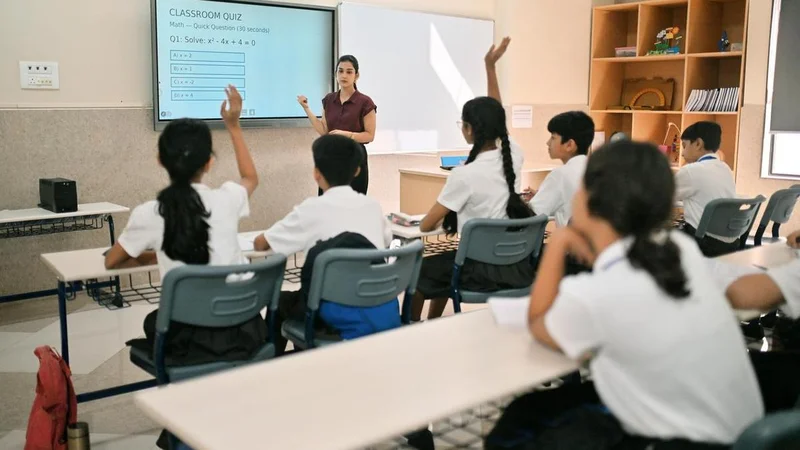
In a Class 6 Maths classroom in Jaipur, a teacher explains fractions on a smart board. The lesson is clear, the class attentive, and students are taking notes. From the outside, it looks like a modern classroom. But when asked to solve a new problem, only a few hands go up. Some students have understood, some have memorised, and some are already lost. The smart board has made the lesson engaging but it cannot tell the teacher who has truly understood and who has not. That is the real challenge before Indian education today.
Better tools
Over the last decade, India has made serious progress in digitising classrooms. A recent NITI Aayog policy report shows that Internet connectivity in schools rose from just 8% in 2014-15 to 64% in 2024-25. This is a significant achievement. Classrooms are more connected, more digital content is available, and teachers have access to better tools than before. But learning outcomes have not improved at the same pace.
The basic Reading and Maths skills in early classes have recovered since the pandemic. That is encouraging. But secondary-level learning and overall literacy continue, even in schools with screens on every wall. Somewhere along the way, we have started treating “digital” and “learning” as the same goal. They are not. A smart board can enhance how much content a teacher shows but it cannot tell the teacher which child has stopped following the lesson. This is the real story hiding behind the data.
In a typical Indian classroom, one teacher teaches 30-40 students, each at a different learning level. One child is ready for the next concept. Another is stuck on the previous one. A third can repeat the answer but cannot apply it. The teacher is expected to identify all this in real time, while also teaching the lesson, managing the class, completing the syllabus, and preparing students for exams. This is not a failure of teachers. It is a failure of the system we have built around them.
For many years, school modernisation has focused on better delivery: better devices, better content, better connectivity, and better presentation. These were important first steps. But delivery is only one part of learning. The harder part is diagnosis. Is the child learning? Where is the child stuck? What should the teacher do next?
A projector cannot answer these questions. A smart board cannot identify the 11 students still struggling with fractions. A video cannot tell the teacher that five children have memorised the definition but have not understood the concept. Our infrastructure has moved forward but our insight into each child has not.
Uses of AI
This is where AI can be genuinely useful in education. It Not as another shiny layer on top of digital infrastructure and certainly not as a replacement for teachers. But to help schools build an intelligence layer beneath teaching and learning. First, it can help identify learning gaps when they appear, not months later. Today, gaps are discovered only after a test or exam. By then, the class has moved on and the child has fallen further behind. AI-enabled learning systems can detect struggle during practise and show where support is needed.
Second, AI can help personalise practise. For decades, schools have accepted that all children must move through the same curriculum at the same speed. But children do not learn at the same pace. AI can help each child practise at the level he/she is ready for, while the teacher remains in charge of the classroom, context, and learning pathway.
Third, AI can reduce the administrative load on teachers. Teachers spend enormous time checking work, recording marks, preparing reports, and compiling data. If technology can take away some of this repetitive work, teachers can spend more time doing what only teachers can do: explain, motivate, guide, observe, and build confidence.
For school leaders, this can be transformational. Most principals today get learning data too late. End-of-term results tell them what went wrong after the damage is already done. AI can give them real-time visibility into classrooms, subjects, and student groups. This changes school leadership from post-mortem analysis to timely intervention.
This does not mean infrastructure is unimportant. Devices, connectivity, and digital content were necessary. But infrastructure was always meant to be a means, not the final goal. The next stage of school improvement in India cannot be about how many classrooms have screens. It must be about how many classrooms know whether children are learning.
As AI becomes central to Indian education, the schools that move ahead will not necessarily be the ones with the most devices. They will be the ones that use technology to strengthen teachers, support school leaders, and respond to the learning needs of every child. A modern classroom shows content better. An intelligent classroom knows whether children are learning. That is the gap Indian education now has to close!
The writer is co-founder and CEO, LEAD Group.
Published - August 13, 2026 01:14 am IST