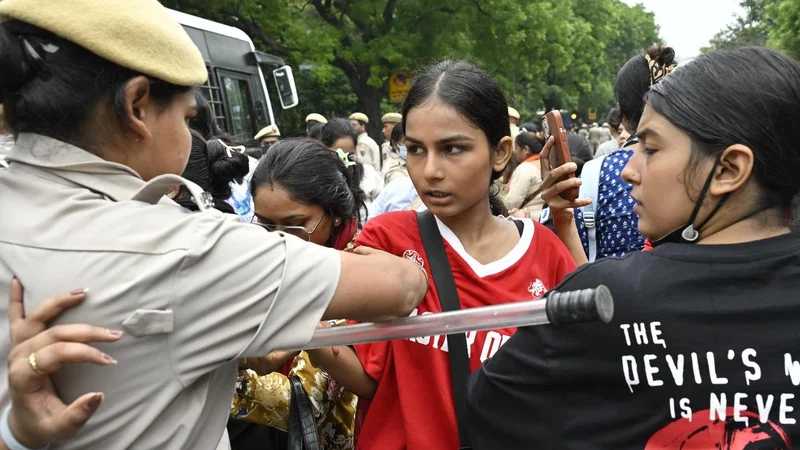
Indian independence was an audacious bet on hope. Audacious not because Winston Churchill was remotely correct in declaring that India ‘was no more a united nation than the Equator’ (Churchill always was bilious about India). No, it was audacious because the freedom that the nationalist leaders fought for was to be bestowed on all citizens of India, regardless of caste, creed, class, political allegiance or gender. Overnight, all women and all men were equal before the law. This really was a nation built on the simple premise of equality for all. That hope powered India through the turbulent early decades where, by any markers of history, or diplomatic weight, or economics, or brute power, India should have failed. India did not fail, but today, those promises of equality shine somewhat less brightly after the misogynistic response to the Cockroach Janta Party (CJP)-organised protests at Jantar Mantar last month.
An old promise
On the eve of independence, the landmass of the subcontinent was divided between British India and the princely states. The trauma of Partition and the pressing need to home the millions who came across the Radcliffe Line, was followed immediately by the need to integrate the princely states into the union. And then there were the challenges that came with the extreme poverty of a colony that had been milked by the colonial power. Everything was in short supply — money, education, health, housing, industry — everything apart from hope.
Against that backdrop, the Constituent Assembly decided to give universal franchise to all Indians above the age of 21; every woman or man over 21 was eligible to vote in the first elections held in independent India in 1952 (it took Switzerland until 1990 to give every woman the right to vote). When the Election Commission fanned out to register voters before that first election, they faced a major challenge in getting all 80 million eligible women to come out in order to be registered. Then, they had to persuade them to not identify themselves as ‘the daughter of X’ or ‘the wife of Y’. Getting each woman to register as an individual in her own right, with her own name was a mammoth task. Yet, the workers of the Commission persisted because the promise of equality was more than just nice words in the wind. They worked to include. It was in stark contrast to the current Special Intensive Revision (SIR) which appears to work on the presumption of exclusion.
Even so, in 1952, 2.8 million women were eventually struck off the rolls since they would not identify themselves by name. It is a measure of how far India has travelled in gender equality that in 2019, the gender gap in voting closed. Since 1952, India has made progress in turning electoral equality into a lived equality for women and men, and the idea of identifying women by the male head of the household is largely for the history books. Yet, ownership of one’s own name, which announces gender electoral equality, has been weaponised against women — most recently in the online attacks against female protesters at Jantar Mantar.
Gendered expectations
Several women who participated in the protests were doxxed in the days following the protest being called off. Their names, numbers, addresses and other personal details were uploaded; they faced vile online abuse. To add fuel to the fire, the Prime Minister, in an Instagram reel on July 31 spoke of ‘forgiving’ the ‘misguided daughters’ who swore (some of them, at him). In singling out the behaviour of women, he divided the protesters sharply along gendered lines. The ‘daughters’ of the nation who used ‘abusive’ language were transgressive and their behaviour was a ‘cultural shock.’ The men who used exactly the same language were not even noticed. Same protest, same demands, same aspirations, but gendered expectations.
The very same women whose great grandmothers or grandmothers had been registered as voters because the government of the day considered them capable of choosing their representatives have now been reduced to ‘misguided children’ who need counselling by a paternalistic Prime Minister, who incidentally would not identify the protests for what they were (he referred instead to ‘what happened at Jantar Mantar’). Since he was reluctant to recognise the protests, the Prime Minister perhaps also missed something else found at Jantar Mantar: hope. It may have been the weakest of echoes, but it was there — that old hope, kindled 79 years ago, that whatever the challenges facing India, a better future was possible.
However, by making that reel about personal grievance, the Prime Minister’s message turned a protest over democratic accountability into a cult of personality. In his telling, this was not a protest, just a mistake, and he was prepared to move on with a gentle chiding. Perhaps the Prime Minister had not noticed the doxxing of the women protesters. Perhaps it was not brought to his attention that many among his huge following on social media routinely employed that same vile language, which he found so offensive coming from the mouths of young women, against anyone who dares to disagree with him. As for those ‘misguided daughters’, the sadly inevitable threats of rape and murder they received by ‘nationalist’ cyber warriors have become their lived experience on the eve of India’s 79th Independence day.
This is the reality of gender equality in India today. Against all odds, India did not fail after independence and held on to hope. We cannot let that hope of equality falter today.
Priyanjali Malik writes on nuclear politics and security.
Published - August 13, 2026 01:12 am IST