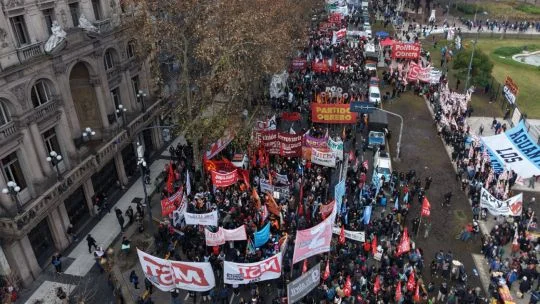
Thousands of people swarmed the streets of Buenos Aires Wednesday to protest President Javier Milei's austerity measures, as World Cup fever subsided in Argentina and public outrage returned.
Prior to the games, pensioners demanding higher payments and improved healthcare access held regular weekly demonstrations outside Congress, which were often dispersed by police.
After a month of national distraction by the World Cup's eventual runner-ups, the protests were reinforced Wednesday by trade unions grouped under the country's largest, the CGT, as well as leftist political parties and other sympathisers.
The huge mobilisation momentarily blocked access to the capital on Wednesday morning, and there were clashes between demonstrators and police reported in Avellaneda on the city's outskirts.
"Twenty percent are becoming millionaires, and then the 80 percent of us down here stay the same, with a low salary," said Raúl Maldonado, 69.
Almost half of Argentina's 7.8 million retirees receive the minimum pension, which paired with a bonus amounts to around US$330 a month – less than a third of what is required to cover seniors' basic needs.
CGT's social security secretary Hugo Benítez said the union would increase its presence at demonstrations from now on.
Argentina is going through a "critical situation for all workers," he said.
Over a two-and-a-half-year period, Milei's government has used austerity to reduce inflation from nearly 200 percent down to 33 percent.
Opponents have denounced the enormous social costs of such a strategy, which even Milei has acknowledged but insists "patience" is necessary.
As outrage at the economic reforms continues unabated, the government touts a fiscal surplus and an improved credit rating.
"We are creating the conditions for employment to improve, for wages to increase, and for the income of the entire population to rise," deputy economy minister José Luis Daza stated Wednesday.
But trade unionist Horacio Jérez counters that "the purchasing power of wages is falling."
"Macroeconomics is one thing, and the everyday social life of all Argentines is another," he said.
– TIMES/AFP