US and several Pacific countries hit out at Chinese nuclear missile test, after PIF misses chance
A number of Pacific Islands countries have joined the United States in effectively accusing China of skirting the rules after Beijing's recent nuclear-capable missile test in the Pacific.
A joint statement released by the US government on August 11th implicitly claimed that China gave the world less than 24 hours notice before launching a dummy warhead in South Pacific waters, near Tuvalu, in early July.
The statement had four Pacific Islands Forum country signatures, including New Zealand, Australia, and two island states which both recognise Taiwan over China - the Marshall Islands and Palau.
It comes just days after a PIF Foreign Ministers meeting last week in Suva failed to produce a joint statement condeming China's nuclear missle test.
In the statement, the US and dozens of other countries said that "recent missile testing in the Pacific area" fell short of standard practices that most states use to avoid the appearance of an attack - and prevent a miscalculated strike-back.
"Conducting nuclear-capable ballistic missile tests without sufficient advance notice and detail is dangerous and disrupts the peace and security of relevant nations in proximity to these tests.
"We remain committed to working with all countries to strengthen the implementation of and expand notification frameworks and to hold accountable any state whose actions fall short of its responsibilities."
Was there enough warning?
The exact amount of warning time China gave to Pacific countries remains an open question. Beijing insists that it followed international law.
New Zealand for one stated that the test happened "within hours" of China's warning, echoed by Australia, Japan and Papua New Guinea.
A US National Geospatial-Intelligence Agency issued a HYDROPAC safety warning at 5:50am UTC on July 5th, around the area where the missile would finally land - at 12:01pm on July 6th, 31 hours later.
Starboard Maritime Intelligence analyst Mark Douglas said that such area warnings aren't the same as forewarning a ballistic missile test - a navigational safety warnings are triggered by a range of activities, including satellite launches that don't have the same geopolitical impact.
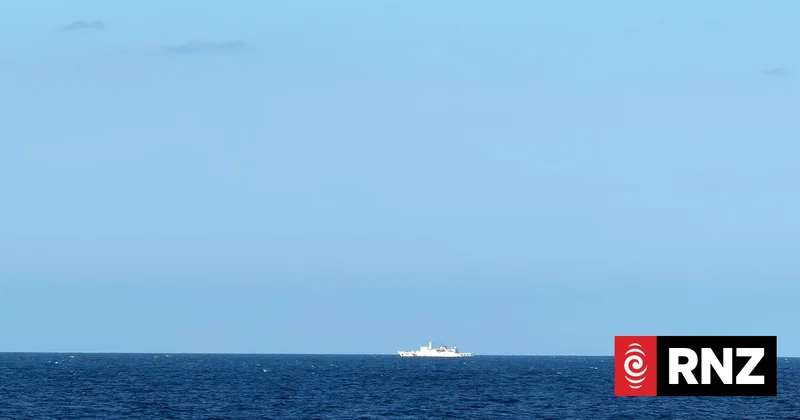
But he also said that, evidenced by the positioning of three Yuan Wang-class tracking ships, one of which was in Suva, the test had been planned for some time.
"It's been widely reported that China provided limited notice to Pacific nations of the test - by which time China had prepared two possible launch options, and placed ships along the flight routes."
All the same, Douglas said that the advanced notice that countries did have was unlikely to inspire trust in China.
"These actions... will likely result in the closer monitoring of Chinese vessels, and particularly satellite tracking vessels, in the Pacific."
Statement of influence
The majority of countries in the Pacific Islands Forum have voiced concern about missile testing in the Pacific, which is a nuclear-free zone.
But while some countries had been reluctant to single out China for its test, most countries were pushing for a joint statement on the issue at last week's Suva meeting of regional foreign ministers.
It's understood Nauru and Kiribati, both closely aligned with China, stood in the way of full consensus on a statement.
An outcomes document released by PIF downplayed this, saying that Ministers "recognised and reaffirmed the value of a consensus-based regional statement" - requesting that officials wrangle something together by the end of the month.
But a frustrated New Zealand Foreign Minister Winston Peters accused Nauru and Kiribati of gaming the system, as a way of showing support to "an external partner."
"They were seeking to use the need for consensus as actually a veto provision, look at it that way," he told reporters on Saturday.
In contrast, PIF Secretary-General Baron Waqa said that it was simply a case of finding the right formatting, and that they were "committed" to getting there in the end.
"There are other ideas that it should be a general statement covering any tests in the Pacific," Waqa insisted.
The Chinese embassy in New Zealand - perhaps incensed after Peters' told a Chinese MP to go back to his home country - lashed out on August 12th, stating Peters has "humiliated himself" in Suva.
"The outcome delivered Peters a resounding slap in the face. Pacific Island countries clearly showed little interest in the agenda he promoted," it read.
It went further, accusing New Zealand of a power grab, and an attempt to become the Pacific's "regional decision maker."
"Peters' failure to achieve his goal fully demonstrates that Pacific Island nations do not want to be used as pawns by others."
"They know very well who is sincerely helping them pursue development and who is placing geopolitical interests above regional well-being."