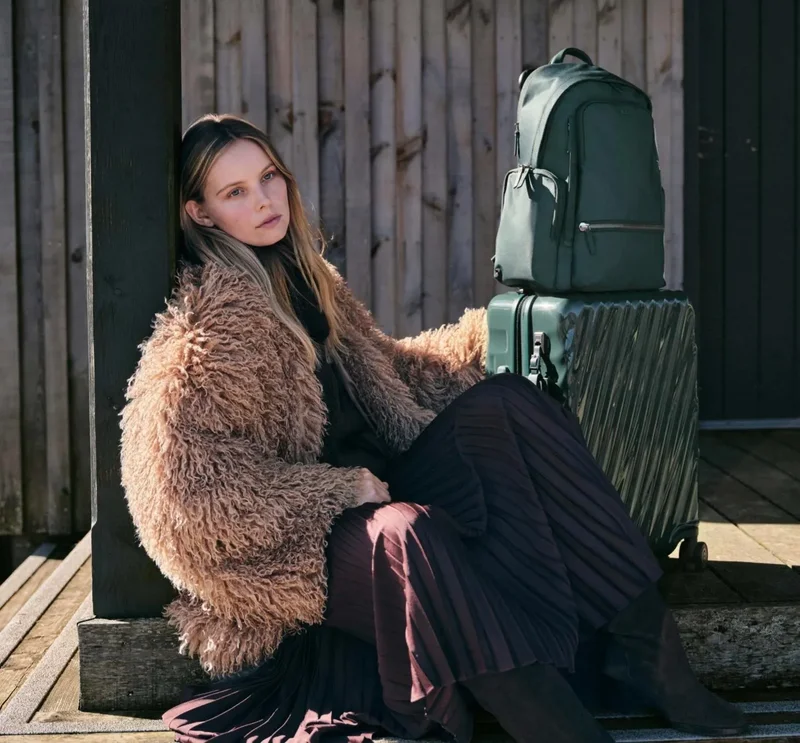
TUMI is taking another step beyond the traditional travel category with Adatto - a hand-crafted, Italian-made collection, bringing further design-led approach to its established women’s business offer.
It arrives at an interesting point for the global luggage market, worth around $19 billion+ and now populated by a much wider mix of luxury houses, established specialists and digitally native challengers.
For established luggage brands, there is a rather obvious commercial challenge: make a brilliant suitcase and the customer may not need another one for a decade. Everyday bags change that relationship, as they create more reasons to buy, more accessible price points and, crucially, allow the brand to stay relevant between journeys. This is no longer simply competing for the travel budget, but for a share of everyday fashion spend.
TUMI’s US women’s assortment now runs to more than 230 products, with Voyageur alone accounting for more than 100. Nylon remains important, but leather, Tegris and aluminium also feature in a range extending from smaller accessories through everyday bags to four-figure luggage.
The pricing shows just how wide that opportunity has become, whilst a Voyageur Celina Backpack sits at around $495, the brand’s McLaren luggage collection can reach $2,695+.
So for younger consumers especially, a tote or backpack is a far more realistic first step into the brand than a signifant luggage investment piece. Commercially, that first purchase matters: it gives TUMI more ways to build a relationship with customers long before they need their next suitcase.
The Economics Of Everyday Carry
There is a wider change taking place in what customers expect from premium bags.
TUMI built much of its reputation around the international business traveller, at a time when the requirements were relatively clear: durability, organisation and the ability to protect whatever needed to make it from one meeting to the next.
Working life has become less formal, but what we carry has arguably become more demanding (and expensive!) Laptops, phones and other pricey technology travel every day, while fewer customers want the rigid corporate briefcase that once defined professional life, and whilst the luxury handbag market still has mass appeal, more consumers desire proven function over pure fashion, which creates useful territory for brands able to combine function with a less formal aesthetic.
Forty Years Of Technical Equity
TUMI does bring substantial product history into that competition, as it introduced ballistic nylon to the consumer market in 1983 and subsequently developed its proprietary FXT ballistic nylon, engineered to improve resistance to abrasion and the wear that comes with frequent travel.
It has built products around the practical realities of travelling with tech and valuable personal items, with dedicated protection and carefully considered internal storage becoming part of its identity. And the Tracer programme adds another layer, with products carrying a unique 20-digit identification number which can be registered with the company’s recovery database, creating greater possibility of reconnecting lost or stolen items with their owners.
Alongside its international repair infrastructure and presence in more than 75 countries, these are relatively unglamorous details that have helped create considerable loyalty.
The familiar black TUMI bag became something of a shorthand among executives, consultants and frequent flyers, without the need for conspicuous luxury branding. It quietly said something about its owner: they travelled often enough to know what worked, and were prepared to pay for it.
Yet TUMI has been careful not to leave that association sitting in the business lounge. Its partnerships have increasingly put the brand alongside people whose lives are defined by movement, from McLaren F1 driver Lando Norris and footballer Son Heung-min to singer-songwriter Gracie Abrams. Whilst its wider sporting relationships include McLaren Racing, the PGA TOUR and LPGA.
Retail Beyond The Suitcase
TUMI has been expanding travel retail across Asia-Pacific, including airport locations in Seoul, Bangkok, Jakarta and Mumbai. Its Jakarta airport store alone sits within an airport serving up to 25 million international passengers annually.
Travel retail therefore becomes more than somewhere to sell luggage, and it places the brand in front of affluent international consumers in precisely the environment where its heritage makes immediate sense, while giving the business an opportunity to introduce them to a much wider product offer.
That is particularly valuable across Asia-Pacific and the Middle East, where travel retail remains an important shop window for premium international brands.
The brand has doubled down on the personal touch, with customers able to add up to three initials in 15 colours, choose metal lettering in gold, silver or gunmetal, while selected products can be individually embroidered online. Luggage tags and monogram patches are available in 21 colours.
Personalisation takes a product built around function and gives it some emotion. It makes gifting easier, creates another reason to engage with the purchase and gives a relatively discreet brand a way to offer individuality without suddenly covering its products in logos.
The Opportunity Between Journeys
Premium travel itself is hardly running out of road. More passengers are paying for business class and premium economy, airports continue to invest heavily in lounges, and the wider travel experience has become increasingly tiered around consumers willing to spend for greater comfort and convenience.
Luggage benefits from that, but it has also attracted considerably more competition for the same premium traveller, and that’s why the relationship build with customer from the earliest opportunity is a shrewder move.
Because in a growing premium travel economy, the battle may not simply be over who sells the suitcase. It is who gets to the traveller first.