Artificial intelligence (AI)-assisted travel often has a goal of finding cheaper flight tickets and affordable accommodation options.
Recently, however, an acquaintance of mine living in Seattle reached out asking for advice on planning her upcoming trip to Korea. She confessed to relying heavily on generative AI.
Seeking an immersive “time-travel” itinerary back to the late 19th and early 20th centuries, she asked Google Gemini to craft a tight, one-day historical tour through Seoul for around 200,000 won ($150).
Before leaving an overseas visitor to navigate the capital based on the whims of an algorithm, The Korea Times set out to field-test the AI-recommended itinerary. The core question: Can AI make an itinerary that can capture the spirit and subtle nuances of local history, or does it merely stitch together facts without understanding real-world urban realities?
While the model displayed impressive spatial efficiency and a strong grasp of overarching narratives, it faltered when confronted with the shifting tides of street-level trends and deep culinary history.
**Morning at Deoksu Palace **
Here, the AI offered a spot-on starting point. Our journey began inside Deoksu Palace, where the morning sun beat down relentlessly on the stone courtyards. Standing beside traditional timber-framed pavilions, the neoclassical facade of Seokjojeon instantly draws the eye. Its pale stone columns gleam in the heat, visually embodying late-19th-century Korea’s rapid push toward modernization.
Gemini correctly framed Seokjojeon not merely as an architectural curiosity, but as a monument to Emperor Gojong’s desperate ambition to assert the Korean Empire’s sovereignty through Westernization — as well as a quiet symbol of the tragic loss of independence that soon followed under Japanese colonial rule.
This former imperial residence offers free guided tours in English with advance reservation. Inside, the grand halls are lined with both authentic period pieces and meticulously restored furnishings used by Emperor Gojong's family — from British-style furniture and formal reception rooms to private bedrooms and early modern restrooms —making it feel like a mini Buckingham Palace transplanted into 19th-century Seoul.
Learning about the intimate daily lives of Emperor Gojong and the final members of the royal family transforms how one views the surrounding stone walls. With dedicated English-language tours available specifically for international visitors, reserving a spot in advance to explore the interior is an absolute must.
Was the AI recommendation reliable?: Yes
Lunch at Gwanghwamun Gukbap
Moving toward Gwanghwamun for lunch, the AI directed us to a spot famous for "dwaeji gukbap" (pork rice soup), pitching it as a taste of early-20th-century street dining.
Selected for the Michelin Guide Bib Gourmand, Gwanghwamun Gukbap requires an early arrival — fail to get here quickly, and you might find yourself stuck in a lineup out front just to get in. Opening its doors at 11 a.m., the restaurant's word-of-mouth reputation for culinary excellence keeps it buzzing with diners eager to savor steaming bowls of soup, even in the dead of summer.
While the clean, savory broth and tender pork belly, priced at 12,000 won was satisfying, the historical reasoning provided by the AI was pure fiction. Dwaeji-gukbap was not a staple of Seoul at the turn of the century; the dish gained widespread popularity decades later, brought by refugees during the 1950-53 Korean War.
A century ago, Seoulites, instead, would have been more likely to frequent long-standing seolleongtang (ox bone soup) restaurants. Local food enthusiasts and Seoul natives would also note that the city's oldest restaurant would be Imun Seolnongtang, which is widely accepted to have been founded in 1904 during the Korean Empire period.
Was the AI's recommendation reliable?: Not quite
Afternoon stroll down Jeongdong-gil in retro outfit
Next, the algorithm suggested strolling down Jeongdong-gil, a street lined with 19th- and early 20th-century red-brick buildings that embody Korea’s early modern history, while dressed in a rented outfit. AI even recommended a couple of boutiques around Jeong-dong and Ikseon-dong, where outfits could be rented for three hours with a budget of 30,000 won to 40,000 won.
Reality struck quickly on the pavement. Marching through five separate rental addresses provided by AI revealed that almost every specialized Enlightenment-era costume rental shop near the palace grounds had been shuttered. Even major platforms like Google and Naver failed to keep pace; unless a place is a wildly popular hotspot, online business listings are rarely kept up to date. Though both search engines still marked the shops as "open," arriving on-site meant finding shuttered doors, empty spaces or entirely different businesses in their place — making for a frustratingly futile trek in the sweltering summer heat.
While traditional hanbok shops continue to flourish, the peak trend of wearing early-1900s lace dresses and suits waned significantly in the post-COVID-19 pandemic era. It was a stark lesson in AI’s limits: machine learning models easily mistake past social media buzz for current storefront realities.
Was the AI's recommendation reliable? Not really
**Appenzeller Noble Memorial Museum **
Continuing along Jeongdong-gil, the path led us to Appenzeller Noble Memorial Museum, nestled within the former East Hall of Paichai Hakdang. Established in 1885 by American missionary Henry Gerhart Appenzeller as Korea’s very first modern private school, the restored structure stands today as a tranquil sanctuary from the urban rush.
Though modest in scale, its classic red-brick façade harmonizes seamlessly with the architectural tapestry of the neighborhood.
In late 19th-century Korea, this institution was far more than just a place of learning; it served as a vital focal point for public enlightenment. Within these grounds, students operated the pioneering Sammun Publishing House and printed Dongnip Shinmun (The Independent), Korea’s first private, independent newspaper. The school also nurtured key historical figures who shaped the modern nation, including Korea’s first president, Syngman Rhee, and prominent independence activist Seo Jae-pil.
Inside its quiet halls, time seems to pause. Visitors can peer into a meticulously reconstructed 19th-century classroom, admire Appenzeller’s handwritten diaries and marvel at one of the earliest grand pianos ever brought into the country — a quiet, hauntingly beautiful reminder of how a single historic spot helped forge modern education and free expression in Korea.
Was the AI's recommendation reliable? Yes
Afternoon coffee at centuries-old medical clinic
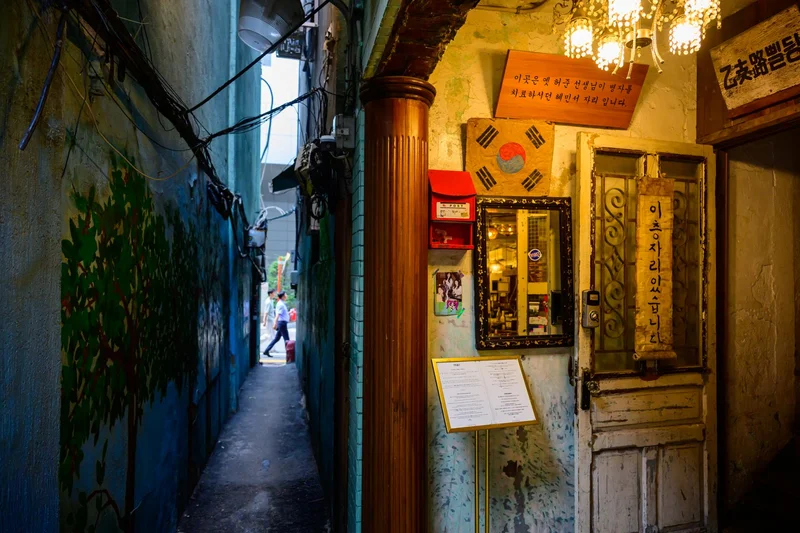
Taking a short subway ride over to Euljiro, we hunted down Coffee Hanyakbang, hidden inside an alleyway so narrow that two pedestrians would have to turn sideways to pass each other. Inside, dark polished wood, intricate mother-of-pearl cabinets and ambient jazz offer sanctuary from downtown's bustle.
This was perhaps the AI’s most inspired highlight. Gemini pointed out that this atmospheric coffee house sits on the former site of Hyeminseo, the Joseon-era medical institution where legendary physician Heo Jun (1539-1615) once treated common citizens. There is a rich poetry in sitting where herbal remedies were once boiled for the public, now enjoying hand-drip specialty coffee and fresh pastries roasted over open flames.
Yet, reality quickly exposed the hallucinated seams in the machine's historical reasoning. While the cafe does occupy the historic grounds of Hyeminseo, the state medical institution was abolished in 1882 — before modern medical facilities took root in the capital. The space itself does not preserve late-19th-century history at all; rather, it cleverly reinterprets mid-to-late 20th-century alleyway architecture with a modern "new-tro" (new retro) aesthetic.
For travelers seeking the authentic story of early modern medicine and Westernization in Korea, an AI model should point to the former site of Chejungwon, Korea's first Western-style medical institution established in Seoul in 1885 during the reign of King Gojong.
Still, standing in the dim, aromatic glow of Euljiro's alleyways, it was hard to hold a grudge against this algorithmic error. Despite the misstep, Coffee Hanyakbang remains a compelling hidden gem. Featuring shimmering lacquerware, vintage wooden staircases and immaculate filter coffee, it offers international visitors an immersive taste of Seoul's alleyway charm — a place where the past isn't strictly preserved, but delightfully reimagined.
Shary Werb, a librarian from the U.S. who visited the cafe with her husband, said she learned about the spot after seeing it featured among the top 20 locations on Atlas Obscura, a U.S. travel website. Admitting that she arrived too early without realizing the café opens at 10 a.m., she waited nearby just to get in, adding that it was well worth the visit. "It looked really cool with the medical history and the unique way they made coffee," she said.
Her husband, Bret Werb, noted that despite the heat, he found the space pleasantly lively and vibrant, adding that he particularly enjoyed the music playing inside.
Was the AI's recommendation reliable? Not fully
Final stop at Seodaemun Prison
The travel's final stop brought us to Seodaemun Prison where many independence activists had been detained and tortured during the 1910-45 Japanese occupation.
While Seodaemun Prison remains an essential historical landmark documenting the sacrifices of Korea's independence movement, field-testing the AI's recommendations on-site revealed significant gaps in how non-Korean visitors experience the complex.
The underground interrogation rooms leave a lasting impression on visitors through their raw depiction of colonial-era atrocities. However, the combination of dim lighting, haunting sound effects and realistic mannequins undergoing severe torture can be overwhelming for young travelers. Families traveling with children are advised to exercise caution.
While plaques offer rich historical background and emotional depth in Korean, English translations are heavily condensed to convey only basic facts like dates and locations. A prime example of this disparity lies in the display of handwritten letters by independence activists. While Korean signage recounts the writer's profound sacrifices and tragic fate, the English placard reduces the poignant artifact to a generic label like "Letter." Stripped of its narrative context, a deeply moving historical testimony is flattened into a simple everyday item for international visitors.
Although the museum offers a smartphone-based audio guide, it provides minimal added value. The audio tracks often merely mirror the concise text on the walls or deliver fragmented commentary. Consequently, they fail to supply the subtle nuances and emotional weight needed to grasp the site's historical gravity.
Was the AI's recommendation reliable? So-so
Verdict: Efficient blueprint, but human touch required
Testing the AI-generated itinerary proved to be an illuminating experiment.
Spatial efficiency was equally impressive, threading major heritage sites together in a logical, seamless physical flow that fully delivered on the promised historical timeline.
Where the algorithm faltered was in its blindness to real-world circumstances. While language gaps at sites like Seodaemun Prison reflect an on-site informational shortfall rather than a flaw in the itinerary itself, other pitfalls — such as shuttered costume shops and misremembered food histories — highlight the machine's inability to keep pace with street-level realities.
Generative AI offers an exceptionally strong, cost-effective blueprint for exploring a city’s past. However, to bridge the remaining gaps on the ground and fully unlock the nuances of a living culture, there is still no substitute for local knowledge, real-time verification and human guidance.