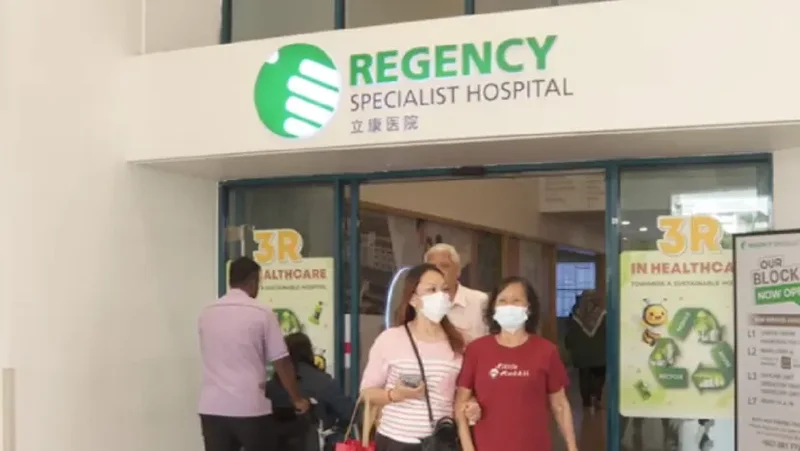
JB hospital sees surge in Singapore patients using MediSave for treatment
About 90 per cent of the patients using MediSave at Regency Specialist Hospital in Johor Bahru are women, with maternity-related care among the most common treatments.
JOHOR BAHRU: The number of patients from Singapore using MediSave at a private hospital in Johor Bahru has doubled since the COVID-19 pandemic.
Regency Specialist Hospital, the only hospital in JB currently participating in Singapore’s overseas MediSave scheme, said about 90 per cent of its MediSave patients are women.
Among the most common treatments sought are obstetrics and gynaecology services, including maternity care. The hospital declined to reveal the exact number of Singapore patients using MediSave.
The hospital sees about 150 to 200 international patients daily, mostly from Indonesia and Singapore.
Regency Specialist Hospital CEO Serena Yong said affordability and accessibility are among the considerations for those seeking treatment across the Causeway.
"I would say that dollar to dollar is about the same, maybe 10 per cent more (for JB). But you know, in terms of currency, it's already one-third,” she said.
But she added that patients should also look at factors beyond cost.
“The quality, the safety, the accessibility of the doctors, the skills are also very important parts of the consideration.”
HOW OVERSEAS MEDISAVE WORKS
From March 2010, the Ministry of Health (MOH) allowed Singaporeans and permanent residents to use their MediSave for elective hospitalisations and day surgeries overseas at specific accredited healthcare facilities.
Patients must first visit Singapore-based healthcare provider Health Management International (HMI) for a clinical assessment, financial counselling and to find out if they are eligible for MediSave coverage.
The same MediSave withdrawal limits for treatments in Singapore also apply to treatments overseas.
Regency Specialist Hospital has participated in the scheme since 2010. The only other hospital currently participating in the overseas MediSave scheme is Mahkota Medical Centre in Malacca.
LOOK BEYOND STICKER PRICE, SAYS EXPERT
Lower treatment costs are a significant draw for patients considering healthcare procedures across the Causeway.
Savings for procedures performed in Malaysia instead of Singapore ranged from 24 to 74 per cent, according to a 2025 study done by the ISEAS-Yusof Ishak Institute, a Singapore-based think-tank.
The savings were estimated at 74 per cent for in-vitro fertilisation (IVF), 37 per cent for knee replacement surgery and 24 per cent for heart bypass surgery.
But cheaper procedure prices do not necessarily mean patients will pay less overall, said Mr Francis Hoan, associate director of financial advisory at Financial Alliance.
“The entire treatment cost is not just a procedure price, but it consists of consultation, pre-op test, the procedure itself, hospital stay, anaesthetist, specialist fees, medication, and follow-up visits, or even complications,” said Mr Hoan.
“Don’t compare just the sticker price but compare the total cost.”
He added that patients should factor in accommodation for each trip, time taken off work and what MediSave will and will not cover overseas.
Patients should also consider their insurance coverage when comparing treatment in Singapore and Malaysia, said Mr Hoan.
“Most Integrated Shield Plans and MediShield Life don't cover overseas private treatment, so the cheap price may be fully self-paid versus a small copayment locally,” he pointed out.
Planned, lower-complexity procedures with limited follow-up care are more likely to make financial sense for patients considering treatment across the border, he said.
RTS LINK COULD BOOST CROSS-BORDER HEALTHCARE
With the Johor Bahru-Singapore Rapid Transit System (RTS) Link slated to open in January 2027, cross-border healthcare could become even more accessible.
Regency Specialist Hospital said it expects to see continued demand for healthcare services in JB and plans to commission more medical services as demand grows.
Cross-border healthcare is likely to become a “growing, meaningful supplement” to Singapore’s healthcare system rather than a “wholesale replacement”, said Mr Hoan.
“It will make cross-border care more mainstream for planned, low-complexity treatment, whereas complex, urgent, high-risk care will likely stay in Singapore for two main reasons: continuity and insurance coverage,” he said.
“The bigger long-term effect will be pricing pressures on (healthcare) providers back home.”