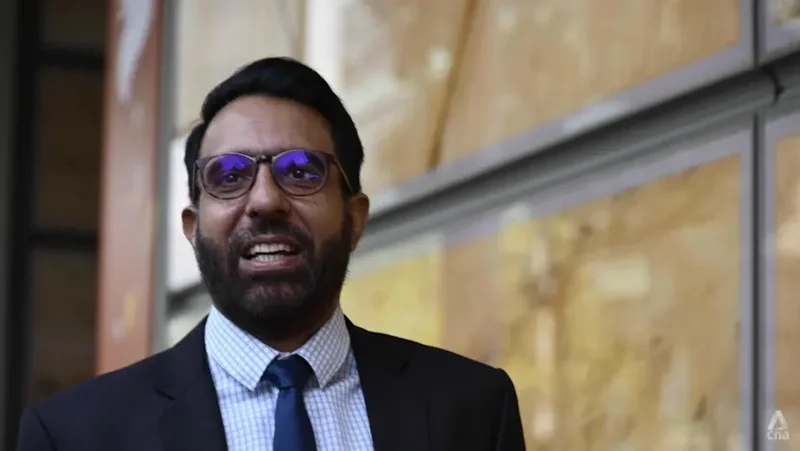
Pritam Singh struck off as lawyer after not contesting Law Society application
Chief Justice Sundaresh Menon said it was not disputed that the WP chief's offences involved dishonesty, and did not meet the high threshold for an exception to being struck off.
SINGAPORE: Workers' Party (WP) chief Pritam Singh was struck off the roll of advocates and solicitors in his disciplinary hearing before the Court of Three Judges on Thursday (Aug 13), in a decision he did not contest.
Mr Singh's lawyer said he accepted that his case did not meet the threshold for an exception to being struck off, which is the typical outcome for lawyers convicted of offences involving dishonesty.
The Law Society of Singapore (LawSoc) sought to have Mr Singh struck off the roll following his conviction on two charges of giving false evidence under oath to the Committee of Privileges investigating former WP parliamentarian Raeesah Khan.
Mr Singh was fined S$14,000 (US$10,900) for the two charges. He appealed against his conviction and sentence, but the High Court dismissed his appeal in December 2025.
Delivering the court's judgment on Thursday, Chief Justice Sundaresh Menon said it was not in dispute that dishonesty was an "integral element" of Mr Singh's offences.
He also said that both parties agreed Mr Singh's case did not meet the high threshold for avoiding an order to be struck off.
Under the Legal Profession Act, where a regulated legal practitioner has been convicted of an offence involving fraud or dishonesty, LawSoc must apply to the court for disciplinary action.
The Court of Three Judges – the highest disciplinary body for lawyers – was tasked with determining what sanction, if any, should be imposed.
Under the Act, the lawyer can be struck off the roll, suspended from practice for up to five years, censured, fined up to S$100,000, or given a combination of these sanctions.
Thursday's hearing was presided over by outgoing Chief Justice Menon, Justice Kannan Ramesh and Justice See Kee Oon.
LawSoc was represented by a team of lawyers from Drew & Napier, led by Senior Counsel Cavinder Bull. Mr Singh was represented by Senior Counsel Chelva Retnam Rajah and Peter Low Chambers lawyers, Mr Peter Low and Ms Elaine Low.
Mr Singh, a non-practising lawyer, has led the WP since 2018 and is a Member of Parliament (MP) for Aljunied Group Representation Constituency. He graduated from Singapore Management University’s Juris Doctor programme in 2012.
LAWSOC'S ARGUMENTS
In arguments for LawSoc, Mr Bull highlighted that it has no discretion in applying for disciplinary measures against Mr Singh and is required to do so by law.
He noted previous remarks by Chief Justice Menon that misconduct involving dishonesty will "almost invariably" lead to an order for striking off, and that this will only be avoided if there are "truly exceptional circumstances" that make it disproportionate.
"In the present case, it's my submission there are no exceptional circumstances," said Mr Bull.
He added that Mr Singh's position as an MP serving the public only reinforced the argument to strike him off, and aggravated his conduct.
"In the present case, the respondent is a lawyer, an MP and he was at the time leader of the opposition," said Mr Bull.
"For him to lie to the (Committee of Privileges) which was looking into the question of whether lies were told in parliament is a serious matter.
"Based on the precedents, it's my submission that the respondent must be struck off. He should be treated the same as others.
"The LawSoc are not asking for him to be treated any differently than any lawyer who has been convicted of an offence involving dishonesty."
NO CONTEST
Responding to LawSoc, Mr Rajah said Mr Singh accepted the court's ruling in his criminal trial and appeal, and LawSoc's application for striking off as a consequence of that.
"Although he's disappointed with the outcome of both his trial and his appeal, he has always had a deep respect for the independence, rigour and professionalism of the Singapore Courts, and he unreservedly accepts the outcome in his trial and at his appeal, and their consequence.
"And it is one of those consequences, your honour, that brings us before this court today," said Mr Rajah.
"It is not disputed that dishonesty is an essential element of the offences the respondent was convicted of. The respondent also appreciates that in such cases, the legal threshold to avoid striking off is a high one, and it is not met in the circumstances for this case."
Added Mr Rajah: "The respondent would also like to say he always tries his best to act in good faith, with sincerity, and will continue to strive to do so in whatever capacity that he has."
COURT'S DECISION
After conferring for some minutes, the three justices ordered Mr Singh to be struck off the roll.
Chief Justice Menon noted that LawSoc's application rested on Mr Singh's conviction on two charges of wilfully giving false answers to the Committee of Privileges.
"It is not disputed that dishonesty is an integral element of these offences," he said.
He also said the court was satisfied that LawSoc's position on striking off was "correct", and that Mr Singh's concession was "well-advised".
He then said that in such circumstances, barring exceptional grounds, the threshold for avoiding an order to be struck off is a high one, and both parties agreed it was not met in this case.
The hearing of about 20 minutes concluded with a discussion on costs and disbursements.
The LawSoc had called for S$6,000 in costs, but would be content with the S$3,000 suggested by Mr Singh's lawyers, said Mr Bull.
With disbursements, Mr Singh will pay a total of S$5,808.
Outside the Supreme Court, Mr Singh declined to speak to the media.