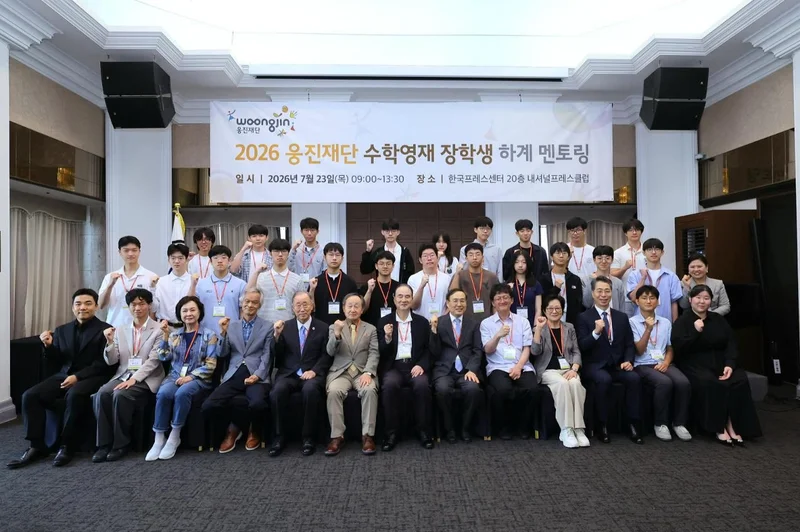
Woongjin Foundation Chairman Shin Hyon-ung, front row sixth from left, Woongjin Group Chairman Yoon Seok-keum, front row center, and former United Nations Secretary-General Ban Ki-moon, front row fifth from left, pose with students during a mentoring event of Woongjin Foundation's summer scholarship program at the Korea Press Center in Seoul, Thursday. Courtesy of Woongjin Foundation
The Woongjin Foundation held its annual summer mentoring session for math scholars at the Korea Press Center in Seoul on Thursday, marking the foundation's 18th anniversary.
Established in 2008 by the Woongjin Group, the organization provides academic support to high school and university students across Korea.
Former U.N. Secretary-General Ban Ki-moon, Woongjin Group Chairman Yoon Seok-keum and former Seoul National University President Oh Se-jung gave congratulatory remarks, with Oh speaking on the role of mathematicians and scientists in the era of artificial intelligence (AI).
Mathematician Kim Min-hyong, a chair professor at the University of Edinburgh who has mentored Woongjin scholars for 11 years and recently proved a long-standing conjecture related to Fermat's equation, lectured on Diophantine equations, a category of polynomial equations central to number theory.
Sociologist Song Ho-keun of Hallym University's Institute of Advanced Studies, meanwhile, spoke on reading and writing. Mathematician Baek Jin-eon, a Woongjin scholarship alumnus and fellow at the Korea Institute for Advanced Study who helped resolve the decades-old "moving sofa problem" — a geometry puzzle about the largest shape that can pivot around a right-angled hallway corner — lectured on studying mathematics in the AI era.
The foundation said four of Korea's six representatives at this month's International Mathematical Olympiad in Shanghai were Woongjin scholars, helping the country place sixth among 117 participating countries.
Since its founding, the foundation said it has awarded 3.2 billion won ($2.2 million) in scholarships to 444 students in math, science and the arts.
This article was published with the assistance of generative AI and edited by The Korea Times.