‘Just in case’, not ‘just in time’: That’s how S’pore deals with vulnerabilities, says Chan Chun Sing
AI generated
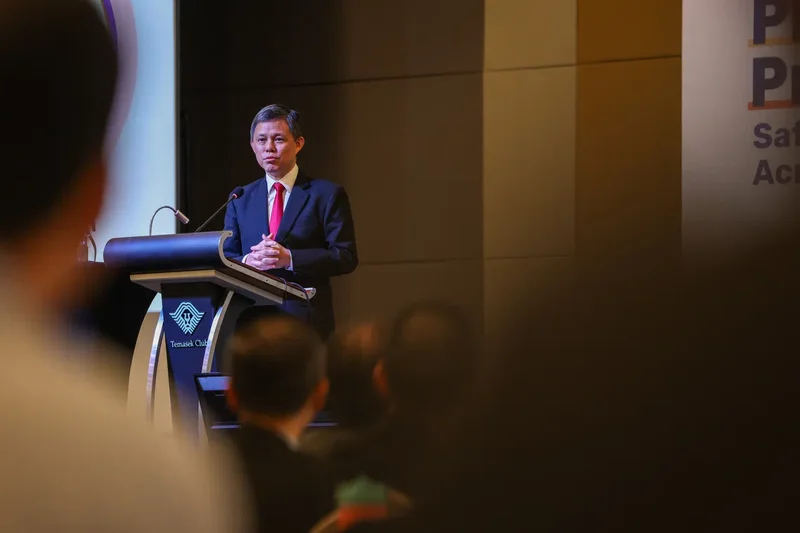
SINGAPORE - Identifying vulnerabilities which carry strategic consequences to the nation if they fail, and adopting a “just in case” instead of “just in time” approach to deal with these is what Singapore requires, said Defence Minister Chan Chun Sing.
The essence of the “just in case” approach is investing ahead of time in capabilities which are not fully appreciated until the moment they are needed, said Chan, when he opened the 20th Public Health and Occupational Medicine Conference on Aug 13 at Temasek Club.
Taking a leaf from what the late former US defence secretary Donald Rumsfeld has said about “known knowns”, “known unknowns” and “unknown unknowns”, Chan described that it was apt for the conference to be themed “from prevention to preparedness: safeguarding health across systems”.
“We all know that preventing something from happening, dealing with the ‘known knowns’ is necessary but not sufficient.......It is much more challenging to deal with the ‘known unknowns’ and the ‘unknown unknowns’”, Chan added.
An example of a “known unknown” is disease outbreaks which are bound to happen in time. However, something on the scale of the Covid-19 pandemic is considered an “unknown unknown” as the world did not know the nature of the public health crisis, the timing of the outbreak or the preparations needed.
Touching on “unknown unknowns”, Chan said these could be in the realm of geopolitics, medicine and public health, for instance, which “should set us thinking about how we should prepare ourselves, our teams and our systems”.
Systems that are built “just in time” are lean and efficient; and deploy resources only when the need arises.
However, drawing parallels between public health and defence, Chan highlighted that there are vulnerabilities where the “just in time” approach is simply not good enough, as there will be no time to build capability from scratch when a crisis hits.
Hence, there is a need to go upstream with the “just in case” philosophy, which is also what the Singapore Armed Forces (SAF) Medical System is built on, said Chan who is also the Coordinating Minister for Public Services.
Through processes including the pre-enlistment medical examination and medical classification, SAF identifies risks and places servicemen in roles suited to their health profile, protect them from avoidable harm, and preserve operational readiness, said Chan.
In addition, the upstream approach continues throughout their service, including through vaccination, heat injury prevention, and follow-up of medical issues that could affect their training and deployment.
“The objective is simply this - to keep our servicemen healthy, safe, deployable, and able to contribute to Singapore’s defence”, Chan said.
Through lessons learnt from dealing with the 2003 severe acute respiratory syndrome (SARS) crisis, Singapore made strategic investments in national stockpiles of masks and antivirals, and SAF’s operational medical stockpiles, he pointed out.
The National Centre for Infectious Diseases was also opened in 2019 with dedicated isolation capacity and outbreak response capabilities.
Chan said that these prior investments gave Singapore a stronger footing when the nation faced the Covid-19 pandemic.
“That is the essence of ‘just in case’ – investing ahead of time in capabilities that are not fully appreciated until the moment they are needed”, Chan added.
Beyond these upstream efforts, there is also a need to ensure the entire system, not just individual sectors, is prepared to deal with the challenges.
As servicemen receive care from the national healthcare system before, during and after National Service, the SAF medical services work closely with public healthcare institutions on specialist care, vaccinations, infectious disease management and continuity of care.
There are also efforts to push for deeper integration, such as SAF adopting the Health Ministry’s Next Generation Electronic Medical Record for the next iteration of its own electronic medical record system.
These moves not only support better continuity of care between the SAF and the national healthcare system, but also helps in ensuring healthcare resilience, which today extends beyond capacity and manpower, to data integrity, system uptime, cybersecurity, and continuity of operations.
“Preparedness must include secure data systems, interoperable systems and platforms, stronger cyber hygiene, regular stress-testing, and trusted coordination across services and sectors. If we neglect this, we are building resilience with a gap in our foundation”, Chan said.
Beyond systems and infrastructure, Chan stressed that people will always remain Singapore’s decisive advantage.
Most important investment is in the people
Investing in the people is the most important “just in case” investment, “because it is the ingenuity and determination of our people that will make or break us in any crisis”.
He added that training needs to be across discipline, rather than within professional silos, and that doctors, nurses, public health practitioners, psychologists, exercise scientists, commanders and data specialists who each bring their own expertise to the table, must learn to operate as one team before the next crisis emerges.
“To be able to deal with the ‘known knowns’ is level 101 basic competency”, said Chan.
“But for Singapore to continue to survive, to thrive and defy the odds of history, we will have to go beyond level 101, to seriously consider how we build our systems, how we build our teams, in order to deal with the many more ‘unknown unknowns’ in this tumultuous world”.
The two-day conference is jointly organised by the Academy of Medicine, Singapore (AMS) and its College of Public Health and Occupational Physicians (CPHOP).
The SAF Medical Corps has partnered AMS and its College for the first time to organise the conference - a move which CPHOP president Brian See described as “especially fitting”.
See, who is also the Chief Air Force Medical Officer, said that military medicine, public health and occupational medicine all share a common purpose “to anticipate risks, protect people, and build resilience before crises occur”.