The government’s plan to relocate hundreds of public institutions outside the Seoul metropolitan area is gaining ground with President Lee Jae Myung throwing his support behind it, intensifying competition among municipalities seeking to host major organizations.
The Ministry of Land, Infrastructure and Transport is drawing up a road map for the second round of relocations, reviewing roughly 350 institutions and their affiliates currently based in the capital region.
The plan comes after the first round of relocations was completed in 2019. It could be outlined this month or by September at the latest, according to Minister of Land, Infrastructure and Transport Kim Yoon-duk. He added that the road map would then be reported to the president.
The relocation drive gained further momentum from Lee’s repeated calls to group institutions in related sectors within the same regions.
“Balanced regional development is a matter of national survival, so we cannot approach it by simply scattering institutions around,” Lee said in March.
At a nationally televised news conference marking his first anniversary in office in June, Lee also mentioned the previous relocation program had failed to produce sufficient clustering because institutions were dispersed too widely.
The president referred to criticism that the first relocation, involving 153 institutions, focused too heavily on redistributing organizations evenly among regions.
“This time, we are thinking of sending them together,” Lee said.
The government is consequently expected to align public institutions with regional industries, raising hopes among municipalities that they can attract multiple organizations from the same sector and develop specialized hubs in fields such as finance, technology and energy.
Busan is seeking to attract a cluster of financial, maritime and advanced-industry institutions, while Daegu has prioritized the Industrial Bank of Korea (IBK) and the Korea Institute for Advancement of Technology.
North Jeolla Province hopes to build a financial and asset management cluster around the National Pension Service and its fund management division, by attracting the Korea Investment Corp. (KIC), the National Agricultural Cooperative Federation and other related organizations.
South Gyeongsang Province is targeting IBK, the Korea Trade-Investment Promotion Agency and the Korea Racing Authority.
South Chungcheong Province is pursuing climate, energy and environmental institutions, while North Chungcheong Province is eyeing Korea Airports Corp., Korea District Heating Corp., Korea Environment Corp. and the Korea Sports Promotion Foundation.
Daejeon has shortlisted around 40 institutions linked to railways and the Daedeok Research Complex.
The government has yet to decide which institutions will be relocated or where.
However, several major financial institutions are emerging as top targets for municipalities across the country, including Korea Development Bank (KDB), IBK, Export-Import Bank of Korea (Eximbank), the KIC and Korea Deposit Insurance Corp.
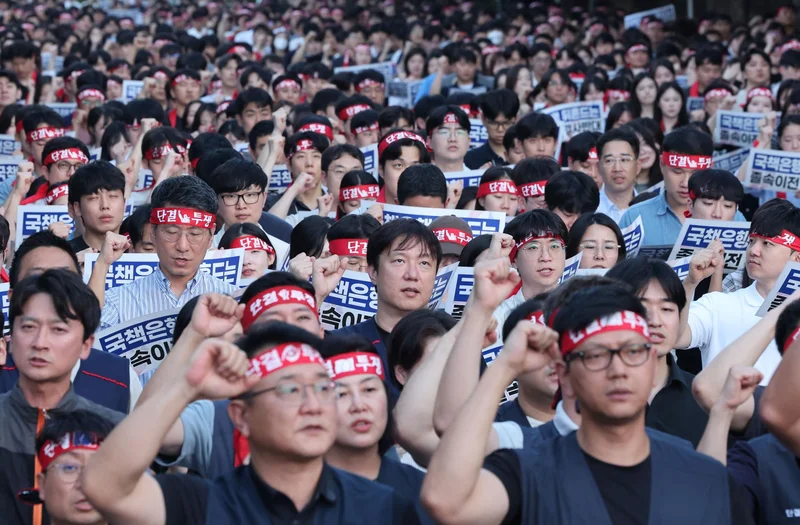
The institutions’ employees and labor unions are strongly resisting the initiative. Unions representing KDB, IBK and Eximbank held a joint rally in Seoul Tuesday, drawing about 2,000 participants.
They warned that relocating financial institutions could weaken cooperation among policy banks, prompt skilled employees to leave and undermine the financial industry’s competitiveness.
Similar opposition arose before the Ministry of Oceans and Fisheries relocated from Sejong to Busan in December 2025, with a survey showing that 86 percent of ministry employees opposed the plan over concerns including housing, their children’s education and their spouses’ jobs.
Against this backdrop, the land ministry said it has established a dedicated team to communicate with public institution unions as it works to address their opposition and help employees settle in their new regions.