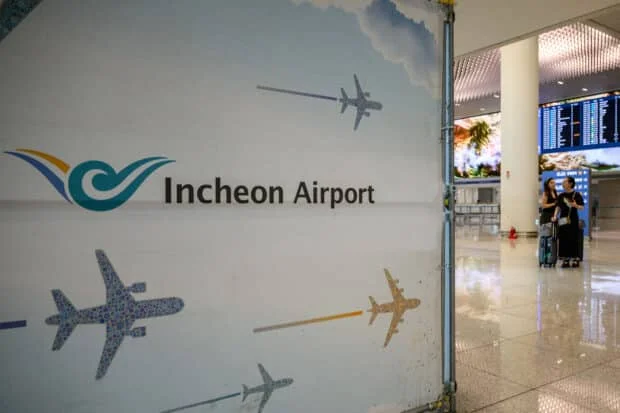
Incheon overtakes London’s Heathrow as world’s busiest int’l airport
SEOUL – Incheon Airport overtook London Heathrow and Singapore Changi to become the world’s busiest international passenger hub in the first half of 2026, reaching No. 1 just 25 years after its opening, latest data showed on Aug 13.
Incheon handled 38.39 million international passengers over the six months, according to preliminary data covering 1,234 airports compiled by Airports Council International. The airport has risen steadily from 10th place in 2002, to fifth in 2018 and third in 2024.
Heathrow ranked second with 37.79 million international passengers, followed by Changi with 34.53 million. Dubai Airport, which had long vied with Heathrow for the top spot, is expected to fall outside the top five.
Article continues after this advertisement
According to the Incheon International Airport Corporation (IIAC), Incheon’s new title, coming on top of its 12th consecutive year as the top airport for service quality, solidifies its standing as a genuine top-tier global hub airport. The airport also surpassed one billion cumulative passengers in just over 25 years after opening, faster than any other major international airport.
The reordering owes as much to shifting geopolitics as to Incheon’s own momentum.
The conflict between the US and Iran choked off transfer traffic through Middle Eastern hubs, diverting travelers to Incheon instead. Transfer passengers climbed 18.1 percent from a year earlier to 4.24 million, while European transfer traffic soared 63.2 percent.
Inbound visitors have also poured into South Korea, led largely by tourists from China and Japan. Foreigners made up 44.4 percent of Incheon’s overall passenger traffic in the second quarter, a record high, and up from 39.5 percent a year earlier.
Article continues after this advertisement
The broader traffic base rests on the airport’s four phases of expansion, completed in November 2024.
READ: 10.7 tons of kimchi confiscated at Incheon Airport in 2024
Article continues after this advertisement
The build-out gave Incheon capacity for 106 million annual international passengers – the world’s third-largest, trailing only Hong Kong and Dubai. Incheon now connects 183 cities across 53 countries through 101 carriers, outpacing the 139 cities served from Hong Kong, the 92 from Shanghai Pudong, and the 86 from Narita.
As South Korea’s gateway airport, IIAC said it has long supported major national events and government policy, and is now investing in artificial intelligence and urban air mobility infrastructure, in step with the government’s goal of 30 million inbound tourists.
“We’re grateful for the government’s support, the public’s encouragement and the hard work of everyone stationed at the airport in making Incheon the world’s No. 1 airport,” said IIAC acting president Kim Beom-ho. The corporation would stay focused on core operations while expanding regional connectivity to help grow South Korea’s aviation industry, he added. /dl