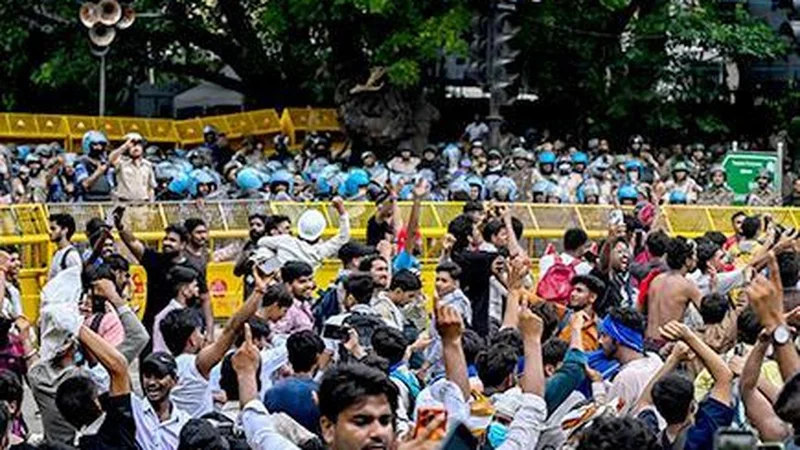
The Supreme Court on Thursday (August 13, 2026) agreed to confront the Centre, Delhi Police Commissioner with questions raised by Rajya Sabha Member of Parliament A.A. Rahim moved the Supreme Court on the deployment of facial recognition technology and allied mass-surveillance measures against students and persons who participated in the Cockroach Janta Party-linked protests over the NEET-UG exam paper leaks.
A three-judge Bench headed by Chief Justice of India Surya Kant addressed senior advocate Menaka Guruswamy and advocate Subhash Chandran that Mr. Rahim’s petition would be tagged with the main NEET-UG protest petitions, which have questioned the police crackdown on students and the use of pellet guns.
Ms. Guruswamy submitted that the surveillance was done by the police on the ground and the data was hosted with private agencies.
“One maps your face. Spectacles are used and a vehicle is also used. The data is taken without permission. Then private entities host the data in violation of DPDP Rules, CrPC and a variety of things,” Ms. Guruswamy submitted.
The MP said that the use of facial recognition technology and covert surveillance on peaceful protesters was unconstitutional.
“The gravamen of the challenge is the automated, algorithmic extraction and matching of the biometric identifiers of thousands of peaceful protesters, and the interlinking of such data with permanent national criminal databases. Since the commencement of the sit-in on July 20, the Delhi Police have subjected thousands of protesters, journalists and ordinary citizens to continuous and pervasive biometric surveillance,” the petition said.
Editorial | Testing troubles: On the National Testing Agency, NEET-UG 2026
The plea said the surveillance was done through the acquisition of videos and photographs through CCTV cameras, drones, a mobile command and control vehicle and hand-held devices.
“The real-time processing of such footage through automated facial recognition technology using the ‘Ikshana’ vehicle and ‘AjnaLens’ smart spectacles and the collection and matching of fingerprints through the National Crime Records Bureau’s ‘Abhigyan’ mobile application against the National Automated Fingerprint Identification System. This surveillance was carried out in a complete legal vacuum,” the petition said.
The plea said neither the Delhi Police’s own standing orders governing protests nor the Criminal Procedure (Identification) Act, 2022 authorise the biometric surveillance of persons attending a lawful assembly.
Published - August 13, 2026 12:57 pm IST