North Korea’s recent criticisms against South Korea’s nuclear submarine plans and Japan’s consideration of non-nuclear policy revisions, coupled with its latest missile tests, are likely aimed at boosting ties with China and Russia and bolstering its nuclear narrative, experts said.
They believe Pyongyang's recent actions were timed with the expected visit of Chinese Foreign Minister Wang Yi to Seoul, as early as next week.
In a commentary released by Pyongyang's state-run news outlet Korean Central News Agency (KCNA) on Wednesday, Jang Kum-chol, first vice minister of North Korea's foreign ministry, criticized Seoul’s nuclear-powered submarine development plan with the United States, saying, "South Korea’s push to acquire nuclear-powered submarines will inevitably trigger a nuclear domino effect across the Asia-Pacific region."
The criticism came three months after Seoul unveiled in May the Jang Bogo N Program, an initiative to develop around three 8,000-ton nuclear-powered submarines.
A piece published by the KCNA on Wednesday attributed to international affairs commentator Ri Myong-nam described Japan’s recent action plan on nuclear energy development as "essentially a strategic ploy to materialize its nuclear ambitions."
It claimed that "Japan is a de facto 'threshold nuclear state' capable of arming itself with nuclear weapons within months if it chooses to do so."
Pyongyang also criticized Japan's latest defense white paper on Tuesday, describing it as an attempt to justify the country's military buildup and calling it a "legalization for the operation of war machine."
Experts say these criticisms are aimed at justifying North Korea’s nuclear program while strengthening its ties with China and Russia to counter the enhancing cooperation among South Korea, the U.S. and Japan.
“As South Korea is also moving to build nuclear-powered submarines, Pyongyang is using Seoul's plans to rationalize its own pursuit of nuclear weapons and nuclear submarines. Also, it is warning that South Korea's submarine projects are a formidable threat to North Korea,” said Park Won-gon, a professor of North Korean studies at Ewha Womans University.
"North Korea has recently been criticizing Japan in an effort to cement the rivalry between the South Korea-U.S.-Japan alliance and the North Korea-China-Russia alliance. Looking at Pyongyang's criticism against Tokyo, the underlying message is that the South Korea-U.S.-Japan alliance is tightening, while Japan transitions into a 'normal country.' By framing it this way, North Korea seeks to reinforce the legitimacy of its own alignment with China and Russia while siding with Beijing — effectively criticizing Japan on China's behalf," Park explained.
"It also wants to warn China not to mention the North’s nuclear issues during the Chinese Foreign Minister Wang Yi's upcoming visit to Seoul.”
Wang is expected to visit Seoul to meet with his counterpart as early as next Wednesday.
Lim Eul-chul, a professor at Kyungnam University's Institute for Far Eastern Studies, echoed the view and added that it could be a sign that Pyongyang is announcing a new nuclear weapon.
“Looking at Pyongyang's tone of criticism, it closely mirrors Beijing's rhetoric against Tokyo. While it certainly contains a warning against Japanese remilitarization, its broader strategic goal is to demonstrate a solidified anti-Japan front alongside China,” he said.
"Since North Korea is continuously advancing its nuclear arsenal, this message appears to seek a strategic buildup to justify its actions and establish external groundwork to legitimize its nuclear ambitions before revealing new weapons at an optimal moment."
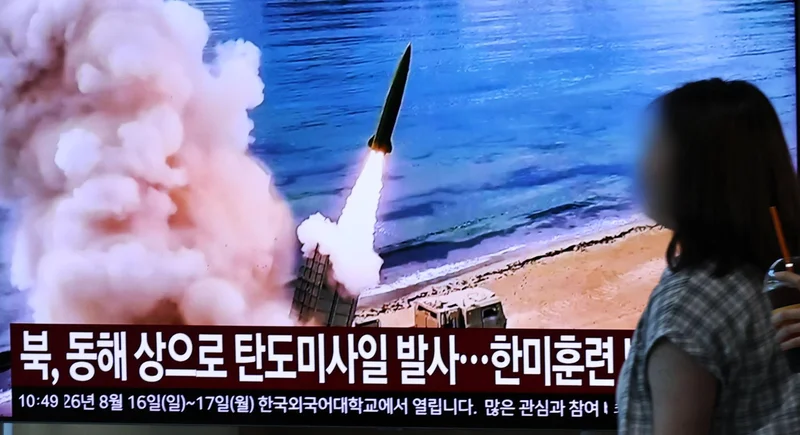
Regarding the North's missile tests, Lim said, "It likely serves multiple purposes. While it is obvious to test the missiles, this could be an effort to exert pressure through strategic ambiguity."
"Unlike previous tests where details were fully disclosed, the details of the missiles are not announced recently. By keeping vague whether this was a short- or medium-range missile deliberately, it creates confusion. By heightening ambiguity, they aim to confuse external interpretations of their true intentions," he added.
Addressing the North's criticism, the Ministry of Foreign Affairs defended Seoul's plan to develop nuclear-powered submarines.
"South Korea’s development of nuclear-powered submarines is a legitimate and defensive move to respond to the rapidly shifting security environment on the Korean Peninsula, driven by North Korea’s advancing nuclear and missile capabilities and its development of nuclear submarines," the ministry said in a statement on Thursday.
Regarding the North's silence in reporting its missile tests, an official from the Ministry of Unification said, "We do not view this as an unusual case ... since there have been multiple cases in the past where several missile launches were reported together in one coverage."