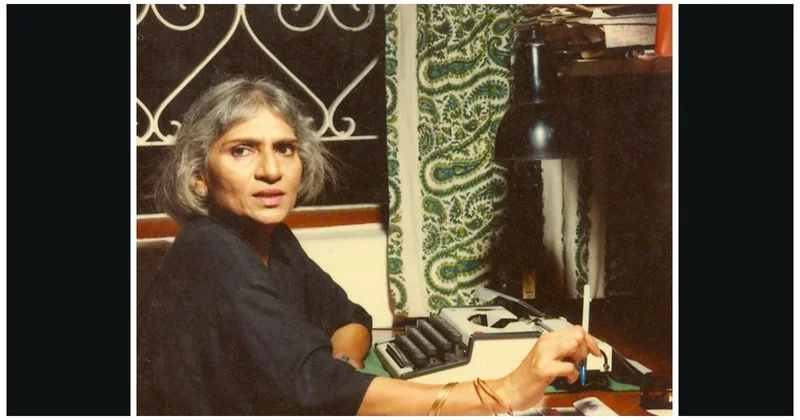
Some people come to us to definitively shape who we later become. Call it providence, fate, destiny, chance or sheer good luck, but Professor Nisha da Cunha, who died on August 11, was one such provocateur in my life.
My recollections of her are perhaps common to every student of English Literature at St Xavier's College of the mid- and late 1970s – the commanding air, the measured diction while reading a text aloud in the classroom, trademark poise, impatience with students who "showed off" and her passionate guidance of those she believed had potential.
It is not an exaggeration to say that we not only wanted to be as bright as she was, we actually wanted to be her, down to her short hair, piercing gaze, woven saree and large red bindi. She was simply cool. (A few years later at my first job, I mimicked an elegant "handloom" saree look. For the admiration expressed by my German bosses, the credit goes to Nisha da Cunha.)
In her lifetime, Da Cunha wore many caps, all of them distinguished and successful: scholar, teacher, writer and theatre director. Born in 1934 into a prominent, highly cultured family, she spent part of her childhood in Germany during the Second World War, deeply affected by the horrors she had witnessed.
She studied English at Miranda House in New Delhi and her postgraduate degree was at Newnham College, Cambridge. She was at St Xavier's College for approximately 25 years, becoming head of the English department there.
Her retirement from teaching in 1985, was the fortuitous beginning of her literary career. In fact, she was already 57 when Old Cypress: Stories (1991) was published. Other works followed: The Permanence of Grief (1993), Set my Heart in Aspic (1997-’98), No Black, No White: Short Stories (2001), Of Age and Merry Wisdom (2001) and The Quiet of the Birds: Collected Stories (2005).
Da Cunha inhabited worlds beyond literature, turning to a broader engagement with the arts, also directing plays by major dramatists in productions such as Chekhov's Three Sisters and Lorca's The House of Bernarda Alba. She also wrote about Goa and old Bombay.
Her literary contribution is particularly significant for its topicality today. Her distinctly female voice carries poignancy and melancholia that goes beyond the mere plot and character of a short story that, in obedience to its genre, carries a twist in the tale. Her story often started where the dramatic event had ended. Loss, separation, death and rejection are major tropes in her work.
Da Cunha skilfully explored desire, memory, longing and the sheer inanity of women's daily preoccupations in contrast to the raw inner worlds that we also inhabit and that are the only spaces for our freedom. The characters she wrote about were not mere victims. It is also true however, that the kind of women presented in those stories would still not have found redemption today, so how far have they travelled?
A compelling reason then, for the continued relevance of her writing.
She also examined ageing with clinical, unsentimental ease. Older women, older friends and companions, came into their own; sexual, comical, unapologetic, strutting on the stage as major presences commanding attention but also our unease with the revelations.
The past, in Da Cunha's work was sometimes a hungry monster banishing older worlds, allowing nostalgia to reign in their place. She often wrote of things usually left unsaid.
The Old Cypress is on author Jerry Pinto's list of the 25 best Indian fiction books in English.
A Mumbai Mirror article in 2025 says that da Cunha at 91 was still reading and talking about books. "The thought of writing never leaves,” she said. A poignant epitaph.
Two incidents I shall never forget, encapsulate her essence as educator and mentor: I once submitted an assignment on Jacobean drama after visiting every city library to prepare my sheets of (hand-written, no computers) notes. I also extensively quoted Professor Una Ellis-Fermor, one of the foremost literary critics on the Jacobean Age.
You can well imagine the jolt when Professor Nisha da Cunha sent back my paper riddled with red ink. There were slashes through entire paragraphs and sarcastic comments in the margins. The most troublesome remark was, “Yes, Ellis-Fermor says this, but what do YOU think?” The YOU had several short red lines underneath the word. Scathing strokes. Disappointment unleashed. A star student fallen from grace, never to be forgiven.
Then, as a junior fellow studying for my Masters degree at the department of which she was Head, I was asked to mark an essay by younger students. In hindsight, I was clearly overzealous, for when I came across the frequent use by students of "but" and "and" to start their sentences, I too, put a remark in the margin.
The students were up in arms, complaining to their lecturer who, in turn, brought it to Nisha da Cunha's notice.
She called me into her office and in a cutting (read scary) manner, asked me to explain my actions. I told her I had been taught it was simply not "good English" to commence a sentence with a coordinating conjunction or a preposition. I could not read her face. I only found out later, that she had vigorously defended me in her department afterwards and additionally, my identity was never revealed to the students, the matter closed with firmness and dignity.
Today, as we know, but and and aperitifs confidently kick off the literary sentence, but what I cherished then, was her conviction that I had done the right thing.
I went on to live in England, carrying her distilled spirit across the Arabian Sea. (I remembered her with pride when I was elected Member of High Table at Newnham, her Cambridge college.) "What do you think?" simply became a part of me. An essential question in academia, but also vital to self-interrogation at life's bumpy crossroads.
Incidentally, I taught my daughters to analyse, dissect, critique and debate but mostly, to stand up for their beliefs. I like to think I would have had her approval.
I write not merely to mourn Nisha da Cunha's passing, but to share with celebration with those who never knew her, that she was a relentless, fierce educator of young minds and as relevant today as she was then. She had her opinions, stood her ground and was often embroiled in sticky debate and fiery controversy at the college. To her students, however, it was a confirmation of her fearless voice.
If one is lucky, sometimes, someone comes along with a sermon and a song to help us find our true selves.
Saumya Balsari is a Senior Member of Darwin College, University of Cambridge.
We welcome your comments at letters@scroll.in.