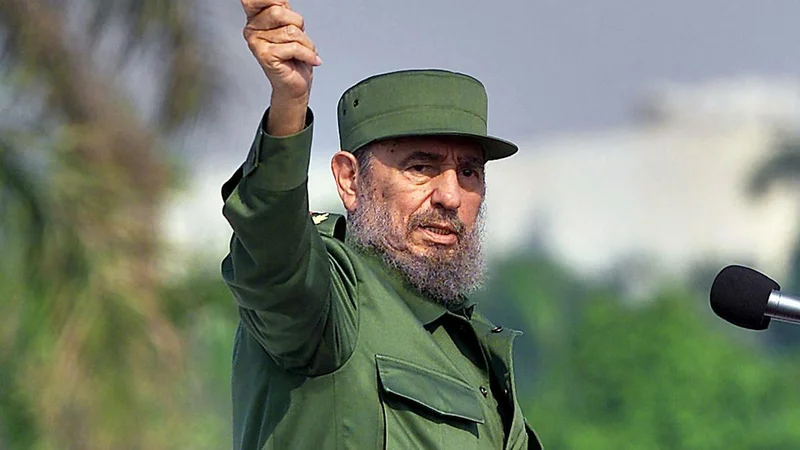
On August 13, 1926, in the village of Birán in eastern Cuba, Fidel Castro Ruz was born. As the world observes his birth centenary this week, what strikes us most forcefully is not merely the memory of what Fidel did, but the weight of his absence. The centenary is being observed at a moment when that absence is immensely impacting the life and events of the world.
Consider the conjuncture. The Trump administration’s atrocities, its tariff wars against the developing world, its threats of annexation against sovereign nations, its gunboat menace in the Caribbean, its complicity and collaboration in the genocide of Palestinians and so on, are the vulgar and naked manifestations of imperialist domination in pursuit of a unipolar world. Against this offensive, the peoples of Asia, Africa, and Latin America are searching for a rallying voice. The absence of a leader of Fidel Castro’s stature, capable of uniting the Global South into a fighting force, is very much visible. That is precisely why his life must be studied afresh. Fidel was an incomparable world leader of revolution, and the different phases of his life, each of which left its impact on the lives of millions, deserve at least a brief survey.
From the ballot to Moncada
Fidel entered politics as a student activist at Havana University, where he was drawn into the turbulent anti-imperialist student movement of the late 1940s. His initial instinct was democratic and electoral; he wanted to contest elections to the Cuban House of Representatives in 1952 as a candidate of the Orthodox Party. History decided otherwise. On March 10, 1952, the U.S.-backed dictator Fulgencio Batista staged a coup d’etat, cancelled the elections and suspended the Constitution. Fidel first moved the courts against the usurper. When the courts predictably failed, he realised that no democratic election was possible under Batista, and he became convinced that the armed suppression of the dictator could be defeated only through armed struggle.
That conviction produced the assault of July 26, 1953, when Fidel led some 160 young rebels in simultaneous assaults on the Moncada barracks in Santiago de Cuba and the barracks at Bayamo. The attack did not succeed. Dozens of captured revolutionaries were tortured and murdered by Batista’s soldiery. Yet out of this military defeat Fidel forged a political victory that would change the hemisphere.
The genius of the Martí connection
Herein lies Fidel’s greatness: he could connect his project of revolutionary upsurge to José Martí, the apostle of Cuban independence. Martí can arguably be considered the greatest visionary of Latin American liberation; for Indian readers, he is best understood as Mahatma Gandhi, Bhagat Singh and Rabindranath Tagore rolled into one. A moral teacher of his people, a fearless fighter against colonialism, and a renowned poet whose verses are sung to this day, Martí was martyred in 1895 at the age of 42, fighting the Spanish colonisers on Cuban soil. He is revered as the father of the Cuban nation.
Put on trial after Moncada in fractured, secretive proceedings, Fidel, a lawyer by training, conducted his own defence. That defence is now known to the world as the ‘History Will Absolve Me’ speech. In it, Fidel declared that the intellectual author of the revolutionary liberation project of Cuba was José Martí. In the centenary year of Martí’s birth, 1953, the young rebels of Moncada called themselves the ‘centenary generation’. To connect a current event of historical significance to an epoch of the past, to make a nineteenth-century poet-martyr the living author of a twentieth-century revolution, is a remarkable act of political imagination. That was Fidel’s revolutionary genius. He understood that a revolution which cannot claim its national past will never win its national future.
Fidel and his fellow revolutionaries were sentenced to 15 years’ imprisonment. Such was the popular demand and upsurge across Cuba that Batista was compelled to release them in less than two years, under the amnesty of May 1955. The dictator believed he was releasing a spent force. He was releasing his own gravedigger.
Granma, Sierra Maestra, Revolution
Exiled, Fidel and his comrades travelled to Mexico, where they met a young Argentine doctor named Ernesto Che Guevara, beginning one of the great revolutionary partnerships of history. In November 1956, 82 fighters crammed into the small yacht Granma and sailed for Cuba. The landing was a disaster; only a small band survived to reach the Sierra Maestra mountains. From that remnant, in barely 25 months, Fidel built a rebel army that was rooted in the peasantry, won over the workers and students of the cities, and shattered a U.S.-armed military. On January 1, 1959, Batista fled, and the Cuban Revolution triumphed.
The significance of that victory cannot be overstated. The Cuban Revolution was successful, and it showed the world that a socialist country is possible even in the western hemisphere, right under the nose of U.S. imperialism, barely 90 miles from Florida. Washington understood this perfectly, which is why it responded with the Bay of Pigs invasion of 1961, decades of terrorism, and an economic war that continues to this day.
Tribune of the Three Continents
Fidel never conceived of the Cuban Revolution as Cuba’s private property. He became an inspiration and material support to liberation movements across Latin America and Africa. More than 300,000 Cuban volunteers served in Angola, where the 1988 victory at Cuito Cuanavale broke the back of the apartheid army and hastened Namibia’s independence and the fall of apartheid itself; Nelson Mandela travelled to Cuba in 1991 to say so in person. Cuban doctors and teachers went where imperialism sent only marines. Fidel provided outstanding leadership to the Non-Aligned Movement, hosting its 1979 Havana summit and chairing the movement twice, insisting always that non-alignment meant alignment with the oppressed.
When the Soviet Union collapsed in 1991 and triumphant ideologues proclaimed the ‘end of history’, Cuba lost the bulk of its trade overnight and entered the terrible Special Period. Fidel refused to capitulate. Even after the collapse of the USSR, he provided leadership for a socialist alternative, proving through Cuba’s survival that socialism was not a Soviet export but a people’s choice.
In these years, Fidel also widened the very agenda of anti-imperialism. He mainstreamed the analysis of new forms of imperialist exploitation, the debt trap, unequal exchange and neoliberal plunder, declaring already in the 1980s that the foreign debt of the Third World was unpayable and should not be paid. At the Rio Earth Summit of 1992, he warned, decades ahead of fashionable opinion, that an important biological species is at risk of disappearing due to the destruction of its natural habitat: humanity itself. And he argued forcefully that the former colonial powers owe reparations to their former colonies for centuries of colonial exploitation, a demand that today resonates from the Caribbean to Africa to our own subcontinent.
The system they could not kill
The CIA and its hirelings attempted to assassinate Fidel on more than 600 occasions, by the count of Cuban security. He overcame every one of them. Those attempts were never aimed at one man alone; the attempts to assassinate Fidel were attempts to murder the Cuban socialist system itself. Having survived them all, Fidel did what few leaders in history have done; he desired to make way for youngsters, voluntarily stepping down from responsibilities from 2006 and spending his final decade as a writer and counsellor of the Revolution until his death in November 2016.
The war on Cuba, however, did not die with its target. For over six decades, the United States has strangled the island through an illegal blockade, which Havana estimates has cost the Cuban economy more than 170 billion dollars, and which the UN General Assembly condemned yet again in 2024 by 187 votes to two. It is this strangulation, tightened further under Trump, that lies at the root of the economic and infrastructure crisis Cuba faces today. Cuba’s present hardships are not a verdict on socialism. They are a verdict on imperialism’s cruelty.
A hundred years after his birth, Fidel, Che and Cuba continue to inspire the world, especially Latin America and the Global South. In an hour when imperialism is again naked and vulgar, the centenary is not an occasion for nostalgia but a summons. The best tribute the workers, peasants and youth of India and the world can pay Comrade Fidel is to build the unity of the Global South and the struggle for socialism that his life embodied. History has absolved him. It is for us to vindicate him.
M.A. Baby is CPI(M) general secretary
Published - August 13, 2026 12:01 am IST