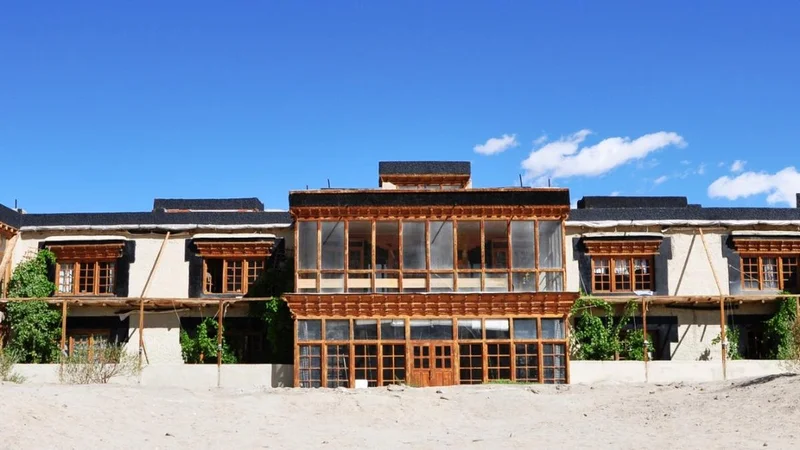
If you have watched the film 3 Idiots, you may remember the school where Rancho was finally found. The school is SECMOL, the Students’ Educational and Cultural Movement of Ladakh, founded by Sonam Wangchuk, who has been more famous as a climate activist than as an educationist.
SECMOL, nestled in the mountains of Phey village in the Indus Valley, about 18 km from Leh, is perhaps best known in popular culture as the campus associated with the film’s closing scenes. Most important, it lets us peek into a window of Mr. Wangchuk’s four-decade engagement with education, long before his hunger strike, supporting Cockroach Janta Party (CJP), brought him back into the spotlight.
Mr. Wangchuk co-founded SECMOL in 1988 after returning to Ladakh following his studies at the National Institute of Technology, Srinagar. The organisation emerged from a belief that the region’s education system was failing Ladakhi children because it had little to do with the place they lived in. The campus itself reflects that philosophy. There are no uniforms or rigid classrooms. Learning is experiential, and students spend as much time solving practical problems as they do reading textbooks. Building ecological toilets, designing solar-heated buildings, and learning sustainable ways of living are treated as part of education rather than extracurricular activities.
According to SECMOL, the roots of Ladakh’s education crisis lay in a system detached from its linguistic and geographical realities. Until Class 8, children studied in a non-Ladakhi language, unfamiliar to many Ladakhi students, before shifting to English in secondary school. Textbooks printed in Delhi described ships, oceans, coconut trees, and the monsoon — the references that meant little to children growing up in the high-altitude cold desert. The organisation points to poorly trained teachers, frequent transfers, and almost no community involvement in government schools. Parents often did not know they had the right to question how schools functioned. Around 95% of students from government schools had been failing the Class 10 Board examinations every year in the late 1980s, according to SECMOL.
Operation New Hope
It was against this backdrop that SECMOL launched Operation New Hope in 1994, bringing together the State Education Department and village communities in an attempt to reform government schools. The reform effort worked simultaneously on classrooms, teachers, and communities. The organisation formed village communities to give parents a formal role in running schools and holding them accountable. SECMOL trained nearly 1,000 committee members in school governance, planning, and financial management. It trained teachers in child-centred and activity-based learning. Working with government teachers and education experts, SECMOL developed textbooks and teaching material rooted in Ladakh’s landscape and culture. Instead of distant examples, the books featured familiar people, places, and experiences, making it easier for children to learn English without feeling alienated from their surroundings.
Reforms interrupted
SECMOL continued working with the government on school reforms until 2007, when it withdrew from the partnership. According to SECMOL, tensions escalated after the appointment of a new Deputy Commissioner of Leh in 2006. The organisation says the administration initiated action against several non-governmental organisations in the district, culminating in allegations against Mr. Wangchuk, including violations of the Foreign Contribution (Regulation) Act (FCRA), land-related irregularities, and alleged links with China. Mr. Wangchuk and SECMOL denied the allegations. The dispute spilled into the public domain, triggering protests by supporters and drawing national attention. The Asian Human Rights Commission issued an appeal, while former students, volunteers and supporters from across India wrote to constitutional authorities seeking intervention. In 2013, a local court acquitted Mr. Wangchuk of the charges, bringing the legal proceedings to a close.
By the time SECMOL withdrew from government school reforms in 2007, Mr. Wangchuk had begun thinking beyond schools. The next step was HIAL, the Himalayan Institute of Alternatives, Ladakh, an attempt to build an alternative university where higher education would be shaped by the realities of mountain life rather than by a one-size-fits-all curriculum. Conceived in the mid-2010s and launched in 2017, the HIAL describes itself as an institution that prepares students to solve problems specific to mountain communities through experiential, context-based learning. Students work on issues such as sustainable architecture, water management, renewable energy, entrepreneurship, and ecological conservation, often through field-based projects rather than classroom instruction alone. The campus itself functions as a living laboratory, with solar-heated buildings, passive design techniques, ice stupas for water conservation, and other technologies developed for Ladakh’s harsh climate.
Four decades
At a time when India continues to debate how education can be made more experiential and multidisciplinary under the National Education Policy (NEP), 2020, Mr. Wangchuk’s institutions offer an example of what context-specific learning can look like in practice. They are evidence that his engagement with education reforms has spanned decades. At 59, Mr. Wangchuk has now been on a hunger strike for 25 days, demanding Union Education Minister Dharmendra Pradhan’s resignation over irregularities in NEET-UG and expressing solidarity with students and families affected by the crisis, including those who lost their lives. Having lost nearly 9 kg and currently under medical care, his protest shows that his involvement in education has extended well beyond building institutions. From founding SECMOL in 1988 to establishing HIAL and now taking to public protest, education has remained a consistent thread in his public life.
Published - July 23, 2026 12:03 pm IST