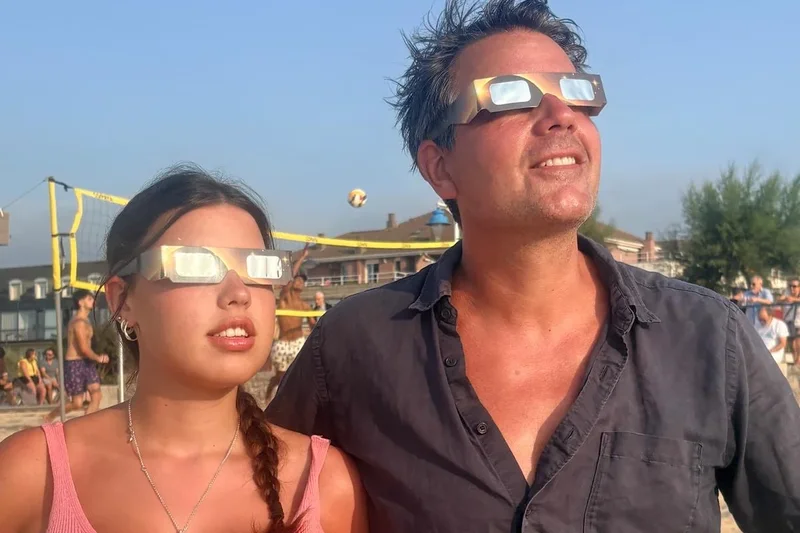
I’ve travelled all over this planet of ours, to more than 50 countries on five continents. But it’s the humble English Riviera that provided me with one of my most memorable trips, when, on 11 August 1999, a friend and I viewed a total solar eclipse.
We shared a leaky tent in a farmer’s field the night before and, by midday the following day, it was all over. Shortly after 11am, the moon had passed across the sun; darkness descended, the air cooled, and we witnessed the most mind-blowing cosmic phenomenon.
Viewing it from a coastal promontory in Torbay, Devon, in a throng of hundreds of other spectators, what struck me most was other people’s reactions. Some cheered, some screamed, some laughed, some freaked out, some even burst into tears. It was my first eclipse, but I solemnly vowed it would not be my last.
Read more: I went on the perfect Tuscan family road trip – at the worst time of year
The problem was, the next total solar eclipse to occur in the UK would not be until 2090, long after I reverted to space dust. So, when I spotted that northern Spain was due for one this August, I leapt at the chance to view it in person. My 18-year-old daughter, Lola, who has plans to study science at university, begged to come along, too.
We took our car on the ferry from Portsmouth to Santander, in Cantabria, which would be slap bang in the path of totality – a roughly 180-mile-wide corridor arcing from Siberia, through Greenland, Iceland, Spain and the Balearic Islands.
Having rented an apartment in the surf town of Somo, just east of Santander, in the days running up to the eclipse we scouted potential viewing points and quizzed locals for advice. Should we head for the remote sea cliffs east of Somo? Would the coastal bluffs close to the city of Santander prove too crowded? If we headed inland to the higher ground of the Picos de Europa mountain range, was there a higher risk of cloud cover? (The latter being a nightmare scenario for any eclipse-watcher). Different people offered conflicting advice.
Expert umbraphiles (the official term for eclipse-chasers) recommend being ready to relocate quickly at the last minute, just in case clouds roll in to ruin the show. My car was ready.
In the end, we joined thousands of others on the vast sweep of Playa de Somo, just metres from our apartment. We made sure to arrive an hour beforehand to secure a great view northwest, armed with our extra-dark eclipse glasses, and ready for the action to unfold.
East of us, hundreds of spectators had set up beach chairs on the cliffs. West of us, residents of Santander were out on their terraces and balconies, eyes skyward. Out in the bay were dozens of yachts and motorboats, all faced towards the sun.
At around 7:40pm, as the moon first edged into the sun’s path, we could see it slowly nibbling more and more into the disc of light. “It looks like Pac-Man,” Lola said.
But then, disaster! As totality approached, clouds moved in from the west. At 8:27pm, when the moon finally occluded our parent star completely, in a cruel twist of fate, much of the eclipse was blocked out by cloud cover.
It meant that Lola and I missed several of those astounding eclipse features I’d seen 27 years before in Devon. Although we did view the corona of the sun glowing around the circumference of the moon, we missed the lunar shadow rolling in at thousands of miles an hour from the west.
We missed the diamond-ring effect, as the last bit of sunlight disappeared – and a minute later reappeared – like a sparkling diamond from behind the edge of the moon. We also missed what’s known as Baily’s beads – blobs of light at the edge of the moon as sunlight passes through gaps in the valleys and mountains on the moon’s surface.
But what we did experience, and what we found most moving, was when full darkness descended, the temperature dropped, and the birds fluttered about randomly, confused by the sudden changes. The hairs stuck up on my forearms and on the back of my neck. All around us, Spaniards clapped, cheered and illuminated their mobile phones.
Totality was achingly short – barely more than a minute. Partially obscured, it was also achingly disappointing.
Next, as the moon slowly continued on its path, the sun gradually started to reappear. By 8:12pm, the grand show was all over.
Read more: Best hotels in Cornwall for beach breaks, walking retreats and sea views
Without wishing to sound too melodramatic, watching the mechanics of our solar system play out made me aware of the universe around me, and my total insignificance within it. Despite the disappointment of the cloud cover, I found it humbling and joyous in equal measures. I nearly shed a tear.
Lola had a very different reaction. “Weirdly, I felt scared,” she said. “It felt almost apocalyptic.”
I was gutted, however, that clouds had ruined her chances of getting the full experience. I had hoped she might have some sort of astronomical revelation.
Total solar eclipses are rare, occurring somewhere on our planet every 16 months or so. Thanks to a beautiful cosmic coincidence, during such eclipses, the moon blocks out the sun precisely, since both objects appear the same size in the sky. The sun’s diameter is 400 times the moon’s, and the sun is, on average, 400 times further away from us than the moon.
It’s an equally beautiful coincidence that there are sentient beings around to witness eclipses. Every year, the moon’s orbit draws away from the Earth by a few centimetres so that, millions of years from now, it will be too far away to occlude the sun. Right now, in the earth’s 4.5 billion-year history, astronomical conditions are perfect. What a privilege to be able to view this.
In August next year, a total solar eclipse will pass over southern Spain and North Africa. It has been called “the eclipse of the century” as, once it reaches Egypt, it will last almost six and a half minutes, making it the longest eclipse on land during the entirety of the 21st century. Still disappointed by the last-minute cloud cover, Lola and I plan soon to book our tickets to Egypt.
I’ve promised her the next one will be the big one.
*Dominic was a guest of Brittany Ferries. *
Read more: Could a wellness retreat be the perfect family break? I took my four children to find out
How to get there
Brittany Ferries operates up to six overnight sailings a week from Portsmouth to Santander and Bilbao, and from Plymouth to Santander.