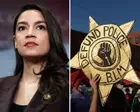
The north may not remember, but 9 August this year marked the 12th anniversary of the police killing of Michael Brown Jr in Ferguson, Missouri. That day, the US representative Alexandria Ocasio-Cortez reassured an ABC news anchor that she, like other progressive politicians and Democratic Socialists of America (DSA) candidates, had “moved away” from statements they made during the pandemic, particularly on police and prison abolition. Questioned further, she explained:
“I have a local city councilman that has this saying: ‘Woke 1 was crazy’… especially during Covid, I think that the doors were really open in trying to entertain any and every policy that was going to get us to a better place. And I actually think that the discussions that were had in that time were quite fruitful. I think that when we talk about crime today, it’s fundamentally different than the way that we talked about crime in bringing crime down. And I think that we all share in the goals of having as low a crime rate as possible. I think that, you know, during lockdown, of course, rhetoric in that time is not rhetoric that we would use today. And I’m grateful that these candidates have the opportunity to present who they are to their electorate and what they’re campaigning on in this moment.”
A few days later, on Wednesday, Zohran Mamdani, the progressive New York mayor, who has previously stated that his pandemic-era tweets supporting the defund movement were “out of step” with where he is now, chimed in on Ocasio-Cortez’s comments, saying: “Sometimes what you believe in can change. I know there are some for whom they still believe in that. I’ve made very clear that I do not believe in defunding the police and that to me, delivering critical public safety also looks like working with our police department alongside many other partners.”
The New York City councilman to whom Ocasio-Cortez was referring, Chi Ossé, was actually inspired by the abolition movement to run for office. But earlier this week, he was quick to proudly claim coinage of the term “woke 1”, which has been used by people who seek to minimize statements they made in the aftermath of George Floyd’s murder by police in May 2020.
In one sense, these politicians are absolutely correct. If “woke 1” represents a political baptism in shallow waters, then I have met many who were swept up in an emotional online conversion toward the radical, romantic rhetoric of “defund the police”. I know the power of the feeling of being connected to an idea that can offer relief and salvation. Ocasio-Cortez, Mamdani and Ossé appeared at an altar of abolition during a global movement that condemned policing. It was a vibe. Sure, they may have even been earnest at the time. But as the abolitionist Mariame Kaba has said about centuries of organizing: abolition is not about your feelings or how you identify. It’s what you do.
During the pandemic, I was a couple of years off from an ongoing campaign to close a jail and about to enter a campaign to prevent another one from opening. I wrote my book, Becoming Abolitionists, in that time partially because of how quickly some conversions happened – through charismatic check-marked profiles and inspirational protests, rather than through an organization or collective. Many people were just beginning to understand how abolition was connected to other movements, including those against capitalism, imperialism, racism and ableism. I wanted to focus on centuries of abolitionist resistance that gave rise to contemporary abolitionist demands. “Defund” wasn’t simply a new idea about removing dollars from a budget (though we’d take it!) and leaving everything in society the same. Rather, it was and is a personal and political commitment and strategy to eliminate carceral, communal, colonial, capitalist and climate-based violence while building the people, practices and institutions to help us thrive.
This fact is what makes Ocasio-Cortez’s comments additionally troublesome. Even by her own logic, “crime” is largely a product of exploitative, unequal social relations, such as economic inequality, and democratic socialism would produce more equal social relationships and reduce crime. So if democratic socialism is effective, then why keep funding the New York police department at $11bn? And why dismiss taking money away as “rhetoric”?
Because: the police were not created for public safety. They were created to keep property owners and slaveowners safe. The abolitionist geographer Ruth Wilson Gilmore writes in Geographies of Global Change that “the best estimate for crime as a driving force of prison expansion shows it to account for little more than 10 percent of the increase. Rather, it is a greater propensity to lock people up, as opposed to people’s greater propensity to do old or new illegal things, that accounts for about 90 percent of US prison and jail growth since 1980.” The rhetoric of public safety obscures this history and protects the institution as a heavily unionized, violent jobs program. This does not mean the police never show up when someone needs help, or that people become cops because they only want to hurt others. What it does mean is that historically, cities are willing to rely on the poverty that capitalism creates to fill its carceral ranks with people looking to enter the middle class.
Seeing progressive politicians move away from their earlier feelings poses a question about what they’re moving toward. Ossé and AOC did not introduce any “woke 1” legislation or resolutions that they now have to retract. Mamdani actually attempted the opposite: the racial justice working group of DSA, among others, successfully pressured him to reverse his commitment to add almost 600 more officers and $70m to the NYPD, against his campaign promise to maintain the headcount of the force. He was positioning this move while boasting historic lows for crime in the city. So unlike the students, artists, congregants and organizers I met and know, the politicians prioritized political office over political homes. Because these figures represent more than their political ideas, I understand. But the dismissal is the problem. The ideas rooted in the defund movement that got them the spotlight were not polling well by the time their volunteers were canvassing for their political campaigns. As a result, they dismissed those ideas as something to grow and learn from, not to publicly explore and explain.
By contrast, for example, upon receiving pushback from the “defund” framing, activists in North Carolina chose “refund Raleigh” instead as an organizing campaign strategy to explain abolition to the community, develop a public services investment strategy and secure policies that decouple public safety and police. Even decades before abolition entered a mainstream branding debate, Wilson Gilmore said that she and others organizing through Californians United for a Responsible Budget chose a “deliberately bland name” to attract community members to the campaign. Still, other organizers chose more explicit “defund” campaign names as clear sites of struggle, sacrificing public palatability for political clarity.
These efforts are equally important: people, politicians and corporations weaponized the ambiguity of “Black lives matter” toward everything, including more police funding and hires. So whether explicit in naming “defund” or not, abolitionist organizers across the country have been spearheading electoral campaigns, mutual aid efforts, disaster recovery, anti-immigrant detention networks, stopping jails and more. It is not always successful and apparent, but the commitment remains because the struggle continues.
Right now, DSA members like AOC, Ossé and Mamdani feel refreshing because electoral politics have been captured for so long by Democrats and Republicans. And the state has done such a horribly impressive job at exhausting, shackling, killing and exiling actual revolutionaries that politicians who repeat the slightest radical rhetoric can start to feel like revolutionaries. What remains, though, is that the very movements producing that rhetoric, from abolition to Free Palestine, also produced the possibilities of their elections. And downplaying those movements puts organizers who continue this work at risk, especially right now.
What time is it when politicians across the political spectrum, from AOC and Ossé to Marco Rubio and Donald Trump, suggest that progressive and left organizers are “woke” and “crazy”? It is the time when those who have not yet realized that the demonization of people, organizations and ideas about justice – regardless of where they come from – leads to targeting, surveillance, deportation, imprisonment and death.
If leaders of DSA, an organization of which I am also a member, want to continue to grow as an electoral political home for people who believe these ideas are not only possible, but also worth pursuing, they must know that they are subject to the same lessons they are teaching establishment Democrats right now: do not laugh off the political demands of those who put you in office. For all of what their constituents, canvassers and staffers did as part of a fight on our behalf, is it worth treating years-long radical, Black and multiracial pursuits of freedom as mere pandemic pandemonium? No, it’s not. But more than what we are called by any of them is what we continue to call ourselves. Our own histories, convictions and clarity, not politicians, lead the way.