- See more Daily Mail on Google - save us as a Preferred Source
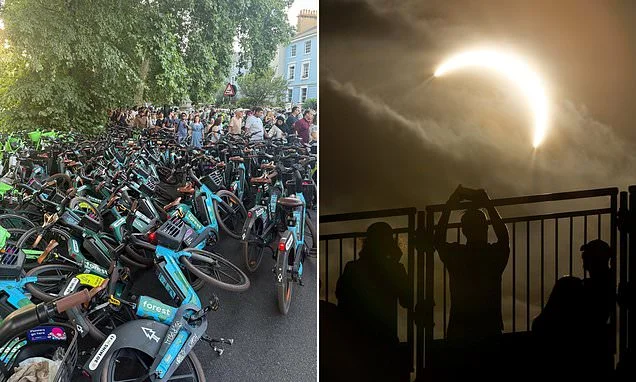
After millions marvelled at Britain's solar eclipse, the morning after brought a less impressive sight: thousands of Lime bikes abandoned on the streets.
Millions gathered to watch the sun disappear behind the moon last night in the first proper solar eclipse since August 1999.
The partial eclipse began shortly after 6pm in parts of the UK, with maximum coverage occurring at roughly 7.05pm to 7.13pm depending on location.
However, in the mad dash to make it to prime viewing spots on time, Lime bikes in their thousands were abandoned on the streets of London.
Hundreds of bikes were seen parked on the edge of Hampstead Heath and Primrose Hill, with many gathered to watch the once-in-a-generation event.
Photos taken at viewing spots show rows of e-bikes strewn across the street, with toppled bicycles triggering a domino effect in some places.
Others show pedestrians picking their way through the chaos after the eclipse, while others took advantage of the e-bike bounty and cycled home with ease.
Meanwhile, clean-up efforts kicked off on Thursday morning, with volunteers sharing photos of the rubbish left behind at popular viewing spots.
After millions marvelled at Britain's solar eclipse , the morning after brought a less impressive sight: thousands of Lime bikes abandoned on the streets (pictured)
In the mad dash to make it to prime viewing spots on time, Lime bikes in their thousands were abandoned on the streets of London (pictured)
Hundreds of bikes were seen parked on the edge of Hampstead Heath and Primrose Hill
Photos taken at viewing spots show rows of e-bikes strewn across the street (pictured)
In West Moors, Dorset, litter pickers filled 13 bags of rubbish while in Hartlepool, County Durham, a single collector filled three bags.
The Tandle Hill Tavern in Greater Manchester told those who had left rubbish behind following the eclipse to 'consider yourself barred'.
The pub wrote on Facebook: 'Honestly enraged by the amount of rubbish my regulars have just brought back from the monument for us to recycle.
'If you went up there to watch the solar eclipse and left all your c*** up there consider yourself barred. How can your conscience allow you to watch a natural phenomenon and trash not only the nature around you but someone's private land in the process.'
It comes as it's revealed mountains of cardboard and plastic framed glasses used to safely observe the eclipse could end up in landfill.
The glasses can be partly recycled. The lenses, which contain a polymer solar-filter film, cannot be processed by recycling facilities, although the cardboard frames can be recycled once removed.
Sky-gazers are also encouraged to check whether they can donate their glasses to local science and astronomy museums, which may accept used pairs.
Meanwhile, Britons who struggled to secure a pair of highly sought-after solar eclipse glasses are now complaining of agonising eye pain.
Many took advantage of the e-bike bounty (pictured) and cycled home with ease
Meanwhile, clean-up efforts kicked off on Thursday morning, with volunteers sharing photos of the rubbish left behind at popular viewing spots (pictured, rubbish in Dorset)
People watch the solar eclipse during the European Athletics Championships Birmingham
One happy pooch donned protective eyewear to accompany its owner watching the eclipse
Those who didn't heed warnings about looking directly at the sun may have damaged their retina, particularly the macula, which is responsible for sharp central vision.
The number of Google searches for the term 'eyes hurt' was 5,000 per cent higher on Wednesday evening than the same time last year. Likewise, searches for 'eye damage' were up 700 per cent week on week following the end of the eclipse.
There was also an impact to natural wildlife, with birds across the country thrown into a state of confusion as the world suddenly went dark.
Videos shared online show large flocks flying chaotically through the air as the sky began to darken, while others show the animals falling eerily quiet.
The peculiar scenes prompted viewers to wonder whether the animals realised something extraordinary was taking place.
'The birds knew something was happening,' one person said after sharing footage of birds flying in a random pattern in the sky above her.
Another user asked: 'Has anyone noticed the birds acting strangely?', while a third said there was suddenly a 'massive flock of crows' in the sky.
A fourth user, from Cornwall, said: 'The birds were definitely spooked!' while one person added: 'The solar eclipse has all the birds in my local area PANICKED.'
The next partial eclipse visible in the UK is not until November 14, 2050, and the next total eclipse is not until September 23, 2090, when a baby born today will be aged 64.
It is due to an incredible cosmic coincidence that perfect solar eclipses can occur on Earth. While the Moon is about 400 times smaller than the Sun, it also happens to be about 400 times closer to Earth - allowing it to perfectly obscure the giant star.
As an astronomical encore, a few hours after the eclipse, the sky was filled with shooting stars as the Perseid meteor shower approached its annual peak, as the Earth ploughed through dust left behind by the Swift-Tuttle comet.
Nasa scientists used the eclipse to unlock secrets of the Sun, sending a high-altitude WB-57 aircraft from Iceland to follow the Moon's shadow, and launching balloons to study how the sudden darkness and cooling affect the lower atmosphere.