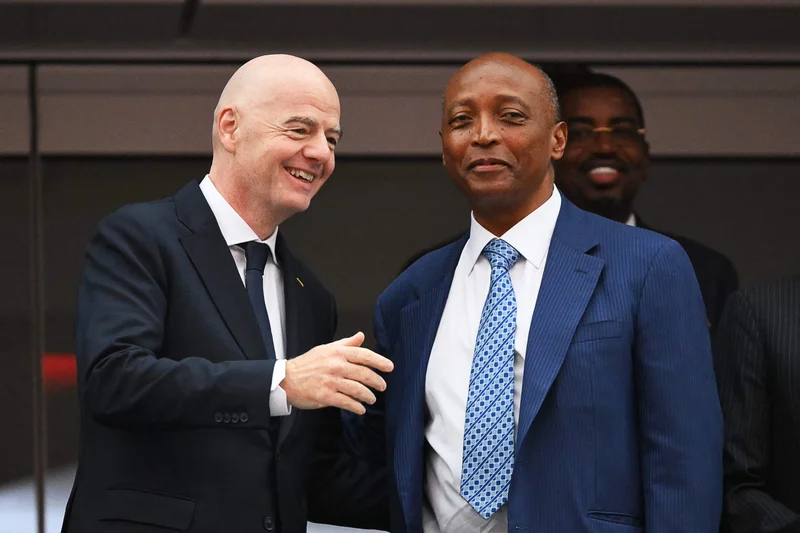
African football associations have largely remained silent amid growing uncertainty over the future of beleaguered FIFA President Gianni Infantino, who is counting on their support to secure another term in office.
The Confederation of African Football has publicly backed Infantino, putting CAF at odds with three other continental governing bodies that want him to explain his now-abandoned plan to carve off World Cup commercial rights. But CAF’s endorsement does not necessarily mean Africa’s 54 member associations will vote as a bloc.
Infantino, the Swiss-Italian who has built strong support among African football leaders by significantly increasing FIFA funding to the continent during his decade in office, cannot take their votes for granted when he faces re-election March 17 at the FIFA Congress in Morocco.
Africa accounts for a significant share of FIFA’s voting power, making its support crucial to Infantino’s bid. Yet previous endorsements by CAF have often failed to translate into unified support from its member associations, reducing the value of such declarations when voting day arrives.
CAF had an alliance with UEFA when the European governing body’s president, Lennart Johansson, stood for the FIFA presidency in 1998, but African member associations voted overwhelmingly to put his rival, Sepp Blatter, in power.
Four years later, when CAF President Issa Hayatou challenged Blatter, the Swiss won a second term in a landslide, with the majority of African countries voting for him.
Infantino’s ascension to power in 2016 came despite CAF’s endorsement of rival Sheikh Salman bin Ibrahim Al Khalifa of Bahrain, with many African countries helping Infantino over the line in the second round of voting.
CAF members also broke ranks despite the organization’s support for Morocco’s bid to host the 2026 World Cup.
Eleven African countries instead voted for the joint North American bid by Canada, Mexico and the United States at the FIFA Congress in Moscow in 2018, mostly in a standoff over Western Sahara, the subject of Africa’s longest-running territorial dispute since Spain, the former colonial power, left in 1975.
Morocco considers the territory its own, while the Polisario Front seeks to establish an independent state called the Sahrawi Republic, which several African countries recognize.
For the moment, Infantino’s African backing appears strong, but that could change if the open revolt he has faced over the past fortnight intensifies, Reuters interviews with several African association leaders in recent days have revealed.
All African associations wrote letters at the FIFA Congress in Vancouver in April expressing support for Infantino’s re-election ambitions, but that was before revelations about his plans to sell a stake in future World Cups.
The proposal has drawn the ire of UEFA, the Asian Football Confederation and CONCACAF, which oversees soccer in the Caribbean, North America and Central America.
Several African association presidents have expressed surprise at the force of the reaction against Infantino but wanted to keep their opinions off the record, waiting to see whether a candidate to oppose him in next March’s election emerges.
Infantino has received formal support over the past week through statements from the Democratic Republic of Congo, Egypt, Mauritania, Morocco and Niger, while others have also expressed their backing.
“I see no reason not to support him,” said Mathurin de Chacus, president of the Benin federation and a member of the CAF executive committee.
Alexandre Muyenge of Burundi said: “He is a president who is doing what is necessary to support Africa, particularly the less wealthy countries. His record is good, so it is logical to support him.”
FIFA holds elections every four years, with Infantino unopposed in 2019 and 2023. Any potential rival next year must submit a candidacy by Nov. 18.
FIFA’s statutes say a simple majority of 106 votes is required to win when there are two candidates.
There are 211 associations that are members of FIFA, and each has a single vote.
The governing bodies of the six continental confederations have no vote in the FIFA presidential election, although each of their presidents receives an automatic seat on the FIFA Council with vice president status.