‘It’s very noisy’: Some Punggol residents affected by noise from Cross Island Line work
AI generated
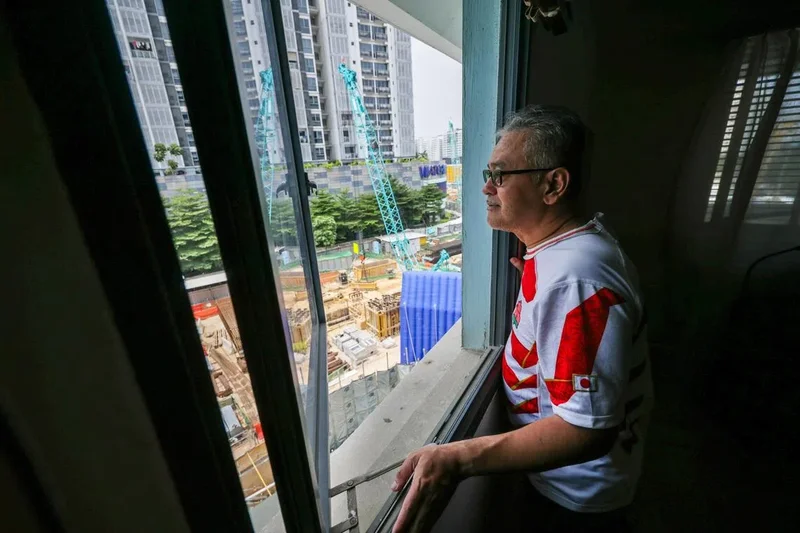
SINGAPORE – Falling asleep is no easy feat for Abdul Rashid, a Punggol resident whose flat overlooks a Cross Island Line (CRL) Punggol extension worksite, as the drilling and hum of machinery have kept him up at night.
Though his home is on the sixth floor of Block 308A Punggol Walk, the retired operations manager said his family has been quite disturbed by how loud and distinct the noise has been.
Abdul, 61, added that his 25-year-old daughter, in her third year at university, has had to tolerate drilling noise while studying at home.
“We don’t dare to open the windows, because it is very noisy (downstairs). What can I do? We just have to suck it up and live with it,” he said.
Of the eight residents living at Waterway Terraces I whom The Straits Times interviewed on Aug 13, six of them felt the construction noise was bearable, however.
Four units on each floor of Block 308A – including Abdul’s – directly face the worksite on Punggol Walk.
Work to build an underground diaphragm wall started in the second quarter of 2026 and is expected to be completed at the end of 2026.
Part of Punggol Walk has been closed to traffic since March 31, 2026, and will remain shut until the third quarter of 2027.
The diaphragm wall is required to hold back surrounding soil, as well as protect nearby buildings and roads from collapsing, said Senior Minister of State for Transport Sun Xueling in a Facebook video on Aug 10.
Sun, an MP for Punggol GRC, announced that the Land Transport Authority (LTA) will lend residents noise blankets measuring 2m by 1m – which can reduce noise by 15 to 17 decibels – and help install them.
While their installation requires no drilling, Sun noted that these blankets are “quite thick”, and will block out light and wind when placed over windows.
These works along Punggol Walk are part of the construction of the 7.3km CRL Punggol extension, comprising four stations: Punggol, Riviera, Elias and Pasir Ris.
This extension will shorten more than 70,000 journeys between Singapore’s north-east and east daily. Punggol station will be connected to the North East Line, while Riviera station will be linked to the Punggol LRT Line.
Passenger service is expected to start in 2032.
The line’s first phase, consisting of 12 stations from Aviation Park to Bright Hill, will open in 2030.
Abdul, who was unaware of the availability of the noise blankets, said he would not consider using them as he thinks they would look “unsightly”.
But he is willing to give the free noise-cancelling earbuds, offered at the Waterway Residents’ Network centre, a try.
Fellow resident Richard Soon, 55, heard about the noise blankets from Sun’s video, but has no plans to use them.
The accounts executive said the blankets would be troublesome to remove whenever he feels warm and wants to open the windows to let fresh air in.
Soon added that he and his family have become accustomed to the construction noise, which remains at a “manageable” level.
He keeps the windows in his home closed most of the time to minimise the noise and dust coming from the worksite below.
Occasionally, when his 17-year-old daughter – who is taking her O-level exams in 2026 – complains about the noise, Soon takes his family out to escape it.
Long Shi Yun, 38, also said she would not consider attaching noise blankets to the windows of her flat because her three-year-old son enjoys watching the traffic, and she does not want to deprive him of that joy.
While her two sons – the other is six months old – have since grown used to the construction noise, the homemaker said they initially had difficulty sleeping well in the afternoons as abrupt sounds often jolted them awake during their naps.
She acknowledged that such noise is an “inevitable” effect of building an MRT line, and said she is looking forward to the end of 2026, when the noisy work is expected to be completed.
In response to ST’s queries, LTA said that before the start of all projects, its contractors will carry out a noise impact assessment to identify and roll out appropriate mitigating measures. These include installing noise barriers around the perimeter of worksites and inflatable noise balloons around machines.
Based on feedback, the authority and its contractors will engage residents whose units are assessed to be severely affected by the noise to provide them with temporary support, such as noise blankets.
It did not answer questions about the number of households that took up loans of the noise blankets, when these measures were first offered to residents of the affected area, as well as the number of noise-related complaints received.